
Q. Is English the medium of instruction at OLFU?
+Yes. All classes, exams, and clinical training are in English. Filipino is spoken outside campus, but English is widely understood across Metro Manila. Indian students face no language barrier.

 Philippines | Est. 1979
Philippines | New York State Education Department (NYSED),Illinois State Board of Education,Medical Council of Thailand & Maldives Medical Council,National Medical Commission (NMC),ECFMG / Intealth | English only; no language preparation required medium
Expert will call you within 2 hours
Our Lady of Fatima University (OLFU) was founded in 1967 by Jose C. Olivares and his son-in-law, Dr. Vicente M. Santos Sr. It started its development in Valenzuela City, Metro Manila, which used to be just a hospital, then slowly developed to become a full-fledged university. The College of Medicine was founded in 1979, and its first graduating class came out of the program in 1983. From there on, OLFU became known as one of the most recognized private medical universities in the Philippines, with several campuses all over Metro Manila and even other neighboring provinces.
The main campus remains in Valenzuela City, situated directly adjacent to the Fatima University Medical Center, a 150-bed teaching hospital that serves as the primary clinical training ground for medical students. This proximity means students do not need to travel far for hospital placements, giving them continuous and convenient access to hands-on patient care from the clinical years onward. In 2009, the Commission on Higher Education (CHED) granted OLFU autonomous status, making it the first private higher education institution in the CAMANAVA area; covering Caloocan, Malabon, Navotas, and Valenzuela; to receive this distinction. CHED further placed OLFU in Category A(t) under its Institutional Quality Assurance programme. Reflecting its commitment to maintaining strong educational standards, the College of Medicine holds ISO 9001:2015 certification on a university-wide basis.
The MD program provided by OLFU has been structured into three different levels in order to be in compliance with the FMGL Regulations of 2021 in India. The first level requires completion of a BS program in pre-medicine, which is a duration of one-and-a-half to two years. Subjects during this phase include General Biology, General Chemistry, Organic Chemistry, Physics, Mathematics, English, Filipino, Social Sciences, and Physical Education. After completing the BS pre-medicine phase, students must sit the National Medical Admissions Test (NMAT), which is a Philippines-wide entrance examination testing aptitude, natural sciences, and social sciences. A valid NEET score is also required under NMC rules.
The second stage is the 54-month core Doctor of Medicine programme, taught entirely in English. Year 1 focuses on Biomedical Sciences I, covering Anatomy; including gross anatomy through cadaver dissection, histology, and embryology; along with Biochemistry, Physiology I, Introduction to Medicine, and Community Health I. Year 2 advances into Biomedical Sciences II, with Pathology (both general and systemic), Pharmacology, Microbiology and Parasitology, Physiology II, Medical Ethics, and Community Health II. The Philippine setting provides strong exposure to infectious and tropical diseases during this stage. Year 3 introduces Clinical Sciences, where students begin supervised clinical activities across Internal Medicine, Surgery, Obstetrics & Gynaecology, Paediatrics, Psychiatry, Radiology, Family and Community Medicine & Medical Jurisprudence. Year 4 and an extended semester constitute the clinical clerkship, during which students rotate through all major departments under attending physician supervision. This clerkship continues until the full 54-month core MD requirement is met. The third and final stage is a mandatory 12-month internship completed at the affiliated teaching hospital in the Philippines, which is required before graduates can sit either the NExT examination in India or the Philippine Physician Licensure Examination. This complete structure; BS pre-medicine, 54-month core MD, and 12-month internship; satisfies the NMC requirement of at least 54 months of core medical study at one institution plus a compulsory internship year.
OLFU has a distinguished record in international clinical training. It was the first Philippine medical school to establish a formal institution-to-institution Clerkship Training Program with foreign hospitals. More than 100 OLFU students have trained at hospitals in the United States, including Peninsula Hospital Center in New York, Jackson Park Hospital in Chicago, and Harbor Hospital in Baltimore. However, students planning to return to India after graduation should note that NMC rules require the entire medical education to be completed at the same foreign institution. International clinical rotations abroad may affect compliance with this requirement, and students must confirm current NMC guidelines at nmc.org.in before participating in any overseas clerkship.
OLFU is listed in the World Directory of Medical Schools (WDMS), is WHO listed, and is recognised by FAIMER/IMED, making graduates eligible for ECFMG certification and the USMLE pathway. The programme also supports the PLAB route for the United Kingdom and the AMC pathway for Australia. The MD degree is treated as equivalent to MBBS under the NMC's evaluation framework. Graduates who complete all three stages and meet NMC requirements are eligible to sit the NExT examination in India. The university's American-influenced medical education model also makes it a strong fit for students considering the United States licensing pathway.
Annual tuition for international students ranges from USD 5,500 to USD 7,000, equivalent to approximately ₹4.6 to ₹5.8 lakh per year. Total programme costs, inclusive of tuition across all stages, typically fall between approximately USD 33,000 and USD 42,000, or ₹27 to ₹35 lakh. When living expenses; including on-campus hostel accommodation at USD 150 to 300 per month, food at USD 100 to 200 per month, and health insurance; are factored in, the all-inclusive full programme cost is approximately USD 50,000 to USD 65,000, or ₹41 to ₹54 lakh. There is no donation or capitation fee.
Scholarships are available for international students. The Leonora Juzgaya Olivares Scholarship Grant offers full or partial tuition support based on academic performance at entry. Partial merit scholarships based on grades are also available throughout the programme.
Valenzuela City is well connected with easy transport access, inexpensive living expenses, and various Indian cuisines available inside & outside the campus. The International Student Office at OLFU offers specialized assistance for housing, visa & campus integration. The university library boasts more than 200,000 books and journals for the registered students. OLFU has produced between 30,000 and 40,000 medical and allied health graduates across all disciplines since its founding, establishing it as a significant institution in Philippine medical education with a strong international student community.
No hidden charges, no donation. The full picture of costs at MBBS in Our Lady of Fatima University College of Medicine.
Tuition Fee
USD 5,500–7,000 / ≈ ₹4.6–5.8 lakh
USD 5,500–7,000 / ≈ ₹4.6–5.8 lakh
Hostel Fee
USD 150–300/month
USD 150–300/month
Food & Meals
USD 100–200/month
per month
Insurance
USD 150–300/year
per year
Donation
no Donation
no Hidden fee
Total Estimated Cost
USD 50,000–65,000 / ₹41–54 lakh
year
25–35%
Average FMGE first-attempt pass rates for students from many overseas medical universities. Students from structured programs consistently score higher.
Students returning to India need to clear the FMGE/NExT exam. MBBS in Our Lady of Fatima University College of Medicine integrates exam-oriented coaching into the regular curriculum so students are prepared from day one.
A structured program that takes you from foundational sciences to clinical mastery.
The first MD year focuses on foundational sciences. Anatomy is taught through cadaver dissection. Students also learn about the doctor-patient relationship from the very beginning.
Anatomy (Gross, Histology, Embryology), Biochemistry, Physiology I, Introduction to Medicine, Community Health I
Year 2 moves students from basic science into understanding disease. Pathology and pharmacology form the core. The Philippine setting provides strong exposure to infectious and tropical diseases.
Pathology (General and Systemic), Pharmacology, Microbiology and Parasitology, Physiology II, Medical Ethics, Community Health II
Students begin supervised clinical activities in Year 3. All major specialities are introduced before the clerkship year. The focus is on clinical reasoning, diagnosis, and case presentation.
Internal Medicine, Surgery, Obstetrics and Gynaecology, Paediatrics, Psychiatry, Radiology, Family and Community Medicine, Medical Jurisprudence
This phase runs until the full 54-month core MD requirement is met. Students rotate through all major departments under attending physician supervision. After the MD is complete, students must do a 12-month mandatory internship at the affiliated teaching hospital in the Philippines. This internship is required before sitting the NExT exam in India or the Philippine PLE.
Internal Medicine, Surgery, Obstetrics and Gynaecology, Paediatrics, Psychiatry, Emergency Medicine, Community and Family Medicine, Elective rotation
This phase builds the science foundation before the core MD begins. Students must pass the National Medical Admissions Test (NMAT) after the BS phase to enter the MD programme.
General Biology, General Chemistry, Organic Chemistry, Physics, Mathematics, English, Filipino, Social Sciences, PE
Final year practical training and structured exam preparation.
Full-time clinical rotations, FMGE/NExT coaching

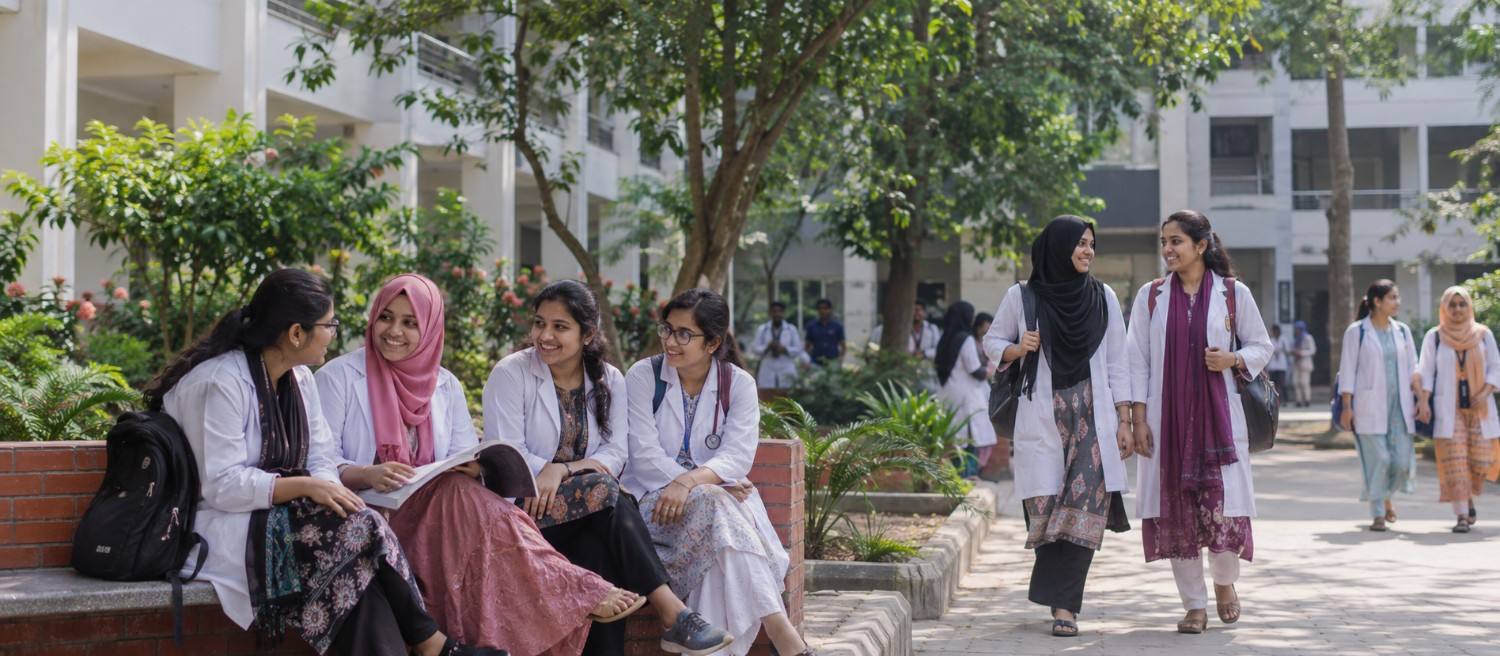
Furnished hostel rooms with Wi-Fi, laundry, 24/7 security, and Indian mess on or near campus.
Indian restaurants and mess facilities serving vegetarian and non-vegetarian home-style food daily.
Strong Indian community with cultural events, festival celebrations, and peer support groups.
Students get hands-on clinical training in government and private hospitals affiliated with the university.
Practical information for students planning to study at MBBS in Our Lady of Fatima University College of Medicine.
Prepare for all seasons. Thermal wear for winters, light clothing for summers. University provides heating in hostels.
Student visa processed with university invitation letter. Direct and connecting flights from major Indian cities.
Health insurance included in fees. Medical facility on campus plus city hospitals easily accessible.
Local SIM cards available. WhatsApp and video calls keep you connected with family back home.
Average monthly expenses of $150–$250 covering food, transport, and personal needs.
University library, online databases, and study groups. Seniors mentor juniors through academic challenges.
Our team guides you through every step — from application to arriving on campus.
The first step is to have a free phone counselling session. This is not a sales promotion or sales pitch. Here, we analyse all the universities mentioned side by side. We go through FMGE rates, total fees, city life, and whether the USMLE or NExT path better suits your goals. Most students walk out of this call with a clear first choice and a backup.
Once you pick a university, we will hand you a Philippines-specific document checklist. It is not a generic list. Every item on it is there for a reason, either for the university application, the 9(f) visa conversion, or the ACR I-Card registration. We check everything before a single paper goes anywhere.
Your application goes directly to the university through our partner channel. Most students get an acceptance letter within 10 to 21 days. However, December intake applications move faster than June ones, so timing matters. We follow up on all applications and will be in touch if there is any delay.
Once you receive your offer letter, we will have an in-depth discussion with you on the fees charged. The first instalment of fees will be deposited without any ambiguity. What you pay, when you pay, and what it covers, all of it is clear before any money moves.
Indian students do not need a pre-departure visa for the Philippines. You enter visa-free for 30 days. However, the 9(f) Student Visa conversion must start within the first week of arrival; it is time-sensitive. We also advise on the best flight route, whether Cebu or Manila, depending on your university.
About a week before you fly, we do a full pre-departure briefing. We cover accommodation options, campus location, Indian food sources near your university, how to transfer money from India, which SIM card to buy, and what the first week on campus actually looks like—students who attend this briefing land in the Philippines significantly less stressed than those who skip it.
On arrival day, our local team in the Philippines meets you at the airport, whether in Cebu or Manila. You are not landing in a new country alone. Someone who knows the ground is there from the first minute.
Within the first week, the 9(f) visa conversion process starts. Our team submits your documents to the Bureau of Immigration and closely tracks your application. The ACR I-Card, your official alien registration card, is processed at the same time. This step is strictly managed because delays here cause real problems later.
By the end of Week 2, your university enrollment is complete, your hostel room is confirmed, and your BS pre-medical orientation is done. You know your timetable, your faculty, and where everything is. Furthermore, our team has already flagged your NMAT preparation schedule, so there will be no surprises at the bridge stage.
After enrollment, our on-the-ground team in the Philippines stays in contact throughout all six years. If there is a university issue, a hostel problem, a visa renewal, or a health concern, there is a local contact to call. Moreover, from Year 3 onward, our FMGE and USMLE coaching track begins, because academic support does not stop at the airport.
Admission Helpline — Contact our counsellors for step-by-step assistance.
“The faculty here is incredibly supportive. The clinical training during hospital rotations has given me real confidence in patient care.”
“Affordable fees without compromising on quality. The campus facilities and hostel life made my transition abroad very smooth.”
“English medium instruction and WHO-recognized curriculum were the deciding factors for me. No regrets so far — excellent experience overall.”
“The university helped with everything from visa to accommodation. Hospital exposure from year three has been invaluable for my FMGE prep.”
“Just cleared my licensing exam on the first attempt. The structured coaching and mock exams during final year were a game-changer.”
“Safe campus, good food options, and a strong Indian student community. The teaching methodology is very practical and hands-on.”
Yes. All classes, exams, and clinical training are in English. Filipino is spoken outside campus, but English is widely understood across Metro Manila. Indian students face no language barrier.
OLFU has been listed with the NMC of India. However, recognition is reviewed regularly. Always verify the current status at nmc.org.in before applying or paying any fees.
The NMAT is a Philippines-wide entrance test for MD admission. Indian students must sit the NMAT after their BS pre-medicine phase. It tests aptitude, natural sciences, and social sciences. A valid NEET score is also required under NMC rules.
Students complete a 1.5–2 year BS pre-medicine, then a 54-month core MD, then a 12-month mandatory internship at the affiliated teaching hospital in the Philippines. This meets the NMC rule of 54 months of core study at one institution, plus a compulsory internship. Graduates can then sit the NExT exam for Indian registration.
Yes, subject to clearing the NExT exam. Graduates must also complete the 12-month internship in the Philippines and obtain a Certificate of Registrability. Always check the latest NMC guidelines at nmc.org.in, as requirements can change.
Yes. The Philippine MD is treated as equivalent to MBBS under the NMC's evaluation framework for screening purposes. Both programmes have similar total duration and clinical exposure requirements.
Yes. The Leonora Juzgaya Olivares Scholarship Grant offers full or partial tuition support. Selection is based on entrance performance. Academic scholarships with fee discounts are also available for students who maintain strong grades.
The hostels are priced from $150 to $300 per month. There is cheap availability of food. The average monthly expense inclusive of food, transportation, and other miscellaneous costs lies from $300 to $500.
Students may take the NExT (India), USMLE (USA), PLAB (UK), and AMC (Australia). Eligibility for the ECFMG facilitates USMLE certification. The PLE for the Philippines also qualifies for the Certificate of Registrability.
The OLFU provides a special International Students Office that offers assistance in accommodation, visa process, academic inquiries, and adjustment within the institution. There is also an adviser for international students.
Our expert counsellors will guide you through the complete admission process — from documents to airport pickup.