
1. What makes the University of Sheffield School of Medicine and Population Health unique?
+A: It combines a 190-year medical teaching history with a compact, single-city, patient-focused MBChB.
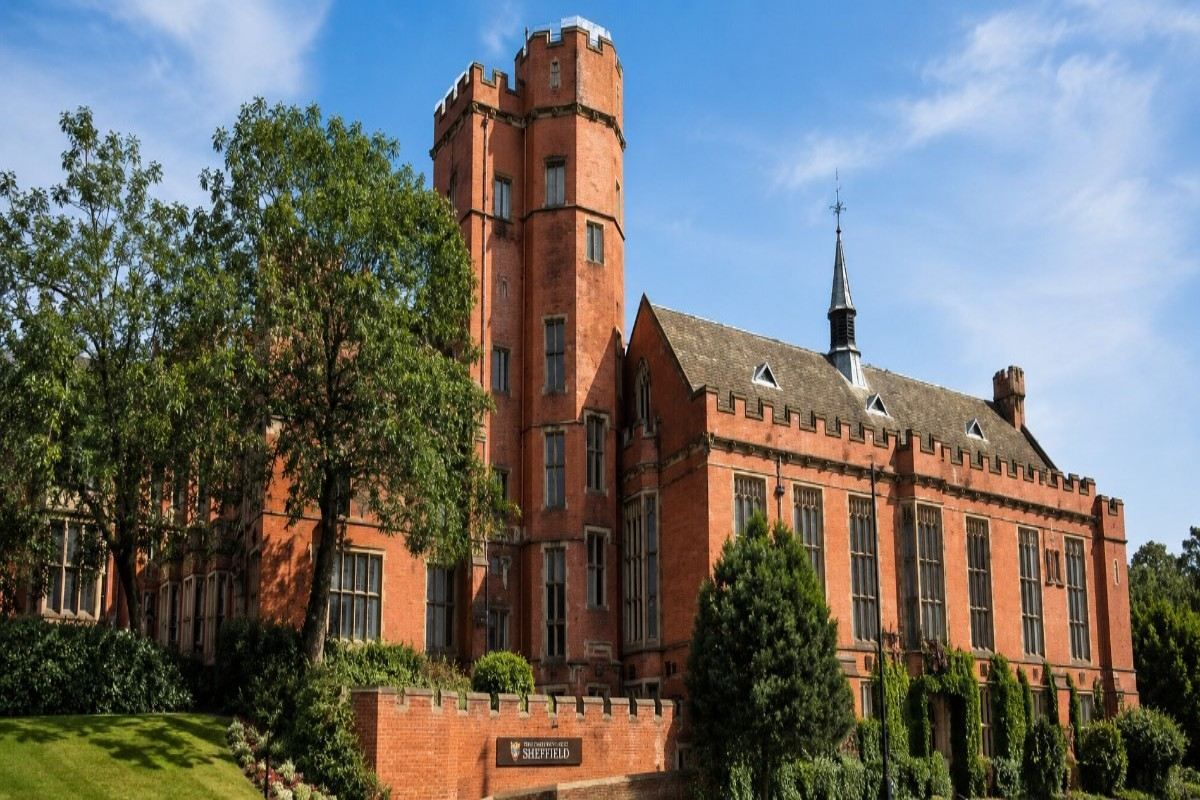
 Uk | Est. 1828
Uk | General Medical Council (GMC); listed in the World Directory of Medical Schools (WDOMS) | English medium
Expert will call you within 2 hours
At present, Sheffield's Medicine programme has become a part of School of Medicine and Population Health within the wider Faculty of Health. The older University brochures may refer to School of Medicine and Biomedical Sciences, but the actual Medicine course has not been affected by the restructuring.
The University of Sheffield is among the institutions in the UK with truly historic medical schools. Teaching of medicine has started in 1828 with the private anatomy school of Hall Overend which then became Sheffield Medical Institution in 1829. It then combined with Firth College and Sheffield Technical School to form the University of Sheffield in 1905. Its research achievements include Edward Mellanby's contribution to preventing rickets and the development of Krebs cycle by Hans Krebs at Sheffield who was then awarded the Nobel Prize.
The structure of the MBChB course in Sheffield includes four stages instead of simple five academic years. In Year 1, the focus lies on various body systems including cardiovascular, respiratory and gastrointestinal medicine. Also, the students engage in Community Attachment Scheme and Patients as Educators program involving repeated visits to patient families. In Year 2, there is a six-week research attachment followed by the move towards growing clinical practice via general practice and community placements.
The Years 3-5 become highly clinical, featuring both hospital and community placements together with an elective and the fourth year student assistantship. At this stage, the students shadow a Foundation Year 1 doctor and thus see firsthand what the postgraduate doctors have to do. One of the unique features of teaching here lies in anatomy. Since 2020, Sheffield no longer performs complete dissection and uses prosections, plastinated specimens and medical imaging instead.
The competition for international admission to Medicine in Sheffield is exceptionally fierce. There are only around 18 international places offered on the A100 Medicine programme compared to 273 home places available. This means that the international applicants compete for a very small number of spots rather than enter a large overseas recruitment programme.
One of the advantages of Medicine at Sheffield is the provision of the fixed-fee guarantee for the international students. Thus, the tuition fee quoted at the entry stage remains applicable to the entire five-year duration of the degree rather than being increased each year.
However, Medicine and Dentistry programmes are excluded from the standard international tuition scholarships provided by the University of Sheffield. It means that the international applicants should not expect that the Medicine tuition discount, which is typically quoted for other international applicants, will apply to the Medicine course. The initial tuition figure becomes especially relevant when considering its cost.
The clinical education is provided through Sheffield Teaching Hospitals NHS Foundation Trust. Key sites include the Royal Hallamshire Hospital, which is situated next to the Medical School, and the Northern General Hospital, which is a major trauma centre. The students may also receive their placement in a number of hospitals and other healthcare facilities in Rotherham, Doncaster, Barnsley and Chesterfield.
Differently from a number of other recent UK medical schools, Sheffield does not require the relocation to another city in the middle of the programme. Most teaching, clinical placements and student activities remain based in Sheffield, allowing the student to enjoy relatively stable five-year experience.
Finally, Sheffield becomes another advantage. Sheffield is substantially cheaper than London and even cheaper than several other large UK student cities. The university accommodation in Sheffield may cost below £100 per week, partially compensating for the high international tuition fee. Together with the fixed-fee guarantee, it makes the total five-year commitment predictable.
For an Indian student, Sheffield can be considered a university with a good historical reputation, strong NHS clinical placement, good research opportunities and relatively stable five-year location. The disadvantages of Sheffield for Medicine include its extremely small intake of the international students, high tuition fee and the absence of the standard international tuition scholarships for Medicine.
No hidden charges, no donation. The full picture of costs at MBBS in Sheffield University School of Medicine and Biomedical Sciences.
Tuition Fee
Approx. GBP 43,150, fixed for all 5 years (Approx. Rs. 54.91 lakh)
GBP 43,150 Approx. Rs. 54.91 lakh
Hostel Fee
Approx. GBP 3,500-6,500 per year (Approx. Rs. 4.45 lakh-8.27 lakh)
GBP 3,500-6,500 Approx. Rs. 4.45 lakh-8.27 lakh
Food & Meals
GBP 1,800-3,000 Approx. Rs. 2.29 lakh-3.82 lakh
per year
Insurance
GBP 776 Approx. Rs. 98,750 (per visa year)
per year
Donation
No Donation
No Hidden Fees.
Total Estimated Cost
Approx. GBP 247,700-266,100 for the complete 5-year programme (Approx. Rs. 3.15-3.39 crore)
Contact us
25–35%
Average FMGE first-attempt pass rates for students from many overseas medical universities. Students from structured programs consistently score higher.
Students returning to India need to clear the FMGE/NExT exam. MBBS in Sheffield University School of Medicine and Biomedical Sciences integrates exam-oriented coaching into the regular curriculum so students are prepared from day one.
A structured program that takes you from foundational sciences to clinical mastery.
• Community Attachment Scheme with a patient family, Patients as Educators sessions, and introductory clinical and communication skills
• Systems-based teaching covering cardiovascular, respiratory, gastrointestinal, musculoskeletal, nervous and reproductive systems
• Ten half-day general practice placements building history-taking and clinical examination skills
• Six-week supervised research attachment developing research skills alongside continued medical sciences teaching
• Student Selected Components in medical ethics and law, based on real cases seen in placement
• Increasing clinical placements across hospital specialties and general practice settings
• Elective period and further Student Selected Components, including audit and community-based options
• Longitudinal integrated clinical placement across primary and secondary care specialties
• Six-week student assistantship shadowing a Foundation Year 1 doctor before starting practice
• Consolidation lectures spanning a wide area of clinical medicine ahead of graduation
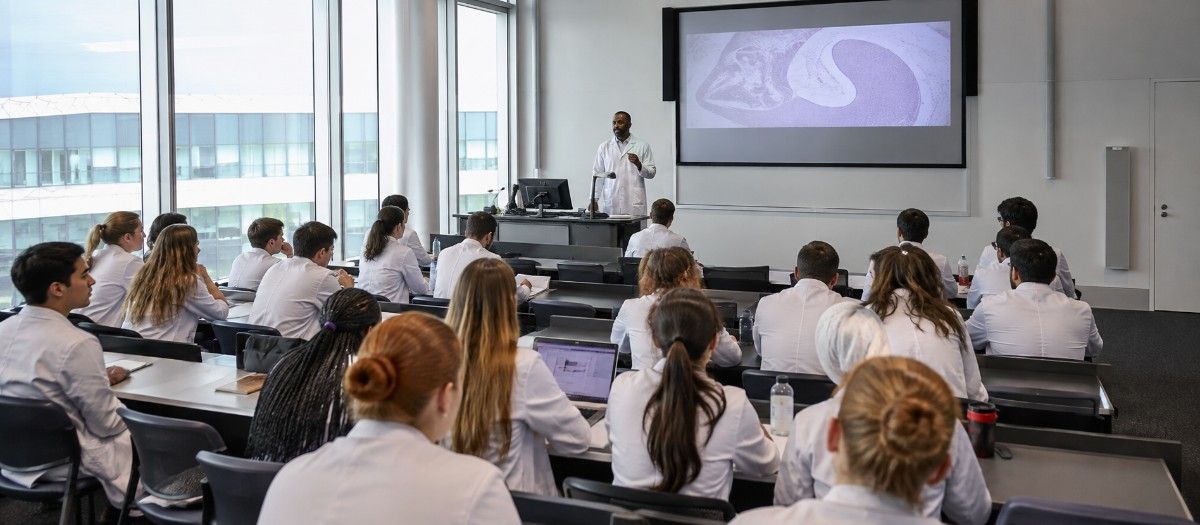
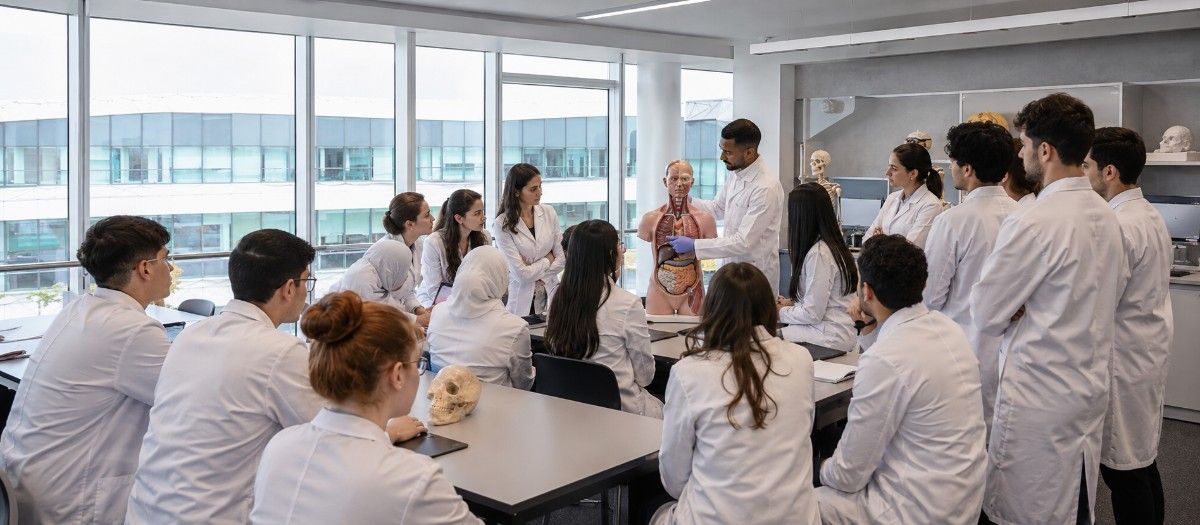
Furnished hostel rooms with Wi-Fi, laundry, 24/7 security, and Indian mess on or near campus.
Indian restaurants and mess facilities serving vegetarian and non-vegetarian home-style food daily.
Strong Indian community with cultural events, festival celebrations, and peer support groups.
Students get hands-on clinical training in government and private hospitals affiliated with the university.
Practical information for students planning to study at MBBS in Sheffield University School of Medicine and Biomedical Sciences.
Prepare for all seasons. Thermal wear for winters, light clothing for summers. University provides heating in hostels.
Student visa processed with university invitation letter. Direct and connecting flights from major Indian cities.
Health insurance included in fees. Medical facility on campus plus city hospitals easily accessible.
Local SIM cards available. WhatsApp and video calls keep you connected with family back home.
Average monthly expenses of $150–$250 covering food, transport, and personal needs.
University library, online databases, and study groups. Seniors mentor juniors through academic challenges.
Our team guides you through every step — from application to arriving on campus.
Compare universities based on fees, city, UCAT requirements, and clinical exposure, starting 12–18 months before your intended entry, not the cycle you’re applying in.
Registration opens in May; the testing window runs July–September. Most successful applicants begin focused preparation 3–4 months ahead, alongside board exam preparation.
Book and complete IELTS, PTE, or TOEFL well ahead of the UCAS deadline, allowing time for a retake if needed.
Submit your application, including personal statement and up to 4 medicine choices, before the 15 October deadline.
Prepare for and attend interviews (MMI or Panel format) typically scheduled November through February.
Offers (conditional or unconditional) typically arrive through winter and spring; conditional offers require meeting stated academic and English-score conditions.
Once Class 12 results and any other conditions are confirmed, your university issues the Confirmation of Acceptance for Studies (CAS), which is required for your visa application.
Apply using your CAS reference number; arrange maintenance funds according to the 28-day rule well in advance rather than at the last minute.
Book flights, confirm accommodation, complete any on-arrival formalities during orientation week, open a local bank account, and begin building connections with your university’s Indian/South Asian student community.
Admission Helpline — Contact our counsellors for step-by-step assistance.
“The faculty here is incredibly supportive. The clinical training during hospital rotations has given me real confidence in patient care.”
“Affordable fees without compromising on quality. The campus facilities and hostel life made my transition abroad very smooth.”
“English medium instruction and WHO-recognized curriculum were the deciding factors for me. No regrets so far — excellent experience overall.”
“The university helped with everything from visa to accommodation. Hospital exposure from year three has been invaluable for my FMGE prep.”
“Just cleared my licensing exam on the first attempt. The structured coaching and mock exams during final year were a game-changer.”
“Safe campus, good food options, and a strong Indian student community. The teaching methodology is very practical and hands-on.”
A: It combines a 190-year medical teaching history with a compact, single-city, patient-focused MBChB.
A: Yes. The entire five-year MBChB programme is delivered in English at the Sheffield campus.
A: Yes. The MBChB is accredited by the GMC and the school is listed in the World Directory of Medical Schools.
A: No. Teaching and clinical placements are based in Sheffield throughout all five years.
A: Yes. Indian students should clear NEET, and future recognition of the degree remains subject to prevailing NMC regulations.
A: No. Medicine (A100/A101) is excluded from Sheffield's automatic international undergraduate scholarships.
A: No. Sheffield offers a fixed-fee guarantee, so the international tuition rate stays the same for all 5 years.A: No. Sheffield offers a fixed-fee guarantee, so the international tuition rate stays the same for all 5 years.
A: Very. Only 18 places on the standard MBChB are reserved for international students each year, against 273 for home students.
A: Yes. All Medicine applicants, including international applicants, must sit the UCAT in their year of application.
A: Applicants usually need academic transcripts, passport copies, UCAT and English proficiency scores, and interview documentation.
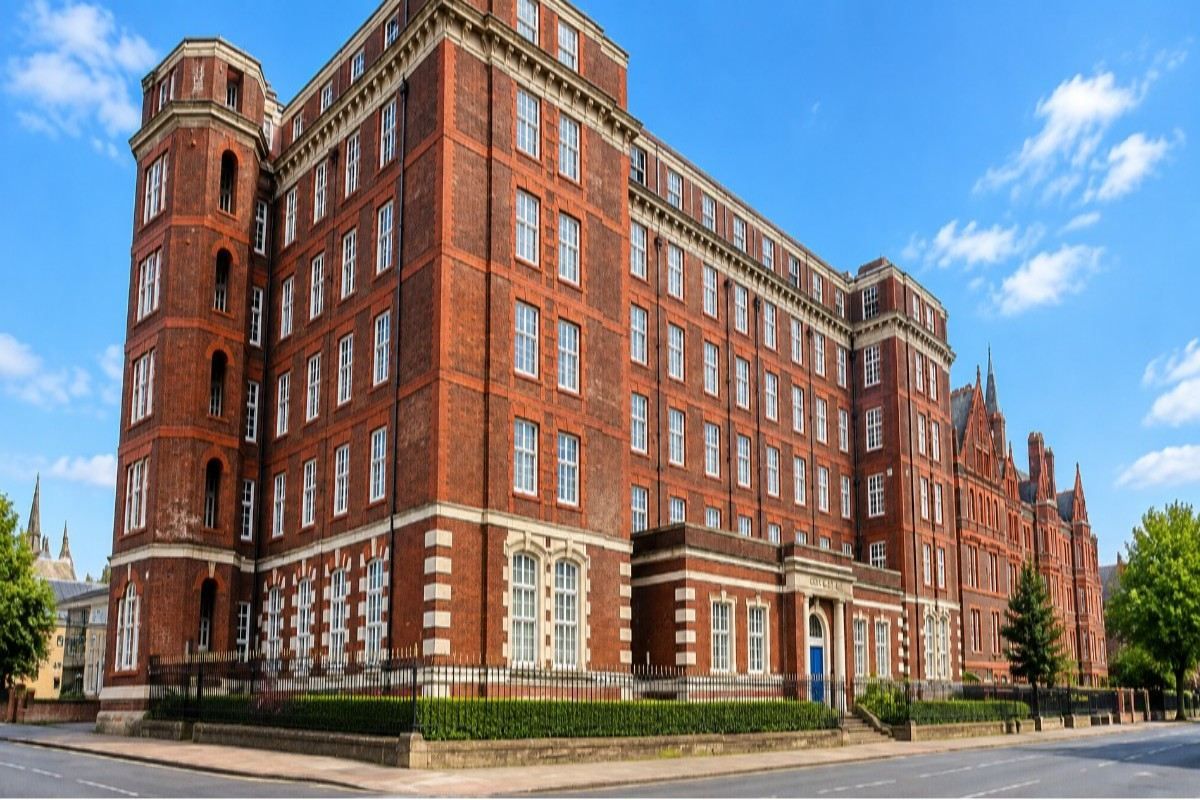
Our expert counsellors will guide you through the complete admission process — from documents to airport pickup.