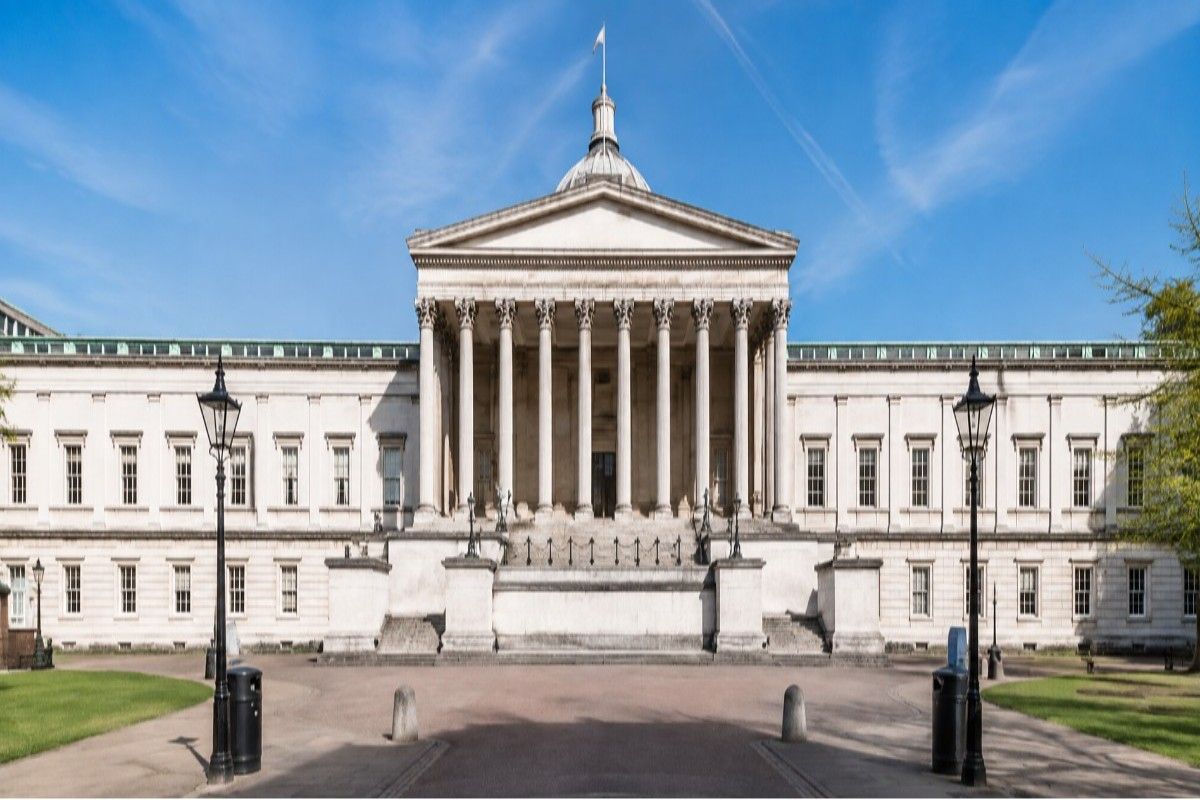
Most agents promoting UK medicine tend to pitch with Oxford, Cambridge, or Imperial, with UCL being mentioned only as an afterthought, which is strange given that the UCL Medical School dates its lineage back to 1834, and, judging by all recent QS subject tables, consistently out-ranks Imperial in Medicine.
However, the school in its present incarnation is not quite that old – it was founded in 2008 by combining three previously separate institutions – the medical schools of University College Hospital, Middlesex Hospital, and the Royal Free Hospital, each operating as a separate institution for more than a century.
So, what one gets with UCL is not just an old building with a traditional name, but three distinct clinical histories in one faculty. The teaching still takes place at UCL's Bloomsbury campus, the Royal Free Hospital in Hampstead, and Whittington Hospital in Archway.
This raises the obvious question – why choosing UCL in favour of Oxford and Cambridge when the fees and commitment are pretty much the same? The honest answer is the cohort size.
UCL admits a much larger group of students, producing 337 doctors annually compared to hundreds produced by Oxbridge, and this cuts both ways. The size of the cohort makes it impossible to reproduce the tutorial intimacy of Oxford and Cambridge, but it also means that the size of the network of NHS placement sites is much larger along with the number of consultant-teachers.
It also means access to a training hospital system, headed by University College Hospital, which processes an amount and variety of cases which is hard to match by most university towns. Those planning to practice in London and/or to focus on global and public health given the research strengths of the university in this area find it a reasonable trade-off.
Structure-wise, the MBBS BSc programme takes either 6 or 5 years, depending on whether or not the applicant has a prior degree. Years 1 and 2 involve study of systems-based modules in basic clinical sciences, along with the Clinical and Professional Practice strand involving learning communication skills and gaining early patient experience from day one.
Year 3 consists of the compulsory intercalated BSc – a genuinely rare feature shared only with Oxford and Cambridge along with a few London schools, and one of the most diverse option sets in the country. The student has the opportunity to specialize in something as varied as human genetics, medical anthropology or sports and exercise medicine for an entire year, including conducting an independent research project, and return to clinical practice afterwards.
Years 4 and 5 mostly involve hospitals, GP surgeries, and community placements in London. Year 6 concludes with an assistantship shadowing a foundation year doctor, an eight-week elective which usually takes place abroad, and a final preparation period before taking the UK-wide Medical Licensing Assessment exam.
Needless to say, none of this is cheap. The 2026/27 international entry fee of £57,300 places UCL into the exclusive club of UK schools along with Oxford, Cambridge, Imperial, and Edinburgh, with their full six-year programme and its associated costs.
A UK national, however, would pay only £9,790 per year. Unlike some other UCL undergraduate programmes, the MBBS programme is specifically excluded from the regular fee-freeze policy of the university, meaning that overseas fees can increase every year up to RPI-X limit.
Thus, prospective international applicants are advised to budget not for the fixed price but for a certain annual increase. Other costs are relatively modest – the lab coat and goggles for the anatomical classes, the stethoscope which is required from the year 4 onwards, verification of identity for the background check, and, for years 5 and 6 – travel expenses for the placement sites.
Some of the expenses can be reclaimed by applying for the NHS Bursary from the fifth year onwards.
The academic argument for studying at UCL is based on its research record. It boasts six alumni and faculty members awarded Nobel prizes, including the discovery of adrenaline, fundamental discoveries in immunology, isolation of aldosterone hormone, and the description of the autoimmune diseases.
The research culture is reflected in teaching – unlike some of the competing schools, the anatomical classes involve actual dissections rather than prosections. In addition, the Clinical and Professional Practice curriculum, running through all years, includes data sciences, ethics and law, and social determinants of health, along with other clinical skills.
The life in London is another factor to consider in choosing UCL. London rents in central parts of the town are costly by any standards, and the commute from the lectures in Bloomsbury to hospitals in Hampstead and Archway will inevitably result in transportation expenses.
On the other hand, London – its hospitals, research institutions and the sheer diversity of medical specialities which it provides – could be considered the strongest argument in favor of UCL. For a student looking for maximum possible exposure to patients, conditions and career path options within a single medical programme, few UK schools can compete.
And all of this is despite the fact that the school in question is not the oldest nor the smallest in the country.