
Q1. Is the University of Surrey's School of Medicine a new medical school?
+Yes, it's genuinely newer than most UK medical schools, and currently sits within the General Medical Council's standard enhanced monitoring period for new schools.

 Uk | Est. 1966
Uk | Listed on the World Directory of Medical Schools; recognised by the UK's General Medical Council as a new school under review | English medium
Expert will call you within 2 hours
People mostly just call it Surrey for short. The wider university was founded in 1966 and has built a genuine reputation for strong industry engagement and graduate employability, consistently ranking in the UK's top ten for a wide range of subjects, from veterinary medicine to manufacturing and production engineering. So, the university's own track record long predates its medical school by several decades.
Here's a fact most guides skip entirely. Surrey's School of Medicine is one of the UK's genuinely newer medical schools, and it currently sits within the General Medical Council's enhanced monitoring period, a standard, mandatory phase for any newly established UK medical school, during which the GMC closely tracks the programme to confirm it meets the country's required standards before that additional oversight is eventually lifted. So, applicants should understand this school is still actively establishing its own independent track record, a genuinely different position from long-established UK medical schools with decades of graduating classes behind them.
A genuinely distinctive feature of Surrey's admissions process is that it accepts either the UCAT or the GAMSAT, rather than requiring only one. This gives applicants real flexibility: someone who finds the UCAT's time pressure difficult, but performs well in GAMSAT's longer format, can play to that specific strength instead, and vice versa. So, unlike most UK medical schools, which typically pick one entrance test and require it exclusively, Surrey lets applicants choose the format that suits them best.
The School of Medicine sits alongside four other schools focused on human and animal health at Surrey: the School of Biosciences and Medicine, the School of Health Sciences, the School of Psychology, and the School of Veterinary Medicine. So, medicine here is embedded within a genuinely broad health-sciences ecosystem, not a standalone department.
Surrey's Stag Hill campus sits in Guildford, a historic town in Surrey, just 34 minutes by train from central London, giving students genuine, easy access to the capital while studying in a smaller, more compact university town. The university hosts students from around 140 different nationalities, with over 30 percent of its overall student body coming from overseas, a genuinely international campus environment.
Clinical placements run throughout all four years of the BMBS programme, beginning from the very first year, through agreements with a number of NHS trusts and primary care providers, giving students early exposure to GP and community mental health settings alongside more traditional hospital placements as the programme progresses.
Surrey's Medicine (Graduate Entry) BMBS runs four years, and, as the name suggests, is open only to applicants who already hold a relevant undergraduate degree. Specifically, UCAT is only considered for applicants holding a relevant Biochemistry, Biology, Biomedical Science, Chemistry, or Natural Sciences degree; other graduates would need to sit the GAMSAT instead. All shortlisted applicants take part in a Multiple Mini Interview cycle lasting under an hour, with candidates independently assessed and marked against agreed criteria at each individual station, before being placed into one of three overall categories. Offers are made subject to satisfactory Occupational Health clearance and appropriate vaccinations.
The programme is listed on the World Directory of Medical Schools and recognised by the General Medical Council as a new school under review, meaning graduates are on track for full UK medical registration once the standard foundation and licensing steps are completed, even while the school itself remains under this standard early-stage monitoring.
Fee figures here are genuinely significant, reflecting both the graduate-entry structure and Guildford's proximity to London. UK, or Home, students pay the standard regulated fee of GBP 9,250 a year. International students pay considerably more: for 2026 entry, the confirmed rate is GBP 48,400 a year, with fees rising by a further 4 percent for each subsequent year of study, rounded up to the nearest GBP 100. Across the full four-year programme, accounting for these annual increases, total tuition for an international student runs to roughly GBP 203,000 to 209,000. Surrey does offer a specific 20 percent discount on first-year fees only for eligible, self-funded Surrey alumni who studied in Guildford, though this doesn't apply to subsequent years or to applicants without a prior Surrey degree.
International applicants need an IELTS score of at least 7.0 overall, with a minimum of 7.0 in every individual component, a genuinely demanding threshold compared to some other UK medical schools' language requirements. Students without a tuition fee loan pay their fees either in full at the start of the programme or in two instalments, the first 50 percent due shortly after the invoice date. NEET remains a genuine requirement for Indian applicants here, exactly as it does for most other MBBS-style destinations, and Indian graduates would still need to clear the FMGE or NExT exam to practise medicine back in India.
Parameter | Details |
Established | University founded 1966; School of Medicine is a newly established graduate-entry school, currently under the GMC's enhanced monitoring period for new medical schools (exact founding year not consistently published) |
Institution Type | Public research university |
Location | Guildford, Surrey, England, United Kingdom |
Medicine (Graduate Entry) BMBS, UCAS code open to graduate applicants only | |
Duration | 4 years |
Medium of Instruction | English |
Foreign Quota Note | International places are limited but genuinely available; fees are considerably higher than the Home rate |
Teaching Hospital | Clinical placements run through agreements with a number of NHS trusts and primary care providers across the region |
Fee Component | Amount | Notes |
Tuition Fee (Home/UK students) | GBP 9,250 per year | The standard regulated UK undergraduate tuition fee for medicine |
Tuition Fee (International, 2026 entry) | GBP 48,400 per year | Rises by a further 4% for each subsequent year of study, rounded up to the nearest GBP 100 |
International Alumni Discount | 20% off the first year only, for eligible self-funded Surrey alumni | Applies only to graduates of Surrey itself who meet specific eligibility criteria; does not apply to later years |
English Language Requirement (IELTS) | 7.0 overall, with at least 7.0 in every component | A genuinely demanding threshold compared to some other UK medical schools |
Living Costs | Not separately confirmed by the university | Guildford sits close to London, so living costs run on the higher side for a UK regional city |
Most rival pages describe UK medical school admission as a single fixed test. Surrey genuinely accepts either the UCAT or the GAMSAT, letting applicants play to whichever format suits their own strengths. So, this represents a real, structural flexibility most other UK medical schools simply don't offer.
Most guides gloss over how recently a medical school was actually established. Surrey's own materials state directly that the School sits within the GMC's standard enhanced monitoring period for new schools, a specific, verifiable regulatory status rather than a vague claim of quality. So, applicants get genuine transparency about exactly where this school stands in its own development.
Be upfront about a few real considerations here. International tuition, at GBP 48,400 a year rising with annual increases, is genuinely among the higher end of UK medical school fees, reflecting both the graduate-entry structure and Guildford's South East England location near London. As a newer school still under GMC enhanced monitoring, Surrey doesn't yet carry the same decades-long graduating track record as some of the UK's older medical schools. The IELTS requirement, at 7.0 in every component, is also genuinely demanding.
So, who fits here best? Graduate applicants who already hold a relevant degree, and who want the flexibility of choosing between UCAT and GAMSAT, fit well here. Students drawn to a genuinely international campus close to London, within an established, well-ranked wider university, fit well too. However, applicants who need the lowest possible international tuition, or who prefer a long-established medical school with a mature track record, should weigh Surrey carefully against other options. Still, the dual entrance-test flexibility and Surrey's strong wider university reputation are real, well-documented strengths.
Established Year: University founded 1966; School of Medicine newly established (exact year not consistently published)
No hidden charges, no donation. The full picture of costs at MBBS in University of Surrey School of Medicine.
Tuition Fee
£48,400 per year
£48,400 for the first year
Hostel Fee
Approximately £5,000–11,300 per year (around ₹5.9–13.3 lakh)
£208.50–217 per week
Food & Meals
Approximately £2,100–4,000 (around ₹2.5–4.7 lakh)
per year
Insurance
Approximately £776
per year
Donation
No donation
No hideen fees
Total Estimated Cost
Approximately £56,300–64,500 per year (around ₹66–76 lakh)
4-year
25–35%
Average FMGE first-attempt pass rates for students from many overseas medical universities. Students from structured programs consistently score higher.
Students returning to India need to clear the FMGE/NExT exam. MBBS in University of Surrey School of Medicine integrates exam-oriented coaching into the regular curriculum so students are prepared from day one.
A structured program that takes you from foundational sciences to clinical mastery.
Begins clinical placements from the very first year, including GP and community mental health settings.
Covers Anatomy, Physiology, and Biochemistry, building directly on students' existing relevant degree background.
Builds toward more structured hospital-based training in the years that follow.
Covers Pathology, Microbiology, and Pharmacology alongside continued clinical placement experience.
Deepens patient-facing clinical responsibility ahead of the final year.
Covers Medicine, Surgery, and allied clinical subjects across a range of NHS trust and primary care placement settings.
Completes the academic requirements needed to begin working as a foundation doctor.
Builds toward independent clinical competence ahead of graduation and Foundation Programme applications.
International graduates returning home face their own country's separate licensing requirements, such as India's FMGE or NExT.
Graduates enter the UK Foundation Programme before applying for full GMC registration.
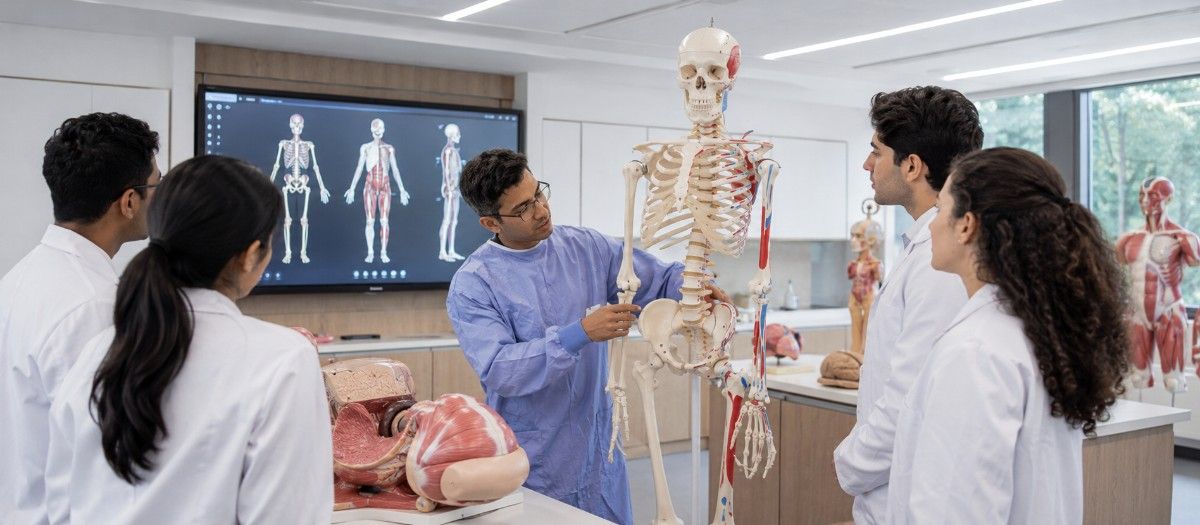

Furnished hostel rooms with Wi-Fi, laundry, 24/7 security, and Indian mess on or near campus.
Indian restaurants and mess facilities serving vegetarian and non-vegetarian home-style food daily.
Strong Indian community with cultural events, festival celebrations, and peer support groups.
Students get hands-on clinical training in government and private hospitals affiliated with the university.
Practical information for students planning to study at MBBS in University of Surrey School of Medicine.
Prepare for all seasons. Thermal wear for winters, light clothing for summers. University provides heating in hostels.
Student visa processed with university invitation letter. Direct and connecting flights from major Indian cities.
Health insurance included in fees. Medical facility on campus plus city hospitals easily accessible.
Local SIM cards available. WhatsApp and video calls keep you connected with family back home.
Average monthly expenses of $150–$250 covering food, transport, and personal needs.
University library, online databases, and study groups. Seniors mentor juniors through academic challenges.
Our team guides you through every step — from application to arriving on campus.
Compare universities based on fees, city, UCAT requirements, and clinical exposure, starting 12–18 months before your intended entry, not the cycle you’re applying in.
Registration opens in May; the testing window runs July–September. Most successful applicants begin focused preparation 3–4 months ahead, alongside board exam preparation.
Book and complete IELTS, PTE, or TOEFL well ahead of the UCAS deadline, allowing time for a retake if needed.
Submit your application, including personal statement and up to 4 medicine choices, before the 15 October deadline.
Prepare for and attend interviews (MMI or Panel format) typically scheduled November through February.
Offers (conditional or unconditional) typically arrive through winter and spring; conditional offers require meeting stated academic and English-score conditions.
Once Class 12 results and any other conditions are confirmed, your university issues the Confirmation of Acceptance for Studies (CAS), which is required for your visa application.
Apply using your CAS reference number; arrange maintenance funds according to the 28-day rule well in advance rather than at the last minute.
Book flights, confirm accommodation, complete any on-arrival formalities during orientation week, open a local bank account, and begin building connections with your university’s Indian/South Asian student community.
Admission Helpline — Contact our counsellors for step-by-step assistance.
“The faculty here is incredibly supportive. The clinical training during hospital rotations has given me real confidence in patient care.”
“Affordable fees without compromising on quality. The campus facilities and hostel life made my transition abroad very smooth.”
“English medium instruction and WHO-recognized curriculum were the deciding factors for me. No regrets so far — excellent experience overall.”
“The university helped with everything from visa to accommodation. Hospital exposure from year three has been invaluable for my FMGE prep.”
“Just cleared my licensing exam on the first attempt. The structured coaching and mock exams during final year were a game-changer.”
“Safe campus, good food options, and a strong Indian student community. The teaching methodology is very practical and hands-on.”
Yes, it's genuinely newer than most UK medical schools, and currently sits within the General Medical Council's standard enhanced monitoring period for new schools.
No, this is a graduate-entry programme only; applicants must already hold a relevant undergraduate degree before applying.
Either the UCAT (for relevant science/biomedical degree holders) or the GAMSAT, giving applicants a genuine choice of format.
Yes, a valid, qualifying NEET score is required for Indian applicants under India's own national rules.
GBP 48,400 a year at 2026 entry, rising 4% annually thereafter, totalling roughly GBP 203,000 to 209,000 in tuition across the full four years.
Training runs through agreements with a number of NHS trusts and primary care providers across the region, beginning from Year 1.
Graduates receive a BMBS degree, preparing them for the UK Foundation Programme and eventual General Medical Council registration.
It runs four years, structured specifically for graduate-entry applicants.
Yes, eligible self-funded Surrey alumni can receive a 20% discount on first-year fees only.
In Guildford, Surrey, just 34 minutes by train from central London.
Our expert counsellors will guide you through the complete admission process — from documents to airport pickup.