Asian Medical Institute (commonly known as AMI or ASMI) is one of the most heavily marketed MBBS options in Kyrgyzstan for Indian students, and one where the gap between marketing language and clear data is worth going through before committing ₹20+ Lakhs.
Here is what is clear. AMI was established in 2004 in Kant, a small city approximately 20 km from Bishkek. It is a private medical institute. Annual tuition is approximately USD 3,400–4,500 (₹3.30–4.37 lakh at ₹97/USD). The total 6-year all-in cost is ₹20–26 Lakhs, depending on lifestyle, making it among the lowest for MBBS in Kyrgyzstan. The institute is listed in WDOMS and recognised by NMC and WHO.
Here is the part that needs honest treatment: NBEMS’s official FMGE 2024 country-wise data lists S. Tentishev Asian Medical Institute at 26.27%, a verifiable, citable figure from a credible aggregator source. One other source cites a markedly lower figure (5.23%) for what it labels “Asian Medical Institute.” Different data likely reflect different cohort years, or possible naming confusion between Asian Medical Institute (Kant) and other similarly named institutions in the region (Asian International University, S. Tentishev branding).
This blog covers the complete picture with AMI’s actual fee structure, the NMC compliance checklist, the honest FMGE/NExT data, the 6-year course structure, Kant city as a study location, and an honest comparison with KRSU, OSMU, KSMA, and JASU, so Indian students can make a properly informed decision.
AMI Quick Facts 2026: Established 2004. Private university. Located in Kant city, ~20 km from Bishkek. NMC + WHO + WDOMS approved. English-medium MBBS.
Annual tuition: USD 3,400–4,500 (₹3.30–4.37 lakh). Total 6-year all-in: ₹20–26 Lakhs at ₹97/USD. 4,000+ total students (750+ Indian students in the MBBS programme). 250+ faculty. FMGE 2024 (NBEMS-sourced): 26.27%. Two intakes: September & February.
Key Decision Factors for Indian Students
1: NMC, WHO & WDOMS Approval: Verify Independently: AMI is listed on WDOMS and recognised by NMC and WHO. This is a non-negotiable starting point for any decision about studying MBBS abroad. Verify the current listing directly on wdoms.org before finalising admission, since approvals can change and consultancy claims should not be the sole source of verification.
2: Cost: Among the Lowest in Kyrgyzstan: Annual tuition USD 3,400–4,500 (₹3.30–4.37 lakh at ₹97). Total 6-year all-in: ₹20–26 Lakhs. This places AMI among the most affordable NMC-approved options in Kyrgyzstan, comparable to JASU and slightly below OSMU. No donation, no capitation fee required.
3: FMGE 2024 Data: 26.27% (NBEMS-Sourced), With a Flagged Discrepancy: The NBEMS-aggregated FMGE 2024 country report lists S. Tentishev Asian Medical Institute at 26.27% below KRSU (39.66%) and KSMA (31.56%), but a verifiable, real figure. A separate source cites a much lower figure of 5.23% for an institution it labels the Asian Medical Institute. This discrepancy is real and should be independently verified with NBEMS’s official FMGE result portal before enrolling. Do not rely on a single secondary source for this critical data point.
4: Private Institution: Established 2004, Younger Than Government Alternatives: AMI is a private medical institute, unlike OSMU, KRSU, KSMA, and JASU, which are all government institutions. This does not automatically mean lower quality, but it does mean a different funding and accountability structure. AMI currently has over 750 Indian students enrolled and a faculty of 250+, who verify current facilities and faculty credentials directly during your admission process.
5: Kant City Town Near Bishkek: AMI is located in Kant, a small city approximately 20 km from Bishkek (Kyrgyzstan’s capital). This gives students easy access to Bishkek’s larger infrastructure, international airport, and bigger Indian community while living in a smaller, quieter, lower-cost town. Kant itself has limited independent infrastructure; most city-level amenities require a trip to Bishkek.
What is the Asian Medical Institute? An Overview for Indian Students
Asian Medical Institute (AMI), also referred to in some sources as ASMI or by its formal name S. Tentishev Asian Medical Institute, is a private medical university established in 2004 in Kant, Kyrgyzstan, a small city roughly 20 km northeast of Bishkek. It functions under the Ministry of Health and the Ministry of Education and Science of the Kyrgyz Republic.
AMI is one of the younger medical universities in Kyrgyzstan’s MBBS-for-international-students market (founded in 2004, compared to OSMU’s 1992 medical faculty or KSMA’s 1939 founding). It has significantly increased its international enrolment, with the university reporting more than 4,000 students across all programmes and over 750 Indian students enrolled in the MBBS (General Medicine) programme.
The institute markets itself heavily around its WDOMS listing, NMC and WHO recognition, accreditation by Kyrgyzstan’s Ministry of Education on three consecutive occasions, and degree acceptance across 14 countries. These are credible claims supported by multiple independent sources, but as with any MBBS abroad decision, verify the current status directly rather than relying solely on marketing material.
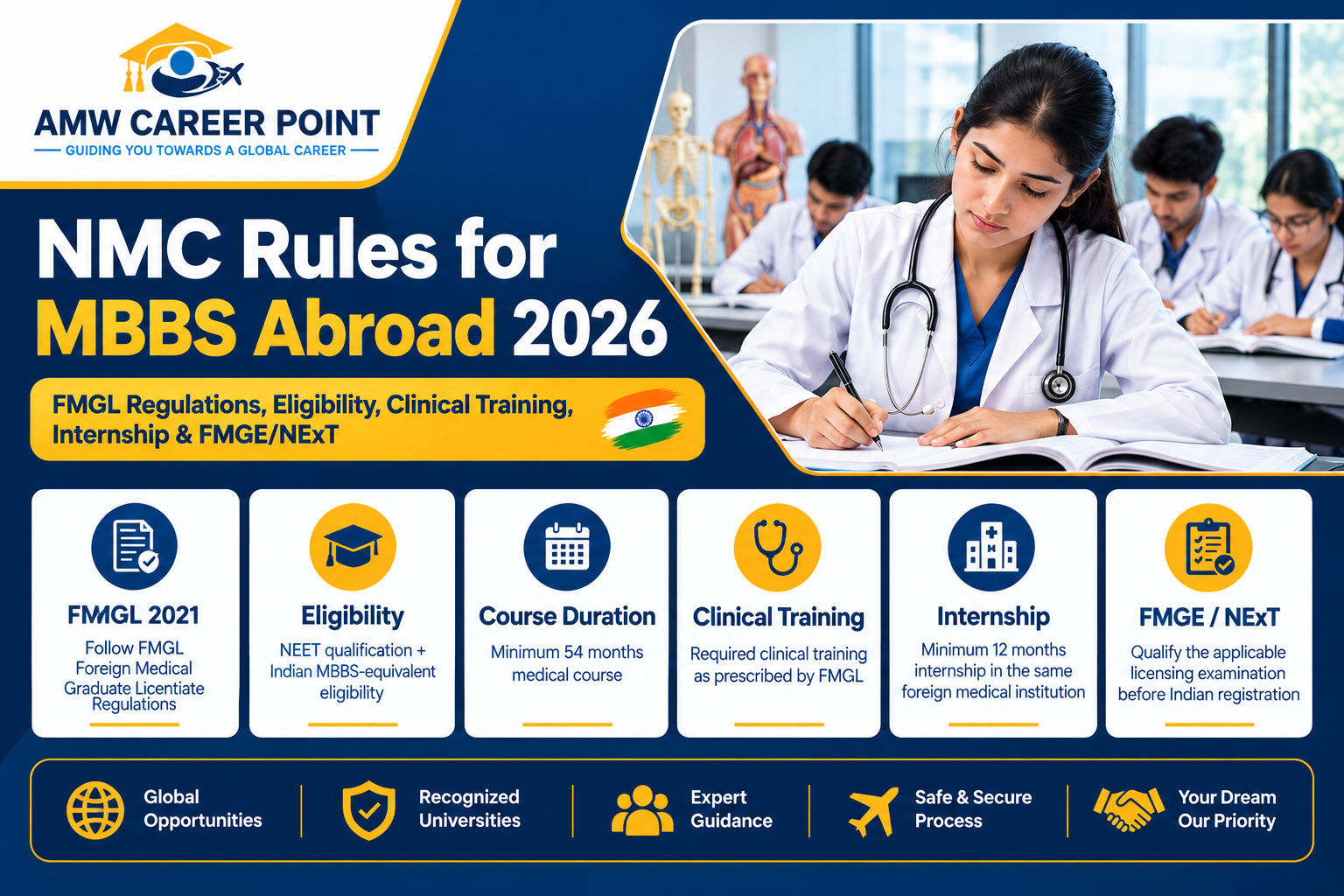
The MBBS programme (General Medicine, leading to a Doctor of Medicine degree) runs 6 years, 5 years of academic and clinical study plus 1 mandatory year of internship at 14 AMI-affiliated hospitals. Some sources describe the academic portion as 5 years; verify the exact current structure (54-month minimum + 12-month internship) directly with AMI at the time of admission.
Asian Medical Institute (AMI) At a Glance 2026
Particulars | Details |
Full Name | Asian Medical Institute (AMI / ASMI), also cited as S. Tentishev Asian Medical Institute. |
Established | 2004 |
Type | Private Medical University |
Location | Kant city, Chuy province, Kyrgyzstan (~20 km from Bishkek) |
Governing Body | Ministry of Education & Science + Ministry of Health, Kyrgyz Republic |
Programme for Indian Students | General Medicine (MBBS equivalent) Doctor of Medicine |
Course Duration | 6 Years 5 years academic + 1 year of mandatory internship (verify exact structure with AMI directly) |
Medium of Instruction | English (100% for international students) |
NEET Requirement | Mandatory 50%+ PCB marks (40% for SC/ST/OBC) + valid NEET qualification |
NMC Approval | Yes, NMC recognised and WDOMS listed (verify current status independently) |
WHO Recognition | Yes, WHO listed; FAIMER recognition is also cited by the university. |
Total 6-Year All-In Cost | ₹20–26 Lakhs, depending on lifestyle |
Annual Tuition | USD 3,400–4,500 (₹3.30–4.37 lakh/year) |
Hostel Fees | USD 600–700/year (₹58,200–67,900/year) verify exact figure at enrollment |
Monthly Living (food, transport, personal) | ₹12,000–18,000/month |
Total University Students | 4,000+ (across all programmes) |
Indian Students in the MBBS Programme | 750+ |
Faculty Strength | 250+ faculty members (including Indian educators, per university claims) |
FMGE 2024 Pass Rate (NBEMS-sourced) | 26.27% verify directly with NBEMS; a separate lower figure (5.23%) appears in one secondary source and should be independently checked |
Affiliated Internship Hospitals | 14 AMI-affiliated hospitals (per university claims, verify current list) |
Intakes | September (primary) and February (secondary) |
Distance from Bishkek | ~20 km; approximately 30–40 minutes by road |
Is Asian Medical Institute NMC-approved?
Multiple independent sources confirm that AMI is recognised by the National Medical Commission (NMC, India), listed on WDOMS, and recognised by WHO. Indian students who complete the full programme at AMI (academic study + mandatory internship satisfying NMC’s 54-month + 12-month structure) are eligible to appear for NExT in India, subject to verification at the time of graduation.
NMC Compliance Checklist for Asian Medical Institute
WDOMS Listing: Verify at wdoms.org that AMI/ASMI and its General Medicine programme are currently listed under the correct institutional name. Given the naming variations across sources (AMI, ASMI, S. Tentishev Asian Medical Institute, Asian International University), please confirm that you are verifying the exact institution you intend to enrol in.
English Medium Throughout: AMI’s General Medicine programme for international students is described as English-medium across all sources reviewed. Confirm this in writing in your admission offer letter, including which subjects (if any) involve Russian/Kyrgyz instruction.
Course Duration: 54 Months Academic + 12-Month Internship: NMC FMGL Gazette 2021 requires a minimum of 54 months (4.5 years) of academic study plus a 12-month mandatory internship. Sources describe AMI’s structure as "5 years + 1 year internship", confirming that the exact month count meets the 54-month NMC minimum before enrolling.
Internship at AMI-Affiliated Hospitals: The mandatory internship must be completed at AMI’s affiliated teaching hospitals in Kyrgyzstan (the university cites 14 affiliated hospitals). Confirm in writing which specific hospitals your internship will be completed at, and that this cannot be transferred to India.
NEET Qualification: Valid NEET UG score mandatory. Minimum 50% PCB marks in 12th (40% for SC/ST/OBC). NEET score must be within the 3-year validity window (2024, 2025, or 2026 for 2026 admission).
NMC Eligibility Certificate: Apply to NMC India for the Eligibility Certificate after receiving AMI’s offer letter. Mandatory before departure from India. Processing time: 10–15 working days.
FMGE/NExT Pass Rate Verification: Given the discrepancy found across sources for AMI’s FMGE performance, independently verify the institution’s actual pass rate directly through NBEMS’s official results portal rather than relying on any single secondary source, including this guide.
Local Licensure Eligibility: Graduates must be eligible to register and practise in Kyrgyzstan upon completion, satisfying the NMC FMGL local licensure requirement. AMI graduates reportedly receive a Doctor of Medicine degree recognised in 14 countries, according to the university's claims, which verify the current recognition status.
Compliance Note: NMC approvals and WDOMS listings are subject to change and should always be verified independently at the time of admission. For Asian Medical Institute specifically, we found a notable discrepancy in FMGE pass rate data across sources (26.27% per NBEMS-aggregated reporting vs 5.23% cited by another source). This may reflect different cohort years, different institutions with similar names, or reporting errors. Before enrolling, independently verify AMI’s exact legal name, NMC/WDOMS status, and FMGE/NExT historical performance directly through NBEMS’s official portal and nmc.org.in. Do not rely solely on this guide or any consultancy’s claims.
FMGE 2024 & NExT The Honest Picture for AMI Students
This is the section that requires the most careful, transparent treatment, specifically for the Asian Medical Institute. The most commonly cited and cross-referenced figure, sourced from NBEMS’s 2024 country-wise FMGE performance reporting (as aggregated by multiple independent education portals), places S. Tentishev Asian Medical Institute at 26.27% FMGE pass rate for 2024. This figure appears consistently in at least two independent secondary sources that cite the same NBEMS data, lending it reasonable credibility.
A separate source cites a markedly different figure of 5.23% for what it labels “Asian Medical Institute.” This is a significant discrepancy that we cannot resolve with full confidence based on the available data. Possible explanations include: a different reporting year, a different cohort size (small cohorts can produce volatile percentages), confusion with a similarly named institution (there are several “Asian”-branded medical universities in the Kyrgyzstan/Central Asia region, including Asian International University).
What this means in practice: if you are seriously considering AMI, do not rely on any single source (including this guide) for FMGE/NExT performance data. Contact NBEMS directly, request the university’s historical FMGE result data by the exact registered name, and cross-check it against the university’s own claimed pass rates (and ask for supporting documentation, not just a verbal claim).
FMGE 2024 Kyrgyzstan University Comparison (Where AMI Sits)
University | FMGE 2024 Pass % | Type | Annual Tuition (USD) | Total 6-Yr All-In (₹97/USD) | Honest Verdict |
39.66% | Government | USD 4,500–5,000 | ₹26–30 Lakh | Best FMGE in Kyrgyzstan. The highest cost among the major government options. | |
31.56% | Government | USD 3,800–4,500 | ₹24–28 Lakh | Strong government institution. Good FMGE. Bishkek location. | |
26.27% (NBEMS-sourced) | Private | USD 3,400–4,500 | ₹20–26 Lakh | Lowest cost. FMGE data require independent verification before enrollment. | |
~25–32% est. (aggregate KG) | Government | USD 3,500–4,000 | ₹22–28 Lakh | Good clinical infrastructure (Osh Regional Hospital). Government institution. Comparable cost to AMI. | |
~22–30% est. | Government | USD 3,500–4,200 | ₹22–28 Lakh | Government institution. Comparable cost. Smaller city. | |
71.43% (2024) | Government | ₹10–12 lakh/yr | ₹45–68 Lakh | Best FMGE per rupee. Far higher cost. Limited seats. | |
80.33% (2024) | Private | USD 6,000 | ₹50–65 Lakh | Best FMGE globally among major destinations. Higher cost. |
FMGE Data Discrepancy Important: The 26.27% figure for AMI is the more credible, cross-referenced figure from NBEMS-aggregated reporting. However, given the conflicting 5.23% figure reported in one source, students should treat AMI’s FMGE performance as an open verification item rather than a settled fact before making any enrollment decision. Request AMI’s official FMGE/NExT historical pass rate data directly from the university and independently from NBEMS before paying any fee.
What Determines NExT Success for AMI Students
Independently verify FMGE/NExT data before enrolling: This is the single most important action item for any prospective AMI student, given the data inconsistency identified above. Do not proceed on assumption.
English-medium academics as the foundation: If AMI’s claimed English-medium instruction holds as described, Indian students can study directly from NExT-relevant textbooks (Guyton, Robbins, Harrison) without a translation layer — a genuine structural advantage if the claim is accurate.
Basic Kyrgyz/Russian for clinical years: As with every Kyrgyzstan university, hospital patients communicate in Kyrgyz and Russian. Students who learn basic clinical phrases by Year 3–4 consistently report higher-quality bedside learning.
NExT MCQ practice from Year 1: This applies across every MBBS abroad destination. Early, consistent MCQ practice (Marrow, DAMS, PrepLadder) from Year 1 is the most reliable predictor of NExT success, regardless of which university a student attends.
Verify the 14 affiliated hospitals’ actual clinical exposure: AMI cites 14 affiliated hospitals for internship. Before relying on this for your clinical training plan, ask current students or AMI directly about case volume, patient diversity, and supervision quality at the specific hospitals you would rotate through.
Connect with the 750+ Indian student community: AMI’s sizeable Indian student cohort can provide peer-verified, on-the-ground information about actual academic and clinical quality, a more reliable source than marketing material for evaluating day-to-day realities.
Asian Medical Institute Fee Structure 2026
AMI’s total 6-year all-in cost comes to ₹20–26 Lakh, depending on lifestyle, among the lowest of any NMC-approved MBBS option covered in this blog series. Some sources quote ₹20.04–20.70 Lakhs as the “total fee”; this typically covers tuition, hostel, and mess for the full course and may not include personal living expenses, visa costs, travel, or other one-time costs. The honest all-in figure, accounting for these additions, is ₹20–26 Lakhs.
AMI fees are quoted in USD. INR figures below use ₹97/USD. Indian mess is reported to be compulsory in Year 1 at an additional cost (figures vary by source; USD 900–1,200/year cited). Confirm the exact current figure with AMI directly.
Year-Wise Fee Breakdown AMI 2026
Year | Tuition (USD) | Tuition (₹) | Hostel (USD/yr) | Hostel (₹) | Mess/Food (USD/yr) | Mess (₹) |
Year 1 | USD 3,400–4,500 | ₹3.30–4.37 lakh | USD 600–700 | ₹58,200–67,900 | USD 900–1,200 (Indian mess compulsory) | ₹87,300–1.16 lakh |
Year 2 | USD 3,400–4,500 | ₹3.30–4.37 lakh | USD 600–700 | ₹58,200–67,900 | USD 900–1,200 | ₹87,300–1.16 lakh |
Year 3 | USD 3,400–4,500 | ₹3.30–4.37 lakh | USD 600–700 | ₹58,200–67,900 | USD 900–1,200 | ₹87,300–1.16 lakh |
Year 4 | USD 3,400–4,500 | ₹3.30–4.37 lakh | USD 600–700 | ₹58,200–67,900 | USD 900–1,200 | ₹87,300–1.16 lakh |
Year 5 | USD 3,400–4,500 | ₹3.30–4.37 lakh | USD 600–700 | ₹58,200–67,900 | USD 900–1,200 | ₹87,300–1.16 lakh |
Year 6 (Internship) | USD 1,500–2,000 (internship fee, verify exact figure) | ₹1.46–1.94 lakh | USD 600–700 | ₹58,200–67,900 | USD 900–1,200 | ₹87,300–1.16 lakh |
Annual All-In Cost Estimate
Cost Category | Budget Student | Average Student | Premium Student |
|
|
|
|
|
|
|
|
|
|
|
|
|
|
|
|
|
|
|
|
|
|
|
|
Total 6-Year All-In Cost Estimate
Cost Component | Budget (6 Years) | Average (6 Years) | Premium (6 Years) |
Tuition (5 yrs at USD 3,400–4,500 + 1 yr internship at USD 1,500–2,000) | ₹18.4–18.9 lakh | ₹21.0–22.0 lakh | ₹23.3–24.8 lakh |
Hostel (6 years) | ₹3.49 lakh | ₹3.78 lakh | ₹4.07 lakh |
Mess/Food (6 years) | ₹5.24 lakh | ₹6.11 lakh | ₹6.98 lakh |
Personal Expenses (6 years) | ₹2.88 lakh | ₹4.32 lakh | ₹5.76 lakh |
One-Time Initial Costs (visa, airfare, NMC cert., documents) | ₹70,000–1.0 lakh | ₹80,000–1.0 lakh | ₹1.0–1.2 lakh |
Annual Visa Renewal & Insurance (6 years) | ₹1.20–1.50 lakh | ₹1.20–1.50 lakh | ₹1.20–1.50 lakh |
Total 6-Year All-In (Approx.) | ₹20–23 Lakhs | ₹23–25 Lakhs | ₹25–26 Lakhs |
MBBS Course Structure at Asian Medical Institute: 6-Year Breakdown
AMI’s General Medicine programme follows the standard Kyrgyzstan medical curriculum structure, designed to satisfy NMC’s FMGL Gazette 2021 requirements (54-month academic minimum + 12-month internship). The structure below reflects the typical Kyrgyzstan medical curriculum pattern; confirm the exact subject sequencing and credit hours directly with AMI at admission, since sources differ slightly on the precise year-wise breakdown.
Phase 1: Pre-Clinical (Years 1 & 2)
The foundation in biomedical sciences is taught in English. Laboratory work in anatomy, physiology, and biochemistry. Early clinical observation postings typically begin in Year 2 at medical universities across Kyrgyzstan.
Human Anatomy: dissection labs, neuroanatomy, surface anatomy, clinical correlations
Physiology & Biochemistry
Histology & Embryology
Medical Biology & Genetics
Medical Physics & Chemistry
Kyrgyz/Russian Language (introductory): Basic clinical communication preparation for later clinical years
Phase 2: Para-Clinical (Year 3)
Para-clinical subjects with high NExT MCQ density. English-medium instruction allows Indian students to study directly from Indian-curriculum-aligned textbooks.
Pathological Anatomy (Histopathology): Robbins-aligned
Pathological Physiology (Pathophysiology)
Pharmacology: Tripathi-aligned; high NExT MCQ density
Microbiology & Immunology
Forensic Medicine & Medical Deontology
Propaedeutics of Internal Medicine: Introduction to clinical examination skills
Social Hygiene & Healthcare Organisation (Community Medicine equivalent)
Phase 3: Clinical (Years 4 & 5)
Full clinical rotations at AMI-affiliated hospitals. The university lists 14 affiliated hospitals for clinical training and internships to verify current case volume, patient diversity, and specific hospital assignments. Verify these directly with AMI or current students before relying on this for your clinical training expectations.
Year 4: Internal Medicine (highest NExT weightage), General Surgery, Obstetrics & Gynaecology, Paediatrics, Infectious Diseases, Neurology, Radiology
Year 5: Oncology, ENT, Ophthalmology, Dermatology & Venereology, Psychiatry, Traumatology & Orthopaedics, Anaesthesiology
Phase 4: Internship (Year 6)
12-month rotating internship at AMI-affiliated teaching hospitals in Kyrgyzstan. Must be completed in Kyrgyzstan and cannot be transferred to India. Mandatory completion before NExT Step 2 eligibility. Confirm in writing at admission which specific hospitals your internship will be conducted at, and what supervision and case-load structure applies.
Hostel, Campus & Student Life at Asian Medical Institute
AMI provides separate hostel accommodation for male and female international students. Facilities are described across sources as ranging from basic to adequate, with Indian mess options available. As with all aspects of this institute, we recommend verifying current facility conditions directly with enrolled students rather than relying solely on promotional descriptions.
Hostel Facilities
Facility | Details |
Room Configurations | Separate hostels for boys and girls; room types vary, confirm current configuration (single/double/triple) with AMI |
Heating | Centralised heating reported for Kant’s cold winters confirms the current condition with enrolled students. |
Internet | Wi-Fi is reported to be available in the hostel and academic buildings. |
Security | Security personnel reported present; standard anti-ragging policies apply across Kyrgyzstan universities. |
Indian Mess | Available; compulsory in Year 1 at additional cost (USD 900–1,200/year, cited across sources confirms exact figure) |
Kitchen Access | Student kitchen facilities are reported to be available for self-cooking |
Sports & Recreation | Basic sports and recreational facilities reported; verify current condition and availability. |
Library | University library reported; verify the availability of Indian medical curriculum textbooks directly. |
Annual Hostel Cost | USD 600–700/year (₹58,200–67,900/year at ₹97/USD), confirm exact current figure at admission. |
What Indian Students Experience in Kant City
Category | Details |
Location | Kant city, Chuy province, ~20 km northeast of Bishkek. Small town with limited independent infrastructure beyond the university. |
Climate | Continental is similar to Bishkek. Hot summers (30–35°C), cold winters (−5 to −15°C). Hostels are heated for winter. |
Indian Community | 750+ Indian students at AMI. Indian mess is available on campus. Indian grocery and food options are limited in Kant itself; most additional shopping requires a trip to Bishkek. |
Monthly Living Cost | ₹12,000–18,000/month (food, transport, personal), lower than Bishkek city centre, comparable to or slightly above Osh/Jalalabad. |
Access to Bishkek | ~20 km, approximately 30–40 minutes by road. Manas International Airport (Bishkek) is the primary entry/exit point closer to AMI than to Osh or Jalalabad-based universities. |
Transport | Local taxis and marshrutkas (shared minibuses) connect Kant to Bishkek regularly. Affordable local transport within Kant. |
Safety | Kant and the broader Chuy province are generally reported as safe for international students. Standard urban safety precautions apply. |
City-Level Amenities | Kant is a small town with most major shopping, entertainment, and healthcare beyond basic services, requiring travel to Bishkek. This is an honest trade-off for the lower cost of living and quieter environment. |
Distance from India | No direct flight from India to Bishkek for most carriers. Typical route: Delhi/Mumbai → Bishkek (FRU) via Dubai/Sharjah/Almaty → Kant (30–40 min by road). Total journey: 8–12 hours, making Kyrgyzstan among the more convenient options due to Bishkek's proximity. |
Eligibility Criteria for MBBS at Asian Medical Institute 2026
Criteria | Requirement |
10+2 Subjects | Physics, Chemistry, Biology (PCB) mandatory |
Minimum Marks General Category | 50% aggregate in PCB in 10+2 or equivalent |
Minimum Marks SC/ST/OBC | 40% aggregate in PCB |
NEET UG | Mandatory. Valid NEET qualification from 2024, 2025, or 2026 (3-year validity). |
Minimum Age | 17 years as of 31 December of the year of admission |
Maximum Age | 25 years as of 31 December (verify latest NMC guidelines) |
Passport Validity | Minimum 18 months from date of travel |
NEET Score Validity | 3 years from the qualifying year |
Language Requirement | No IELTS or TOEFL required, per the university's claims |
Donation / Capitation | Reported as none required, confirm directly with AMI during application. |
NMC Eligibility Certificate | Mandatory before departure from India |
Admission Process for MBBS at Asian Medical Institute 2026
AMI offers two intakes annually: September (primary) and February (secondary). The process below reflects the standard Kyrgyzstan MBBS admission pathway; confirm exact current steps and timelines directly with AMI or AMW at the time of application.
Step 1: Application Submission: Submit scans of required documents to AMI via AMW or directly to AMI’s admissions office.
Step 2: Offer/Invitation Letter: AMI issues the Admission Confirmation Letter based on eligibility verification.
Step 3: NMC Eligibility Certificate: Apply to NMC India for the Eligibility Certificate using AMI’s offer letter. Mandatory before departure. NMC processing time: 10–15 working days.
Step 4: Kyrgyz Student Visa Application: Apply for the Kyrgyz student visa at the Embassy of Kyrgyzstan in India (New Delhi) using AMI’s Invitation Letter. Processing time: 7–14 working days.
Step 5: Fee Payment: Pay first-year tuition and hostel fee to AMI’s official account. Verify the account details independently (do not transfer funds based solely on an email or WhatsApp instruction), and confirm directly with AMI’s official channels.
Step 6: Travel & Arrival in Kant: Typical route: Delhi/Mumbai → Bishkek (FRU) → Kant (30–40 min by road). AMW coordinates group travel and local reception for arriving students.
Step 7: Migration Card Registration: All international students must register their migration card with local Kyrgyz authorities within 5 days of arrival. Missing this deadline creates legal and visa complications.
Step 8: Academic Commencement: Classes begin as per the September or February intake schedule. Use the orientation period to independently verify facility conditions, faculty quality, and hostel standards against what was represented during the admission process.
Documents Required for AMI Admission
10th Marksheet & Certificate (SSLC/Matric)
12th Marksheet & Certificate
NEET UG 2026 Scorecard original
Valid Passport with a minimum of 18 months' validity
Passport-size photographs with a white background
Birth Certificate
Medical Fitness Certificate
NMC Eligibility Certificate, which is mandatory before departure
Gap Certificate if applicable
Migration Certificate from the last attended school/college
AMI vs Other Kyrgyzstan MBBS Universities
Given the FMGE data discrepancy identified for AMI, this comparison is especially important for students weighing AMI against the government alternatives in Kyrgyzstan.
Parameter | AMI (Kant) | OSMU (Osh) | KRSU (Bishkek) | KSMA (Bishkek) | JASU (Jalalabad) |
Type | Private | Government | Government (Russian co-funded) | Government | Government |
Established | 2004 | Medical Faculty 1992 | 1993 | 1939 | 1993 |
City | Kant (~20 km from Bishkek) | Osh (southern KG) | Bishkek (capital) | Bishkek (capital) | Jalalabad (southern KG) |
Annual Tuition | USD 3,400–4,500 | USD 3,500–4,000 | USD 4,500–5,000 | USD 3,800–4,500 | USD 3,500–4,200 |
Total 6-Yr All-In (₹97) | ₹20–26 Lakh | ₹22–28 Lakh | ₹26–30 Lakh | ₹24–28 Lakh | ₹22–28 Lakh |
FMGE 2024 Pass % | 26.27% (NBEMS) / discrepancy flagged | ~25–32% est. | 39.66% | 31.56% | ~22–30% est. |
Data Reliability | Discrepancy found, verify independently | Reasonably consistent across sources | Consistent, well-documented | Consistent, well-documented | Limited university-specific data |
Bishkek Access | ~20 km closest to Bishkek of any option here | 600 km 45-min flight | In Bishkek | In Bishkek | 600 km requires Osh Airport access |
Indian Students | 750+ | 1,000+ | Largest in Kyrgyzstan overall | Large community | 500+ growing |
Best For | Lowest-budget students prioritising Bishkek proximity, but verify FMGE data independently first. | Budget-to-mid students want better clinical infrastructure and government accountability. | FMGE-first students with flexible budget. | Strong FMGE at moderate fees, with access to Bishkek. | Lowest-cost government option for self-directed learners. |
AMW Honest Assessment: Among the Kyrgyzstan options compared in this blog series, AMI is the only private institution and the only one where we found a meaningful, unresolved discrepancy in FMGE performance data across independent sources. This does not mean AMI should be ruled out; its proximity to Bishkek, lower fee structure, and sizable Indian community are genuine advantages. But given the data uncertainty, students considering AMI should place greater weight on independent verification than on the government alternatives (OSMU, KRSU, KSMA, JASU), for which FMGE data were more consistently reported across sources. If your NEET score and budget allow flexibility, comparing AMI against a government option at a similar fee level (OSMU or JASU) is a reasonable additional due diligence step before committing.
Key Takeaways
NMC, WHO & WDOMS Approved: Verify Independently as AMI is recognised by the NMC and WHO and is listed on WDOMS, according to multiple sources. Indian graduates who complete the full programme are eligible for NExT. Given the data inconsistencies found for this institute, independently verify the current status at wdoms.org and nmc.org.in before enrolling. Do not rely solely on this guide or any consultancy.
Among the Lowest-Cost MBBS Options in Kyrgyzstan: Annual tuition USD 3,400–4,500 (₹3.30–4.37 lakh/year). Total 6-year all-in at ₹20–26 Lakhs. This is genuinely competitive and among the lowest figures in this entire blog series.
FMGE Data Requires Independent Verification: NBEMS-sourced data cites 26.27% FMGE 2024 below KRSU and KSMA, but it is a real, citable figure. A separate source cites 5.23% for an institution by the same name. This discrepancy is unresolved in available data and is the single most important due diligence item for any prospective AMI student. Verify directly with NBEMS before enrolling.
Closest Kyrgyzstan University to Bishkek in This Series: At ~20 km from Bishkek, AMI offers easier access to Kyrgyzstan’s capital, its international airport, and larger city infrastructure than OSMU (Osh, 600 km) or JASU (Jalalabad, 600 km) while still benefiting from Kant’s smaller-town lower living costs.
Private Institution with a Different Accountability Structure: Unlike OSMU, KRSU, KSMA, and JASU (all government-run), AMI is privately run. This is not inherently negative, but it does mean a different oversight and funding structure that is worth factoring into your overall risk assessment alongside the FMGE data question.
Best For Students Who:
Have qualified NEET 150+ per NMC minimum for MBBS abroad
Have a hard budget ceiling at or below ₹26 Lakhs all-in
Value proximity to Bishkek over the southern Kyrgyzstan cities (Osh, Jalalabad)
Are committed to independently verifying FMGE/NExT data with NBEMS directly before enrolling, not optional for this specific institution
Are comfortable evaluating a private institution against the government alternatives (OSMU, KSMA, JASU) at similar fee levels before making a final decision
Frequently Asked Questions
Q1. Is Asian Medical Institute NMC-approved?
Multiple sources report that AMI is recognised by the National Medical Commission (NMC, India), WHO-listed, and listed on WDOMS. Indian graduates who complete the full programme are eligible to appear for NExT, subject to verification at graduation.
Q2. What is the total MBBS fee at Asian Medical Institute in Indian Rupees?
The total 6-year all-in cost (tuition + hostel + food + personal living + visa + one-time costs) is approximately ₹20–26 Lakhs, depending on lifestyle. Annual tuition is USD 3,400–4,500 (₹3.30–4.37 lakh/year).
Q3. What is the FMGE pass rate for Asian Medical Institute?
This requires an honest, transparent answer: NBEMS-aggregated 2024 data, cited consistently across at least two independent sources, places S. Tentishev Asian Medical Institute at 26.27%.
Q4. How long is the MBBS course at Asian Medical Institute?
Sources describe the programme as 6 years total, 5 years of academic study plus 1 year of mandatory internship at AMI-affiliated hospitals (the university cites 14 affiliated hospitals). Confirm with AMI directly that the exact month count meets NMC’s 54-month academic + 12-month internship minimum before enrolling.
Q5. Is the medium of instruction English at Asian Medical Institute?
Yes, the General Medicine programme for international students is conducted in English. No IELTS or TOEFL is required for admission. As with all Kyrgyz universities, clinical and hospital interactions involve Kyrgyz- and Russian-speaking patients, so that basic clinical language can benefit students during clinical years.
Q6. How does AMI compare to OSMU or KRSU for Indian students?
AMI is the lowest-cost option among the three (₹20–26 Lakhs vs OSMU’s ₹22–28 Lakhs and KRSU’s ₹26–30 Lakhs) and is closest to Bishkek (~20 km vs OSMU’s and JASU’s 600 km). However,
Q7. What is Kant city like for Indian students?
Kant is a small city, ~20 km from Bishkek, with a continental climate similar to the capital. It has limited independent city-level infrastructure; most major shopping and entertainment require a trip to Bishkek (30–40 minutes by road). AMI has 750+ Indian students, with an Indian mess available on campus. The proximity to Bishkek’s international airport (Manas) is a genuine convenience compared with the more remote Osh- or Jalalabad-based universities.
Q8. How do I apply to Asian Medical Institute for September 2026?
Contact AMW Career Point after NEET UG 2026 results. AMW conducts independent verification of AMI’s current NMC/WDOMS status and FMGE/NExT data (given the discrepancies identified in this guide), provides the honest fee breakdown, and compares AMI against government alternatives (OSMU, KSMA, JASU) for your specific NEET score and budget. We recommend treating the FMGE verification step as mandatory, not optional, before proceeding with AMI specifically.