Every year, a new batch of NMC notices, clarifications, and public advisories reshapes some part of how foreign medical degrees are treated in India. 2026 has been a genuinely active year on this front — enough that a comparison written even eighteen months ago would already be missing real, operative rules.
The current regulatory framework Indian students and parents need to understand rests on a small set of documents: the Foreign Medical Graduate Licentiate (FMGL) Regulations, 2021; the Compulsory Rotating Medical Internship (CRMI) Regulations, 2021; the Competency-Based Medical Education (CBME) Curriculum, 2024 governing Indian MBBS; the Graduate Medical Education Regulations, 2023; the NExT Regulations, 2023; and a series of 2026 public notices and FAQs clarifying how these apply in practice.
The single most important idea in this guide, and the reason it's structured the way it is: you cannot judge a foreign medical university merely by its country. 'Russia' is not one curriculum, one clinical-training standard, or one compliance status; it is dozens of universities, each with its own program structure, teaching hospital arrangements, and (as the sections below will show) its own answer to the question of whether it actually satisfies NMC's requirements. The specific university, the specific curriculum, the specific clinical training arrangement, and the specific licensing status are what actually matter and not the country label on a brochure.
2026 at a Glance Documents Worth Knowing Exist FMGL Regulations 2021 (the core foreign-graduate framework) • CRMI Regulations 2021 (India-side internship) • CBME Curriculum 2024, dated 12 September 2024, with clarification dated 10 October 2024 (current Indian MBBS curriculum) • Graduate Medical Education Regulations 2023 • NExT Regulations 2023 (rollout deferred since 13 July 2023) • NMC's 5 March 2026 and 18 March 2026 notices on physical compensation for online medical education • 2 April 2026 notice on the NMC Eligibility Certificate • 11 March 2026 notice on CRMI seat allocation for FMGs. |
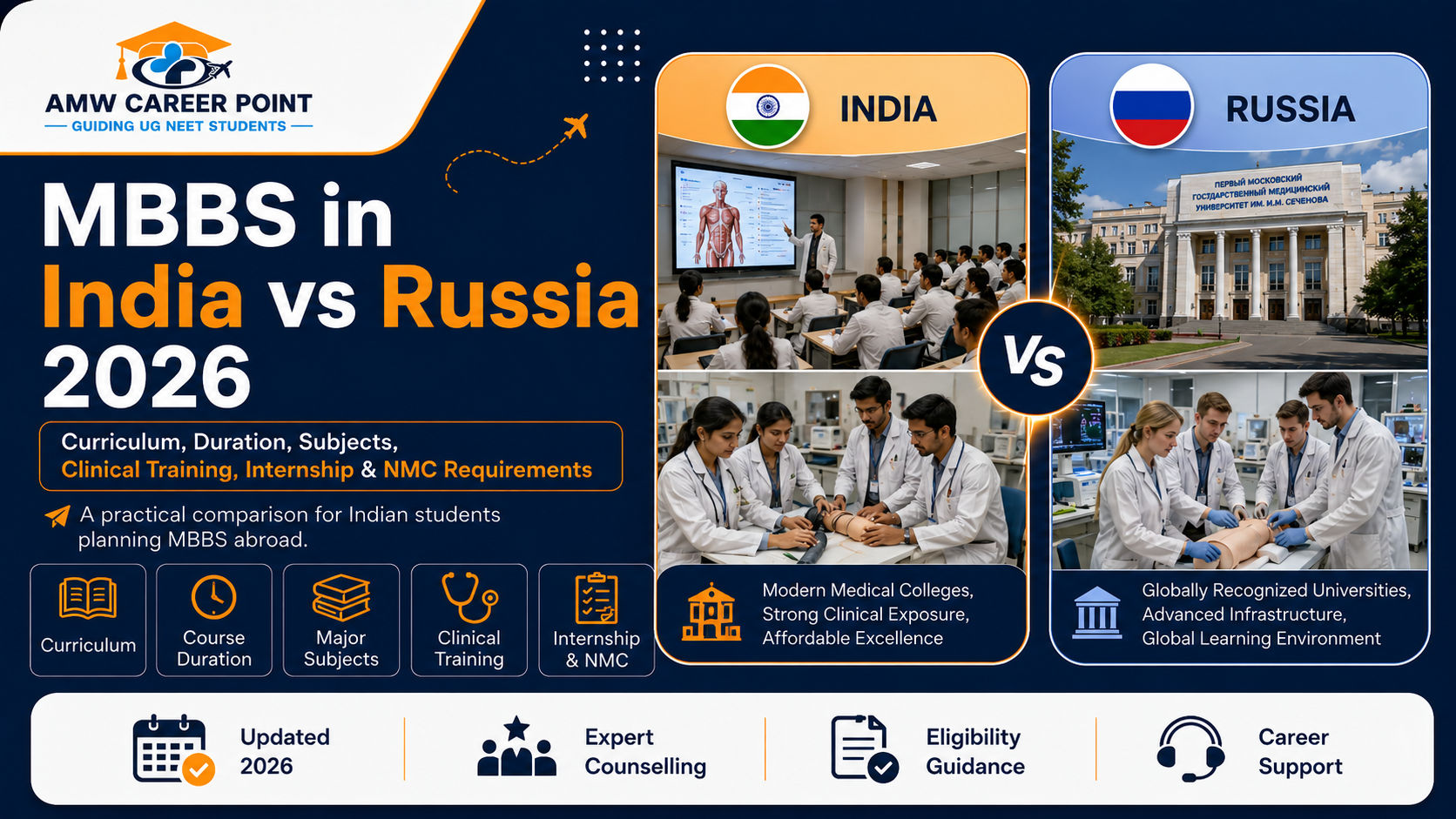
MBBS in India vs Russia: Quick Comparison
Parameter | ||
Medical qualification | MBBS (Bachelor of Medicine, Bachelor of Surgery) | Specialist Degree in ‘General Medicine’ (Лечебное дело) qualification title ‘Врач’/‘Physician’, treated as MBBS-equivalent |
Standard duration | 5.5 years (4.5 years academic + 1-year CRMI internship) | 6 years (5 years academic + 1-year internship), university-specific |
Academic structure | NMC CBME 2024 competency-based, four professional phases | Russian Federal State Educational Standard (FSES) specialist-level program, university-specific implementation |
Pre-clinical training | Anatomy, Physiology, Biochemistry, Foundation Course, early clinical exposure | Anatomy, Histology, Embryology, Cytology, Physiology, Biochemistry, Medical Biology, Medical Informatics, Latin, plus local language |
Para-clinical training | Pathology, Pharmacology, Microbiology, Forensic Medicine, Community Medicine | Pathology, Pathophysiology, Pharmacology, Microbiology, Hygiene, Immunology, Forensic Medicine, Public Health |
Clinical training | Structured clinical postings from Professional Phase II/III onward, standardized nationally under CBME. | From roughly Year 3 onward, university- and hospital-specific verification per institution |
Internship | 12-month CRMI, standardized under NMC regulation, completed in India | 12-month internship, completed at the same foreign institution per FMGL 2021 cannot be split with India |
Teaching language | English, uniformly | English at English-medium programs; university- and track-specific otherwise |
Local/clinical language | Not applicable in India | Russian is practically important during clinical years at most universities, regardless of academic medium (see our dedicated Russian Language Requirements guide) |
Practical/hospital exposure | Standardized across NMC-recognised colleges, logged via CBME competency framework. | Varies significantly by university's affiliated teaching hospitals — verify specifics, not assume from marketing |
Licensing pathway | None additional direct registration after CRMI | FMGE (or NExT, once implemented for FMGs) + CRMI required after returning to India |
NMC requirements for Indian students | Governed directly by CBME/GME Regulations | Governed by FMGL 2021 + CRMI 2021 — course duration, English medium, curriculum equivalence, and internship location all independently verified |
Post-graduation pathway in India | Direct eligibility for internship, then registration | FMGE/NExT clearance → provisional registration → CRMI in India → permanent registration |
Editorial Note Every Russia-side row above should be checked against each university's current documentation, not treated as a fixed, countrywide fact. We've flagged this explicitly wherever it matters most throughout this guide. | ||
What Is the Current MBBS Curriculum in India?
India's current MBBS curriculum is governed by the Competency-Based Medical Education (CBME) Curriculum, 2024, dated 12 September 2024, with an additional clarification issued on 10 October 2024, not the older, purely subject-and-years syllabus that many general-purpose MBBS articles still describe.
Competency-Based Medical Education
Rather than measuring progress purely by subjects passed, CBME defines specific competencies a student must demonstrate knowledge, skills, attitudes, and communication ability at each stage, tracked through structured assessment.
Foundation Course
A structured orientation period at the start of MBBS, covering communication skills, basic life support, and an introduction to the medical profession before core academic subjects begin in earnest.
Pre-Clinical, Para-Clinical, and Clinical Education
Pre-clinical: Anatomy, Physiology, Biochemistry
Para-clinical: Pathology, Pharmacology, Microbiology, Forensic Medicine, Community Medicine
Clinical: General Medicine, Surgery, Obstetrics & Gynecology, Pediatrics, Psychiatry, Orthopedics, Dermatology, Radiology, and other clinical specialties
Early Clinical Exposure (ECE)
A defining CBME feature: structured, supervised clinical exposure introduced from the first professional year, rather than clinical contact beginning only in later years as under the older curriculum.
AETCOM
Attitude, Ethics and Communication is a dedicated, longitudinal module running across all years, addressing a gap that earlier Indian curricula were criticized for.
Skills Training, Logbooks, and Electives
Structured skills training with competency checklists, mandatory logbook documentation of clinical exposure and procedures performed, and elective postings allowing some specialization exposure before graduation.
Internship
A 12-month Compulsory Rotating Medical Internship (CRMI) follows the academic phase, covering rotations across Community Medicine, General Medicine, Surgery, Pediatrics, Obstetrics & Gynecology, Orthopedics, ENT, Ophthalmology, Dermatology, Psychiatry, Anesthesia, Emergency, and laboratory services.
How Long Is MBBS in India Under the Current NMC Structure?
Academic MBBS Training
Approximately 4.5 years of academic instruction across the pre-clinical, para-clinical, and clinical phases.
Compulsory Rotating Medical Internship
A further 12 months of supervised, hands-on clinical internship mandatory before full registration, regardless of academic performance.
Total Pathway
4.5 years academic + 1 year of CRMI = 5.5 years total, the figure most commonly cited for Indian MBBS.
Why It's Commonly Described as ‘4.5 Years + 1 Year’
Because the academic and internship phases are regulated somewhat differently, the internship has its own dedicated CRMI Regulations, 2021, which make clear that the internship is a distinct, mandatory clinical-training phase, not an optional add-on.
Has NMC Changed the Basic Duration in 2026?
No Confirmed Change to the Core 5.5-Year Structure As of this guide's writing, we found no NMC notice changing the fundamental 4.5-year academic + 1-year CRMI structure for Indian MBBS. The 2026 developments covered in this guide concern foreign medical graduates and the FMGL/CRMI framework, specifically not a restructuring of the domestic Indian MBBS duration itself. |
India MBBS: Year-Wise Curriculum
First Professional Year
Anatomy, Physiology, Biochemistry
Foundation Course and early clinical exposure components
Practical/laboratory training integrated throughout
Second Professional Year
Pathology, Pharmacology, Microbiology
Forensic Medicine and relevant Community Medicine components
Continued practical and laboratory training
Third Professional Phase (Part I)
Community Medicine, ENT, Ophthalmology, Forensic Medicine
Increasing clinical integration alongside these subjects
Final Professional Phase
General Medicine, Surgery, Obstetrics & Gynecology, Pediatrics
Psychiatry, Orthopedics, Dermatology, Radiology, Emergency Medicine
Other applicable clinical competencies and electives
What Is the Russian Medical Curriculum?
An Important Distinction Most Blogs Skip Russian ‘General Medicine’ (Лечебное дело) is, in fact, a specialist-level higher education program, not simply an Indian MBBS syllabus translated into Russian terminology. Kirov State Medical University, for example, identifies its program by the Russian classification code 31.05.01 ‘General Medicine/Лечебное дело’, specialist-level, six years, awarding the qualification ‘Врач-лечебник’ (Physician) a distinct academic classification from a Bologna-style Bachelor's degree, though treated as MBBS-equivalent for Indian licensing purposes once FMGL requirements are met. |
Structure: a specialist program under Russia's Federal State Educational Standards (FSES), not a generic Bachelor's-then-Master's split
Duration: 6 years, standard across most Russian medical universities offering this qualification
Components: academic (theoretical) study combined with practical and clinical training, integrated progressively across the six years
Standardization: governed by federal educational standards, but implemented with real variation at the individual university level; exactly why this guide keeps returning to ‘verify per university’.
Why Is MBBS/General Medicine 6 Years in Russia?
The Russian Six-Year Structure
Kirov State Medical University's program, cited throughout this guide as a documented example, structures its six years as five years of academic and laboratory instruction followed by one year of compulsory internship in affiliated hospitals with a structure broadly consistent across most Russian medical universities. However, exact year-by-year subject allocation varies by institution.
Is the Sixth Year an Internship?
At most universities, yes: from the sixth year onward, the internship serves as a clinical internship year, distinct from the preceding five years of primarily academic study, though clinical exposure typically begins well before Year 6 (commonly from Year 3 onward).
Does Russia Use the Same MBBS + Internship Structure as India?
Structurally similar (academic years followed by an internship year), but not identical in regulatory framework, competency structure, or, critically for Indian students, where that internship is recognized for licensing purposes. India's CRMI and Russia's internship year are governed by entirely separate regulatory systems that intersect only through the specific requirements of FMGL 2021.
What Does ‘General Medicine’ Actually Mean?
The Russian degree title for what Indian students colloquially call ‘MBBS in Russia.’ It's the standard undergraduate/specialist medical qualification pathway in the Russian higher-education system, distinct in name and formal classification from India's MBBS, but generally treated as equivalent for NMC's foreign-graduate framework, provided the specific program meets FMGL 2021's requirements independently.
Why Students Shouldn't Compare 6 Years vs. 5.5 Years Superficially
The Comparison That Actually Matters The extra half-year doesn't tell you whether the clinical training is more rigorous, whether the curriculum is genuinely equivalent, or whether the specific university satisfies FMGL 2021. Duration is one input NMC checks (the 54-month minimum, covered in Section 14); it is not, by itself, a measure of educational quality or regulatory compliance. |
Russia MBBS Curriculum: Year-Wise Structure (Kirov State Medical University as a Documented Example)
Using Kirov's own published programme information as a concrete reference rather than a generic infographic its General Medicine programme includes anatomy, histology/embryology/cytology, biochemistry, physiology, microbiology, hygiene, immunology, pathology, pharmacology, surgery, internal medicine, paediatrics, obstetrics & gynaecology, psychiatry, neurology, ophthalmology, ENT, infectious diseases, epidemiology, anaesthesiology, and emergency/intensive care, among others.
Years | General Focus (Kirov-Reported Pattern) |
Years 1–2 | Basic medical sciences: Anatomy, Physiology, Biochemistry, Histology, Embryology, and foundational subjects including Russian language instruction |
Years 2–3 onward | Clinical exposure begins; students start attending clinical studies, including nursing care experience, around the second year at some universities. |
Years 3–4 | Para-clinical and early clinical subjects: Pathology, Pharmacology, Microbiology, alongside continuing clinical integration |
Years 5–6 | Advanced clinical training: Surgery, Internal Medicine, Obstetrics & Gynecology, Pediatrics, and other specialties, culminating in the internship year |
Map This to the Current, Official Study Plan: Not an Assumed Pattern The table above reflects a commonly reported pattern, cross-referenced across several sources that specifically describe Kirov. For the actual, current year-wise allocation at any university you're considering, request the official 2025–26/2026–27 study plan directly; don't assume any single infographic's year-by-year breakdown applies universally, even within Russia, let alone across every Russian medical university. | |
MBBS Subjects in India vs Russia
Subject | India |
Anatomy | Yes |
Physiology | Yes |
Biochemistry | Yes |
Histology / Embryology / Cytology | Integrated within Anatomy |
Pathology | Yes |
Pharmacology | Yes |
Microbiology | Yes |
Forensic Medicine | Yes |
Community Medicine / Public Health | Yes |
Hygiene | Integrated within Community Medicine |
Psychiatry | Yes |
Medicine, Surgery, Pediatrics, OBGYN, ENT, Ophthalmology, Neurology, Anaesthesiology, Emergency Medicine | Yes, across all |
Same Subject Names Don't Mean Identical Curriculum Similar subject titles across India and Russia do not automatically mean identical contact hours, competency requirements, assessment rigor, or clinical exposure. Treat this table as a starting reference for what's covered, not a claim of equivalent depth. | |
India vs Russia: Pre-Clinical Medical Education
India | Russia |
Anatomy | Anatomy |
Physiology | Histology, Embryology, Cytology |
Biochemistry | Physiology |
Early clinical exposure (from Year 1, under CBME) | Biochemistry |
Competency-based learning framework | Medical Biology, Medical Informatics, Latin, and (per Kirov's documented foreign-language program) Russian as a foreign language |
Kirov's own foreign-language General Medicine program materials explicitly list these foundational subjects, including Russian-language instruction, as part of the formal pre-clinical curriculum rather than an optional extra.
India vs Russia: Para-Clinical Education
Pathology and Pathophysiology: core subjects in both systems
Pharmacology: core subjects in both systems
Microbiology: core subjects in both systems
Hygiene: a distinct, separately taught subject in the Russian system; integrated within Community Medicine in India
Immunology: more explicitly separated as its own subject in several Russian curricula
Forensic Medicine and Public Health: covered in both, with structural differences in how they're sequenced
Transition to clinical medicine: occurs progressively in both systems, though the exact timing varies by university on the Russian side
India vs Russia: Clinical Medical Education
This is where curriculum comparisons matter most in practice, and where the least standardized information exists for Russia specifically.
Timing of clinical exposure: structured and standardized from Year 1 (Early Clinical Exposure) under India's CBME; typically begins around Year 2–3 in Russia, varying by university
Hospital postings, outpatient and inpatient exposure: standardized nationally in India through NMC-recognised teaching hospitals attached to each medical college; university-specific in Russia, depending on each institution's affiliated hospital network
Ward rounds, case-taking, physical examination: core components in both systems, though language of practice differs (English throughout in India; often Russian in practice, regardless of the academic medium, in Russia, as you can see in our dedicated Russian Language Requirements guide)
Procedures, and clinical exposure across Surgery, Medicine, Pediatrics, OBGYN, Psychiatry, and Emergency Medicine: covered in both systems' final years, with real variation in patient volume and hands-on responsibility by specific hospital, not just by country
Clinical Training in Russia: What Indian Students Actually Need to Check
This is where a genuinely useful comparison becomes a verification checklist rather than a marketing pitch.
Teaching hospital: does the university operate its own teaching hospital/clinic, or rely entirely on external affiliations?
Affiliated hospitals: how many, and what is their actual patient volume and specialty range?
Number/type of clinical bases: how many distinct clinical sites host rotations, and how are students distributed across them?
Clinical rotation schedule: request the actual, current rotation schedule, not a general description
Patient interaction: genuine hands-on interaction, or predominantly observation?
Clinical language: Russian, English, or a mix, and how this is actually handled in practice, not just on paper
Student participation: are international students integrated with local students in clinical settings, or kept separate?
Simulation training: what simulation-center facilities exist, and how much of ‘clinical training’ is simulation versus real patient contact?
Clinical logbooks: is structured, competency-tracked documentation actually maintained, comparable to India's CBME logbook system?
Final-year clinical practice: what does the internship year concretely involve, hospital by hospital?
The NMC 54-Month Rule for Foreign Medical Education
This section is non-negotiable in any serious India-vs-Russia comparison.
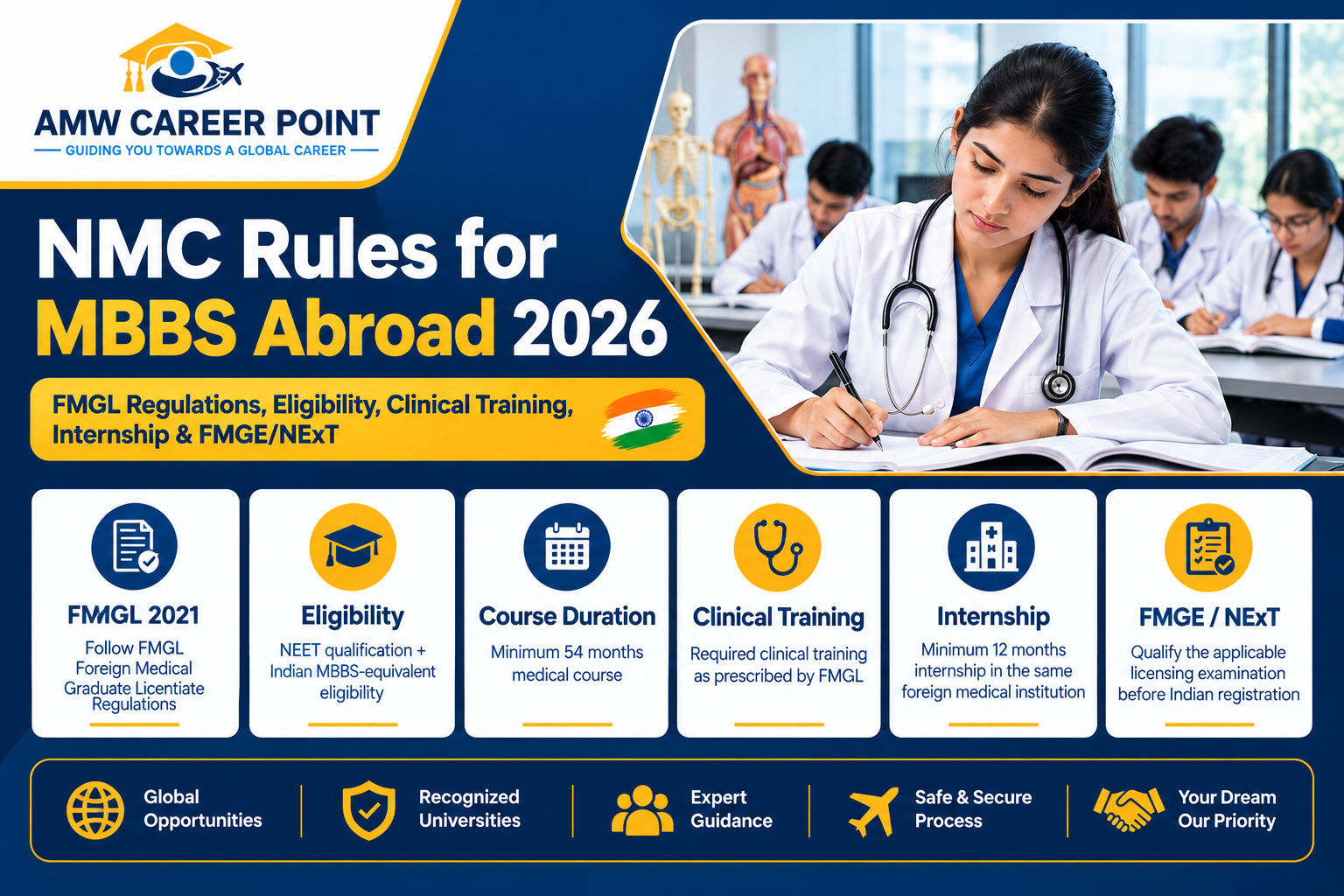
FMGL Regulation 4(a)(i) NMC's FMGL Regulations 2021 require a minimum course duration of 54 months (4.5 years) of theoretical, practical, and clinical training, excluding the internship, before a foreign medical qualification is considered for registration in India. |
What Does 54 Months Mean?
54 months of academic (non-internship) training at the same foreign institution. This is measured independently of the internship year, which is a separate, additional 12-month requirement.
Does a Six-Year Russian Program Satisfy the Duration Requirement?
On paper, yes, as a 6-year program with 5 years of academic study + 1 year of internship comfortably exceeds the 54-month academic minimum. But the satisfaction of duration alone does not mean every other FMGL requirement is automatically met.
Why Duration Alone Is Not Enough
The Rule Students Get Wrong Most Often If the theoretical and practical academic duration is less than 54 months, NMC will reject the degree outright, regardless of other factors. But satisfying the 54-month minimum is a floor, not a full compliance check. English-medium instruction, curriculum equivalence, internship location, and local registrability must all be independently verified. ‘Six years’ satisfying the duration rule is not the same as ‘this specific program is FMGL-compliant.’ |
What Else Must Be Checked?
Medium of instruction (English)
Curriculum commensurate with Indian MBBS (Section 16)
Clinical training and internship completed at the same institution (Section 15)
Registrability/licensing eligibility in the country of study before FMGE (Section 15)
NMC Foreign Medical Graduate Requirements for Students Going to Russia
FMGL 2021 describes a foreign medical qualification as one recognized for enrolment as a medical practitioner in the country where it is awarded, with a curriculum commensurate with India's MBBS. Applied specifically to Russia, this breaks down into:
FMGL Requirement | What It Means for a Russia-Bound Student |
NEET requirement | A qualifying NEET-UG score is mandatory before admission, for any Indian student intending India-return eligibility. |
Eligibility before admission | The NMC Eligibility Certificate process (see the 2 April 2026 notice referenced below) should be initiated before, not after, enrolling. |
Duration of foreign medical course | Minimum 54 months academic, excluding internship, see Section 14 |
English-medium requirement | The degree's medium of instruction must be English [Reg. 4(a)(iii)] university- and track-specific in Russia; verify directly; don't assume from a general ‘English-medium’ marketing claim |
Theoretical, practical, and clinical training | Must be equivalent to India's MBBS curriculum a genuine comparison requires the actual syllabus, not just subject titles (see Section 9's caution) |
Internship/clinical clerkship | 12 months, at the same foreign institution cannot be split, cannot be substituted with early India internship (see Section 34) |
Recognition in the country of study | The Russian institution and program must itself be properly recognized under Russian regulatory frameworks. |
Licensing/registration in the country of study | The student must be eligible for registration/licensing in Russia itself, at par with Russian citizens, before FMGE eligibility applies. |
NMC registration requirements (post-return) | FMGE (or NExT, once implemented) clearance, followed by CRMI in India, followed by permanent State Medical Council registration |
NMC Curriculum Equivalence: What Does ‘Commensurate with MBBS’ Mean?
This is one of the most misunderstood phrases in the entire FMGL framework, and one worth explaining precisely rather than glossing over.
Curriculum availability: the foreign institution must have an actual, documented curriculum comparable in scope to Indian MBBS, not simply a list of similar-sounding subject titles
Syllabus at the time of joining: what matters is the syllabus in effect when a student actually enrolls, not a historical or aspirational version
Following the curriculum throughout the course: consistency matters; a program that changes structure mid-way, or that a student doesn't actually follow in full (e.g., through excessive online substitution see Section 18), creates compliance risk
Theoretical, practical, and clinical training components: all three must genuinely be present and documented, not just theoretical instruction with limited hands-on exposure
Internship: completed at the same institution, per FMGL's specific requirement
Licensing: registrability in the country of study, independent of the curriculum question itself
Why We Won't Write ‘Russia Is NMC Approved’ NMC recognition is not a blanket, country-level approval of every university and course. NMC no longer publishes a static ‘approved list’ of foreign universities at all; it publishes rules (FMGL 2021), and places the responsibility of verifying compliance, university by university and cycle by cycle, on the student and their counselor. ‘Russia is NMC approved’ is a claim we will not make anywhere in this guide, because it isn't how the current framework actually works. |
Does a 6-Year Russian Medical Course Meet NMC Requirements?
Probably the most valuable table in this guide is a requirement-by-requirement verification framework, rather than a yes/no answer that would be dishonest to give at the country level.
NMC Requirement | What a 6-Year Russian Program Typically Offers | What the Student Must Personally Verify |
Minimum duration (54 months academic) | Comfortably exceeded by most 6-year programs (5 years academic + 1 year internship) | Confirm the actual academic-only duration excludes the internship year in the university's own documentation. |
English medium | Present at English-medium tracks; not universal across all Russian medical universities or all programs at a given university | Get written confirmation of the medium of instruction for the exact program, not the university's brand as a whole. |
Curriculum commensurate with MBBS | Broadly comparable subject coverage, per Section 9's comparison | Request the actual current syllabus document, not a summary |
Clinical training | Present, quality, and hospital access vary meaningfully by university | Verify affiliated hospitals, rotation schedule, and patient-contact structure directly (Section 13's checklist) |
Practical training | Present across pre-clinical and clinical years. | Confirm laboratory and simulation-center access, not just lecture-based theory. |
Internship | 12 months, typically Year 6 | Confirm it is completed entirely at the same institution, not split, not substituted (Section 34) |
Local recognition | Present for properly accredited Russian state medical universities | Confirm the specific university's current Russian accreditation status directly |
Licensing eligibility (in Russia) | Available to graduates who complete the full program | Confirm registrability in Russia is genuinely available to the specific graduate, not assumed |
Indian registration pathway | Not automatic; requires FMGE/NExT + CRMI after return | Understand this is an additional, multi-step process, not a formality (Section 15, Section 24 onward) |
Important 2026 NMC Update: Online Medical Education & Physical Compensation
This section belongs at the center of this guide, not buried at the end, as the March 2026 developments materially affect how any Indian student evaluating a foreign medical program, including in Russia, should approach exposure to online education.
Many Indian students studying in Russia experienced disrupted, partly online education during COVID-19 and, separately, some students in the wider region were affected by conflict-related disruption. NMC's position, reiterated and tightened through 2026, is unambiguous: online classes cannot simply replace required physical, hands-on medical training.
The March 5 and 18, 2026 Notices Issued by NMC's Undergraduate Medical Education Board (UGMEB), these notices clarify that any online component of a foreign medical course must be compensated by physical, on-site training at the same foreign institution, covering both theoretical and clinical/practical components. Students admitted on or before 18 November 2021 (the date FMGL 2021 was notified) who have compensated their online classes with physical on-site training, completed one year of internship at their foreign institution, and passed an MBBS-equivalent exam are considered under the older Screening Test Regulations. Students admitted after 18 November 2021 are governed by FMGL 2021 and the CRMI Regulations 2021, and are required to complete the full one-year mandatory internship in India, in addition to any foreign internship they have completed. Verification is not a formality: State Medical Councils are required to corroborate claims of compensatory training against visa-stamping and passport entry/exit records; a compensation certificate alone, without genuine, documented physical presence, will not be accepted. The commission has been explicit that certificates obtained without a real extension of physical study time constitute a regulatory violation. |
2026 NMC Update: Physical Training Compensation for Russia/Ukraine-Affected Students
A June 2026 NMC FAQ clarifies that the March notices primarily concern implementation of earlier rules on verifying and recognizing compensatory physical training for students affected by COVID-19 or the Russia-Ukraine conflict, as they do not create a new relaxation or a new eligibility category.
Who is affected: students whose foreign medical education included a genuine online-instruction period due to COVID-19 or regional conflict disruption
What counts as compensatory training: documented, verifiable physical onsite theory and clinical training at the same institution, not a certificate alone
Physical vs. online training: only physical, onsite training satisfies the requirement; online supplementation, however extensive, does not
University documentation: must specifically and credibly demonstrate the compensatory training actually occurred
Final examination and internship timing: must reflect the genuine, compensated academic timeline and not be artificially compressed
Verification by NMC: cross-checked against visa and passport records, not accepted on the university's certificate alone
Why New Students Should Take This Seriously Now This isn't only a legacy COVID/war-era issue. Any new student whose program relies on significant online instruction for any reason is taking on real, avoidable regulatory risk under the current framework. Retain all travel, visa, and attendance documentation from day one; don't assume a university's compensation certificate alone will be accepted years later. |
2026 NMC CRMI Requirement for Foreign Medical Graduates
The Compulsory Rotating Medical Internship (CRMI) Regulations, 2021 govern the mandatory India-side internship for foreign medical graduates seeking permanent registration.
Who needs it: FMGs covered under FMGL 2021 generally; students admitted after 18 November 2021 are required to undergo internship at par with Indian medical graduates
Duration: 12 months, following NMC's 2024 clarification reducing what had briefly been a proposed 2–3 year internship period back to the original 1-year standard for students who genuinely compensated online classes and passed an MBBS-equivalent exam
Timing: must be completed within 2 years of qualifying FMGE
Where it can be completed: only at NMC-recognised medical colleges as of the March 2026 notice, which specifically addressed CRMI seat allocation for FMGs, and an earlier clarification confirmed standalone PG institutes and non-teaching hospitals are not entitled to conduct FMG internships
Seat allocation: per NMC's framework, a defined share of seats in old medical colleges and effectively all seats in certain newer colleges (without their own CRMI-eligible students) are made available to FMGs
Rotation coverage: Community Medicine, General Medicine, General Surgery, Pediatrics, Obstetrics & Gynecology, Orthopedics, ENT, Ophthalmology, Dermatology, Psychiatry, Anesthesia, Emergency Services, and laboratory services
Is NExT Operational for Foreign Medical Graduates in 2026?
No, FMGE Remains the Operative Screening Test The National Exit Test (NExT), created under the NExT Regulations 2023 as a unified licensing framework for Indian and foreign medical graduates, had its rollout deferred as of 13 July 2023 and has not been implemented with a confirmed schedule for FMGs as of 2026. FMGE remains the operative screening test. FMGE June 2026 was scheduled for 28 June 2026, with applications opening 21 April 2026. Do not defer FMGE preparation on the assumption NExT will replace it imminently. |
The Realistic Full Pathway: Russia MBBS to Practicing in India
Complete the 54-month academic course + 12-month internship at the same foreign institution (FMGL Reg. 4(a)(i))
Obtain registration with Russia's own medical regulatory body, at par with the license given to Russian citizens, which is a mandatory eligibility condition for FMGE (FMGL Reg. 4(b))
Clear FMGE (or NExT, once and if implemented for FMGs) conducted by NBEMS
Apply for provisional registration with the relevant State Medical Council through NMC
Complete the 12-month CRMI at an NMC-recognised Indian hospital, within 2 years of qualifying FMGE
Apply for permanent registration with the State Medical Council
The Realistic Minimum Timeline From Class 12 to independent medical practice in India: 54 months of academic study + 12 months foreign internship + FMGE preparation and clearing (commonly 6–18 months) + 12 months CRMI with a realistic minimum of roughly 8 years. Students who don't clear FMGE on the first attempt add further time; the total combined duration (course plus all training) is also required to be completed within 10 years under FMGL 2021. |
How to Verify a Russian Medical University Before Admission
A working checklist treats every unchecked item as a question to put directly to the university's international admissions office, in writing, before paying anything.
University recognition in Russia
Degree awarded and its exact formal title/classification
Six-year curriculum, confirmed against current documentation
The current curriculum document itself, not a marketing summary
Genuinely English-medium program, confirmed for the exact track
Clinical training structure and affiliated hospitals
Hospital affiliations, patient volume, and rotation specifics
Internship/practical structure, confirmed as single-institution
Russian-language training provision (see our dedicated Russian Language Requirements guide)
Licensing eligibility in Russia itself
NMC/FMGL compliance, verified independently, not taken on the university's or an agent's word
NEET requirement and NMC Eligibility Certificate process
Current fees, in writing
Hostel arrangements
Insurance requirements
Visa process and requirements
Refund policy
Official, university-published admission rules, not an agent's paraphrase
Red Flags Indian Students Must Avoid
Seven Claims Worth Interrogating, Not Accepting ‘NMC approved university’ ask: approved under what framework, exactly? NMC no longer issues blanket university approvals. ‘FMGE guaranteed’: No legitimate university can guarantee an individual's licensing exam outcome. ‘No Russian required’: Investigate the actual clinical environment before accepting this at face value (see our Russian Language Requirements guide). ‘Six years includes everything’: Ask exactly what ‘everything’ covers, and get it in writing. ‘No internship required’: Ask which country's registration rules are being discussed; India's are not optional. ‘100% clinical exposure’: Ask for the official clinical rotation schedule, not a marketing claim. ‘Same curriculum as India’: Ask for the actual curriculum document and compare it yourself. |
Final India vs Russia MBBS Comparison Table
Factor | India | Russia |
Degree/qualification | MBBS | Specialist Degree, General Medicine (‘Врач’/Physician) — MBBS-equivalent |
Duration | 5.5 years (4.5 academic + 1 CRMI) | 6 years (5 academic + 1 internship), university-specific |
Curriculum framework | NMC CBME 2024 | Russian Federal State Educational Standards (FSES), university-implemented |
Pre-clinical | Anatomy, Physiology, Biochemistry + Early Clinical Exposure | Anatomy, Histology, Embryology, Cytology, Physiology, Biochemistry, Medical Informatics, Latin |
Para-clinical | Pathology, Pharmacology, Microbiology, Forensic Medicine, Community Medicine | Pathology, Pathophysiology, Pharmacology, Microbiology, Hygiene, Immunology, Forensic Medicine |
Clinical | Standardized nationally under CBME, from Year 1 (ECE) onward | University- and hospital-specific, typically from Year 2–3 onward |
Practical training | Structured, competency-logged | Present, quality varies by university's clinical bases |
Clinical language | English throughout | Russian practically important even at English-medium programs (see dedicated guide) |
Internship | 12-month CRMI in India | 12 months at the same foreign institution, per FMGL 2021 |
Licensing | None additional | Registration in Russia → FMGE/NExT → CRMI in India |
Indian FMG requirements | N/A | FMGL 2021 + CRMI 2021, verified per university |
FMGE/NExT | N/A | FMGE operative; NExT not yet implemented for FMGs as of 2026 |
CRMI | Standard part of Indian MBBS pathway | Additional requirement after FMGE, for most current students |
Cost (6-year, all-in) | ₹70 lakh – ₹1.5 crore+ (private) | Roughly ₹20–40 lakh, university-dependent |
Best for | Students with a competitive NEET rank for a preferred seat | Budget-conscious students prepared for the additional licensing pathway and language reality |
Final Verdict: MBBS in India vs Russia Which Should You Choose?
Choose India If...
You have a NEET rank competitive enough for a government seat, or a private seat your family can genuinely afford without financial strain
You want the most direct, single-country licensing pathway with no additional foreign screening exam
You'd rather avoid navigating a second regulatory system (FMGL/CRMI) on top of NMC's own domestic framework
Consider Russia If...
Your NEET rank doesn't secure a suitable Indian seat, and private MBBS in India is financially out of reach
You're prepared to independently verify a specific university against FMGL 2021, not rely on marketing claims
You're realistic about the Russian-language reality of clinical years, even at English-medium programs
You're financially and mentally prepared for the FMGE/NExT + CRMI pathway on return — roughly 2+ additional years beyond the degree itself
Consider Another MBBS-Abroad Destination If...
A specific concern raised in this guide language, a particular university's compliance status, or clinical-training transparency which makes another destination a clearer fit for your specific priorities
See our other country-specific guides (Uzbekistan, Georgia, Kyrgyzstan, Kazakhstan, Italy) for destination-specific comparisons built on the same verification standard as this one
Decision Matrix
Weigh these together, not any single one in isolation: NEET rank + budget + language comfort + specific university's verified compliance + clinical training quality + realistic licensing timeline + long-term career goal. No single factor should override the others, and no country label should substitute for university-specific verification.
Who Should Choose MBBS in Russia?
Suitable For
Students who don't secure a suitable Indian seat
Students with a realistic, honestly budgeted financial plan
Students willing to genuinely learn Russian, not just tolerate the idea of it
Students comfortable with sustained life abroad, away from family support networks
Students mentally and financially prepared for FMGE/NExT and CRMI as real, additional requirements
Think Twice If
You expect zero language barrier because a program is marketed as ‘English medium’
You assume ‘English medium’ means English-only clinical life throughout all six years
You're choosing solely based on the lowest advertised fee
You haven't personally checked the university's actual curriculum document
You don't yet understand the FMGE/NExT + CRMI licensing requirements in concrete terms.
Conclusion
Comparing MBBS in India vs Russia by duration alone, with 5.5 years against 6, answers almost none of the questions that actually determine whether a specific program is right for a specific student. The real comparison runs through curriculum depth, clinical training quality, the genuine language reality of the clinical years, and a precise, per-university check against NMC's FMGL 2021 and CRMI 2021 frameworks, which were meaningfully clarified and tightened through NMC's own notices across March, April, and June 2026.
If you're weighing a specific Russian university against a specific Indian option and want a second, independent check on curriculum equivalence, clinical training, or FMGL compliance before deciding, that's exactly the kind of verification AMW Career Point builds into every counseling conversation on a zero-commission basis, since 2009.
Frequently Asked Questions
Is Russian MBBS equivalent to Indian MBBS?
Generally treated as equivalent for NMC's foreign-graduate framework, provided the specific program satisfies FMGL 2021's requirements; this is a per-university determination, not an automatic country-level equivalence.
What is the MBBS curriculum in Russia?
A specialist ‘General Medicine’ (Лечебное дело) program covering pre-clinical, para-clinical, and clinical subjects across six years.
What are the MBBS subjects in Russia?
Broadly similar core subjects to India (Anatomy, Physiology, Biochemistry, Pathology, Pharmacology, Microbiology, and clinical specialties), plus some subjects taught as separate disciplines in Russia (Histology, Embryology, Hygiene, Medical Informatics) that are integrated differently within India's curriculum.
Does NMC recognize the Russian MBBS curriculum?
Not as a blanket, country-wide recognition; NMC evaluates FMGL 2021 compliance per university and program, not per country.
What is the NMC 54-month rule?
A minimum 54-month (4.5-year) academic training requirement, excluding internship, under FMGL Regulation 4(a)(i).
Does a six-year Russian medical degree meet NMC requirements?
It meets the duration requirement comfortably, but duration alone doesn't guarantee full FMGL compliance; English-medium, curriculum equivalence, internship structure, and local registrability must all be independently verified.
Is clinical exposure better in Russia or India?
We won't make a blanket claim either way; India's CBME framework standardizes clinical exposure nationally; Russia's varies meaningfully by university and its specific hospital affiliations. Compare the specific institutions being considered, not the countries as a whole.
Does MBBS in Russia include an internship?
Yes, with a 12-month internship, typically completed in the final year, at the same institution, per the requirement in FMGL 2021.
Do Russian medical graduates need CRMI in India?
Yes, generally, for students admitted after 18 November 2021, a further 12-month Compulsory Rotating Medical Internship in India is required, after clearing FMGE.
What is FMGE for Russian medical graduates?
The Foreign Medical Graduate Examination is the current mandatory screening test Russian (and other foreign) medical graduates must clear before Indian registration.
Will NExT replace FMGE?
Eventually, as intended under the NExT Regulations 2023, but its rollout has been deferred since 13 July 2023 and remains unimplemented for foreign medical graduates as of 2026.
What is the NMC FMGL 2021 regulation?
The core regulatory framework governing foreign medical graduates' eligibility for Indian registration — covering course duration, medium of instruction, curriculum equivalence, internship, and local licensing requirements.
What changed for FMGs in 2026?
Primarily, tightened and clarified enforcement of physical-training compensation rules for any online-education component (March 2026 notices), an April 2026 clarification on the NMC Eligibility Certificate process, and a March 2026 notice on CRMI seat allocation.
What is NMC's 2026 rule on online medical education?
That any online component of a foreign medical course must be compensated through genuine, verifiable physical onsite training at the same institution; certificates alone, without documented physical presence (cross-checked via visa/passport records), are not accepted.
Can I pursue a PG in India after an MBBS in Russia?
Only after completing the full FMGE/NExT and CRMI pathway and obtaining permanent registration. PG eligibility follows the same competitive NEET-PG process as for Indian graduates once registered.
How much does MBBS in Russia cost?
Roughly ₹20–40 lakh all-in over six years at most public universities, depending significantly on the specific institution and city; see our dedicated Russia-specific cost guides for university-by-university figures.