
Q1. Can I apply to ASMPH straight after Class 12?
+No. ASMPH requires a completed Bachelor's degree in any subject first. There is no direct 12th-to-medicine entry here, unlike Romania or Georgia.

 Philippines | Est. 1859
Philippines | Approved by the Philippines' Commission on Higher Education (CHED); listed with WHO and WDOMS | English, full stop; no Filipino or local language test stands between you and a seat medium
Expert will call you within 2 hours
ASMPH is located within Ateneo de Manila, one of the oldest schools in the Philippines. Jesuit priests opened it back in 1859, first as a small city school in Manila. By 1959, its centennial year, it had grown into a full university. In fact, Jose Rizal, the man Filipinos now call their national hero, studied here as a boy. So, this is not a random new college chasing international students. It is a 165-year-old name with real weight behind it.
Now, the medical school itself is much younger. ASMPH opened its doors in 2007, inside the Don Eugenio Lopez Sr. Medical Complex in Pasig City. Its partner hospital, The Medical City, sits right next door. So, from day one, students train beside a live, working hospital, not a distant campus clinic.
Here is the part that almost no blog explains clearly. ASMPH is not a direct 12th-to-medicine program. You cannot apply here right after school, the way you can in Romania or Georgia. Instead, you first need a completed Bachelor's degree in any subject. Then you take the NMAT, the National Medical Admission Test in the Philippines. ASMPH prefers a score in the 90th percentile or higher. Also, and this catches most applicants off guard, ASMPH does not offer a plain MD. It runs a joint MD-MBA program. You earn both degrees together, over five years, and you cannot opt out of the MBA half.
So how does this compare with the usual Indian path abroad? In Russia or Georgia, a student finishes Class 12, then walks straight into a six-year MBBS. At ASMPH, you first need three to four years for a Bachelor's degree, then five more years for the MD-MBA. That's eight to nine years in total, similar in length to the Oulu route in Finland, though far more achievable, since English is the full medium of instruction here and no second language stands in the way.
Also worth a direct correction: several ranking pages claim that Philippine MBBS fees run far below those at Indian private colleges, and that Indian mess food is common on every campus. Neither claim holds up specifically for ASMPH. Current tuition is close to PHP 190,000 per semester, which comes to roughly INR 28-30 lakhs over the full five years, including books, housing, and daily costs. That is genuinely on the higher end among Philippine medical schools, not the budget option some blogs suggest. And Pasig City, where ASMPH sits, does not have the dense Indian food scene that cities like Manila's Malate or Quezon City offer, so students should plan for that rather than expect it on arrival.
None of this makes ASMPH a poor choice. Quite the opposite, if the fit is right. Its Jesuit roots bring a strong ethical grounding. Its MD-MBA design is genuinely rare in Asia, built for students who want to lead hospitals and health systems, not just treat patients one at a time. It runs real research in partnership with Harvard's School of Public Health, the University of Melbourne, and the World Health Organisation. And because English is the medium of teaching, no language barrier stands between admission and graduation.
So, who does ASMPH actually suit? Students who already hold, or are close to finishing, a Bachelor's degree. Also, applicants are strong enough to score in the high percentile range on the NMAT. And anyone who wants a management edge alongside a medical degree, not just a clinical one. Plus, families who can plan for a higher fee bracket than the usual budget MBBS-abroad options. For a student straight out of Class 12 hoping for a quick, low-cost medical seat, this is not that path. But for the right profile, it is a genuinely strong one, just a longer and costlier road than most blogs let on.
Quick Overview
Parameter | Details |
Parent University Founded | 1859, One of the Oldest Universities in the Philippines |
Medical School Founded | 2007, Ateneo School of Medicine and Public Health (ASMPH) |
Location | Pasig City, Metro Manila, Philippines |
University Type | Private, Jesuit (Catholic), Non-Profit Research University |
Teaching Hospital | The Medical City, a major private tertiary hospital, is next door to the campus. |
Degree Offered | Joint MD-MBA (Doctor of Medicine and Master of Business Administration) |
Course Length | 5 Years (Includes Internship); Entry Needs a Prior Bachelor's Degree |
Medium of Teaching | Fully in English, No Second Language Needed |
Fee Structure (2026–27, Estimated)
Fee Head | Per Year (Approx.) | Notes |
Tuition and Fees | PHP 340,000–380,000 (INR 5.2–5.8 Lakhs) | Covers tuition, labs, and basic school fees; rises about 5% each year |
Books and Study Material | PHP 20,000–30,000 (INR 30,000–45,000) | Not part of the tuition; some texts are optional if the library carries them |
Housing | PHP 120,000–180,000 (INR 1.8–2.7 Lakhs) | Pasig City housing near campus; shared flats cost less than solo units |
Food and Daily Costs | PHP 180,000–240,000 (INR 2.7–3.6 Lakhs) | Metro Manila runs higher than smaller Philippine cities |
Health Cover and Extras | PHP 20,000–30,000 (INR 30,000–45,000) | Basic insurance, uniforms, and clinical gear |
Total (5-Year MD-MBA, All Costs) | — | Roughly INR 28–32 Lakhs in full, among the higher-cost Philippine medical schools |
Why Most “ASMPH MBBS” Blogs Get This Wrong
Most online pages treat ASMPH as just another budget MBBS-abroad option. It isn't. So here is what the existing content leaves out, and why it matters.
First, almost no blogs state clearly that you need a Bachelor's degree before you can even apply. This is the single biggest gap in most write-ups. A student fresh out of Class 12, reading these pages, might think ASMPH works the same way as Georgia or Russia. It does not. You need three or four more years of undergraduate study first.
Second, the MD-MBA structure barely gets a mention. Many pages describe ASMPH as a purely medical degree, when in truth, you cannot separate the MD from the MBA here. Management subjects run through all five years, and dropping the MBA half is not allowed. That's a major commitment most applicants don't see coming until deep into their research.
Third, the cost claims are often just wrong. Several sites repeat the blanket claim that MBBS costs in the Philippines are far cheaper than at private colleges in India. That may hold for some schools in the country. It does not hold for ASMPH, where fees rank among the highest in the Philippines once housing and Metro Manila living costs are factored in.
Fourth, the Indian food claim gets repeated everywhere without any real check. Pasig City, where ASMPH sits, is not the same as Manila's traditional Indian food areas. Students should plan their meals around what's actually near campus, not around a generic promise copied from another country's page.
Finally, what almost nobody covers is what actually makes ASMPH worth a serious look: its research links with Harvard's School of Public Health, its exchange ties with the University of Melbourne, and its project work with the World Health Organisation. For a student aiming at hospital leadership or global health work, not just clinical practice, these links matter more than any fee comparison, and they're missing from nearly every ranking page out there.
No hidden charges, no donation. The full picture of costs at MBBS in Ateneo School of Medicine and Public Health.
Tuition Fee
PHP 340,000–380,000 (roughly INR 5.2–5.8 lakhs), among the higher end for Philippine medical schools
PHP 340,000 to 380,000 a year, going up close to 5% annually
Hostel Fee
PHP 10,000–15,000 a month for shared flats near the Pasig City campus
PHP 10,000 to 15,000 a month near campus in Pasig City
Food & Meals
PHP 15,000 to 20,000 across Metro Manila
per month
Insurance
PHP 20,000 to 30,000 cover, uniforms, and clinical supplies
per year
Donation
No Donation
No Capitation Fees
Total Estimated Cost
About INR 28 to 32 lakhs — Full 5-year MD-MBA, plus 3 to 4 years of prior Bachelor's study
Contact us
25–35%
Average FMGE first-attempt pass rates for students from many overseas medical universities. Students from structured programs consistently score higher.
Students returning to India need to clear the FMGE/NExT exam. MBBS in Ateneo School of Medicine and Public Health integrates exam-oriented coaching into the regular curriculum so students are prepared from day one.
A structured program that takes you from foundational sciences to clinical mastery.
• Foundational management and health-systems courses run alongside the science load from day one
• Anatomy, physiology, biochemistry, and cell biology form the core of your first year
• Business and organisational courses continue, building toward your later MBA coursework
• Pathology, pharmacology, and microbiology take over as the main science subjects
• Applied management modules now tie directly to real hospital operations and case studies
• Supervised clinical rotations begin at The Medical City, your partner teaching hospital
• The final block of MBA coursework wraps up during this same clinical year
• Full rotations run across internal medicine, surgery, paediatrics, and OB-GYN
• An MBA capstone project runs in parallel, usually built around a real health-system or public-health problem
• A full clinical internship takes up most of this last year, across multiple hospital departments
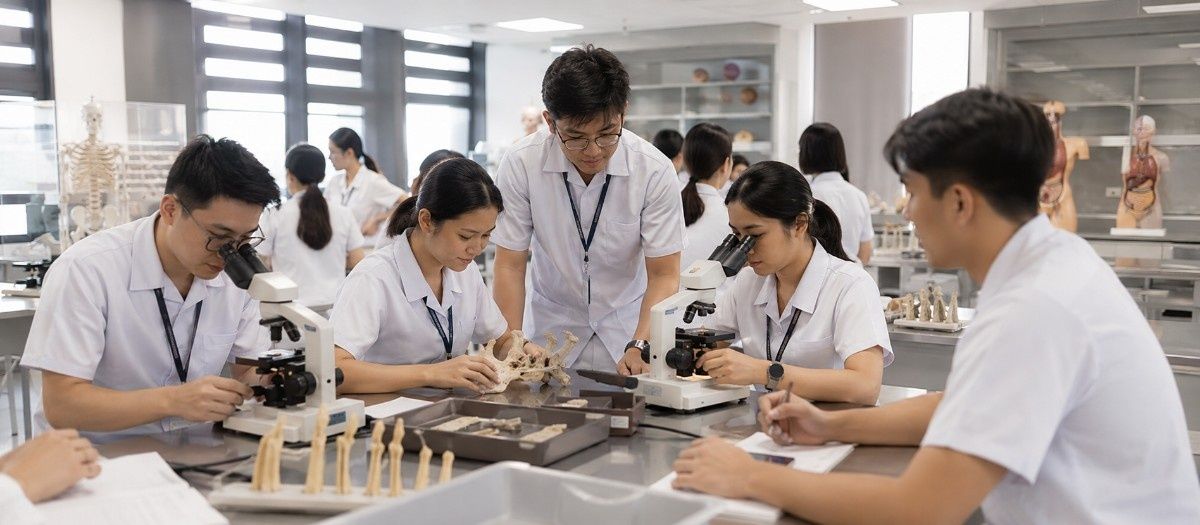

Furnished hostel rooms with Wi-Fi, laundry, 24/7 security, and Indian mess on or near campus.
Indian restaurants and mess facilities serving vegetarian and non-vegetarian home-style food daily.
Strong Indian community with cultural events, festival celebrations, and peer support groups.
Students get hands-on clinical training in government and private hospitals affiliated with the university.
Practical information for students planning to study at MBBS in Ateneo School of Medicine and Public Health.
Prepare for all seasons. Thermal wear for winters, light clothing for summers. University provides heating in hostels.
Student visa processed with university invitation letter. Direct and connecting flights from major Indian cities.
Health insurance included in fees. Medical facility on campus plus city hospitals easily accessible.
Local SIM cards available. WhatsApp and video calls keep you connected with family back home.
Average monthly expenses of $150–$250 covering food, transport, and personal needs.
University library, online databases, and study groups. Seniors mentor juniors through academic challenges.
Our team guides you through every step — from application to arriving on campus.
The first step is to have a free phone counselling session. This is not a sales promotion or sales pitch. Here, we analyse all the universities mentioned side by side. We go through FMGE rates, total fees, city life, and whether the USMLE or NExT path better suits your goals. Most students walk out of this call with a clear first choice and a backup.
Once you pick a university, we will hand you a Philippines-specific document checklist. It is not a generic list. Every item on it is there for a reason, either for the university application, the 9(f) visa conversion, or the ACR I-Card registration. We check everything before a single paper goes anywhere.
Your application goes directly to the university through our partner channel. Most students get an acceptance letter within 10 to 21 days. However, December intake applications move faster than June ones, so timing matters. We follow up on all applications and will be in touch if there is any delay.
Once you receive your offer letter, we will have an in-depth discussion with you on the fees charged. The first instalment of fees will be deposited without any ambiguity. What you pay, when you pay, and what it covers, all of it is clear before any money moves.
Indian students do not need a pre-departure visa for the Philippines. You enter visa-free for 30 days. However, the 9(f) Student Visa conversion must start within the first week of arrival; it is time-sensitive. We also advise on the best flight route, whether Cebu or Manila, depending on your university.
About a week before you fly, we do a full pre-departure briefing. We cover accommodation options, campus location, Indian food sources near your university, how to transfer money from India, which SIM card to buy, and what the first week on campus actually looks like—students who attend this briefing land in the Philippines significantly less stressed than those who skip it.
On arrival day, our local team in the Philippines meets you at the airport, whether in Cebu or Manila. You are not landing in a new country alone. Someone who knows the ground is there from the first minute.
Within the first week, the 9(f) visa conversion process starts. Our team submits your documents to the Bureau of Immigration and closely tracks your application. The ACR I-Card, your official alien registration card, is processed at the same time. This step is strictly managed because delays here cause real problems later.
By the end of Week 2, your university enrollment is complete, your hostel room is confirmed, and your BS pre-medical orientation is done. You know your timetable, your faculty, and where everything is. Furthermore, our team has already flagged your NMAT preparation schedule, so there will be no surprises at the bridge stage.
After enrollment, our on-the-ground team in the Philippines stays in contact throughout all six years. If there is a university issue, a hostel problem, a visa renewal, or a health concern, there is a local contact to call. Moreover, from Year 3 onward, our FMGE and USMLE coaching track begins, because academic support does not stop at the airport.
Admission Helpline — Contact our counsellors for step-by-step assistance.
“The faculty here is incredibly supportive. The clinical training during hospital rotations has given me real confidence in patient care.”
“Affordable fees without compromising on quality. The campus facilities and hostel life made my transition abroad very smooth.”
“English medium instruction and WHO-recognized curriculum were the deciding factors for me. No regrets so far — excellent experience overall.”
“The university helped with everything from visa to accommodation. Hospital exposure from year three has been invaluable for my FMGE prep.”
“Just cleared my licensing exam on the first attempt. The structured coaching and mock exams during final year were a game-changer.”
“Safe campus, good food options, and a strong Indian student community. The teaching methodology is very practical and hands-on.”
No. ASMPH requires a completed Bachelor's degree in any subject first. There is no direct 12th-to-medicine entry here, unlike Romania or Georgia.
No, it's a joint MD-MBA. You earn both degrees over five years, and you cannot drop the MBA halfway to study medicine only.
Not really. Its fees are among the higher end for Philippine medical schools, at around PHP 190,000 per semester before housing and living costs.
There is none to support this regarding ASMPH. Pasig City does not have the clustering of Indian restaurants you see in some parts of Manila.
ASMPH prefers scores at the 90th percentile or higher, taken within the last two years. It's a competitive cutoff, not a formality.
Plan for eight to nine years in total: three to four years for your Bachelor's degree, then five more years for the MD-MBA, including internship.
Yes, on the same terms as any other foreign MD earned after a Bachelor's degree, once you clear India's FMGE or NExT screening test. Confirm current NMC rules before you commit.
Its built-in MBA, its Jesuit ethics grounding, and its research ties with Harvard, Melbourne, and the WHO set it apart from a standard clinical-only MD.
No, not strictly. ASMPH welcomes graduates from biology, engineering, economics, and other fields, though science coursework does help your application.
Bachelor's degree holders with a strong NMAT score, a genuine interest in health-system leadership, and a budget for one of the pricier Philippine medical schools.
Our expert counsellors will guide you through the complete admission process — from documents to airport pickup.