
Q1. When was Medizinische Hochschule Hannover founded?
+It was founded in 1965 as Germany's first fully independent medical university.
 Germany | Est. 1963
Germany | A public, state-funded institution under Lower Saxony state law. Graduates who pass the Staatsexamen and complete registration requirements receive the Approbation, Germany's licence to practise medicine. | German runs through nearly all of the Humanmedizin course medium
Expert will call you within 2 hours
Medizinische Hochschule Hannover, usually just called MHH, was set up in the 1960s as a medical school with no parent university attached to it. That is unusual. In Germany, almost every medical faculty sits inside a bigger university, sharing a rector, a senate, and a name with law students, engineers, and historians down the road. MHH never had that. It is its own university, and medicine (plus a short list of related subjects) is the only thing it teaches.
Here's a fact most guides skip. In March 1963, while the school was still just blueprints and a committee, planners sailed across the Atlantic to study American university hospitals in person. They wanted a campus where clinics, labs, and lecture halls sat close enough that patient care, teaching, and research could blend daily, instead of living in separate buildings on separate streets. So, MHH's single-campus layout is not an accident of geography. It is the direct result of that 1963 trip.
The wider reason MHH exists at all goes back to 1961, when West Germany's Wissenschaftsrat (Science Council) warned the country lacked enough places to train new doctors and pushed for seven brand-new medical academies. Lower Saxony's government picked up the idea within weeks and began planning one for Hannover.
Here's a fact most guides skip: MHH did not open as "MHH." It began life as the Medizinische Akademie Hannover, a training academy, and only later grew into a full university with its own degree-awarding rights. So, the name most people know is younger than the institution itself.
The formal timeline runs like this. A founding committee first met in December 1961. Hannover was chosen as the site in February 1962. Lower Saxony's government issued the founding order on 1 April 1963. And on 17 May 1965, the school held its official founding ceremony, with internist Rudolf Schoen of Göttingen as founding rector. So, MHH's 1965 birthday marks the ceremony, not the paperwork, which is two years older.
Medicine is not the only degree on offer. MHH also runs Dentistry (Zahnmedizin) as a state-examination degree, plus Bachelor's and Master's programmes in Biochemistry and a Master's in Biomedicine, alongside a handful of smaller health-science courses.
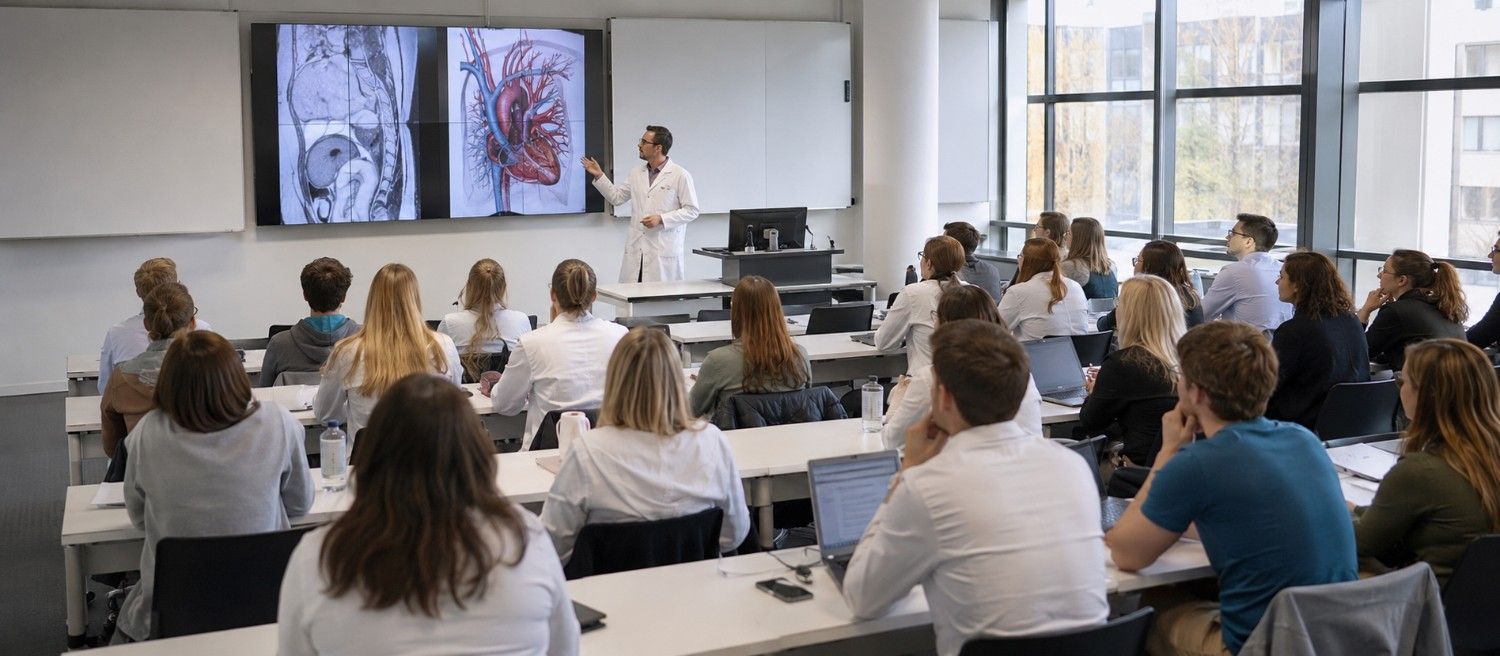
Since the winter term of 2005/2006, MHH's medicine degree has run as HannibaL, short for Hannoversche integrierte, berufsorientierte und adaptive Lehre (Hannover's integrated, career-oriented, and adaptive teaching). Instead of splitting years of pure theory (Vorklinik) from years of hospital work (Klinik), HannibaL puts students next to real patients from semester one and teaches in five roughly seven-week blocks a year rather than classic 15-week semesters. So, a first-year MHH student is already doing supervised bedside work while students at many other German schools are still stuck in the lecture hall.
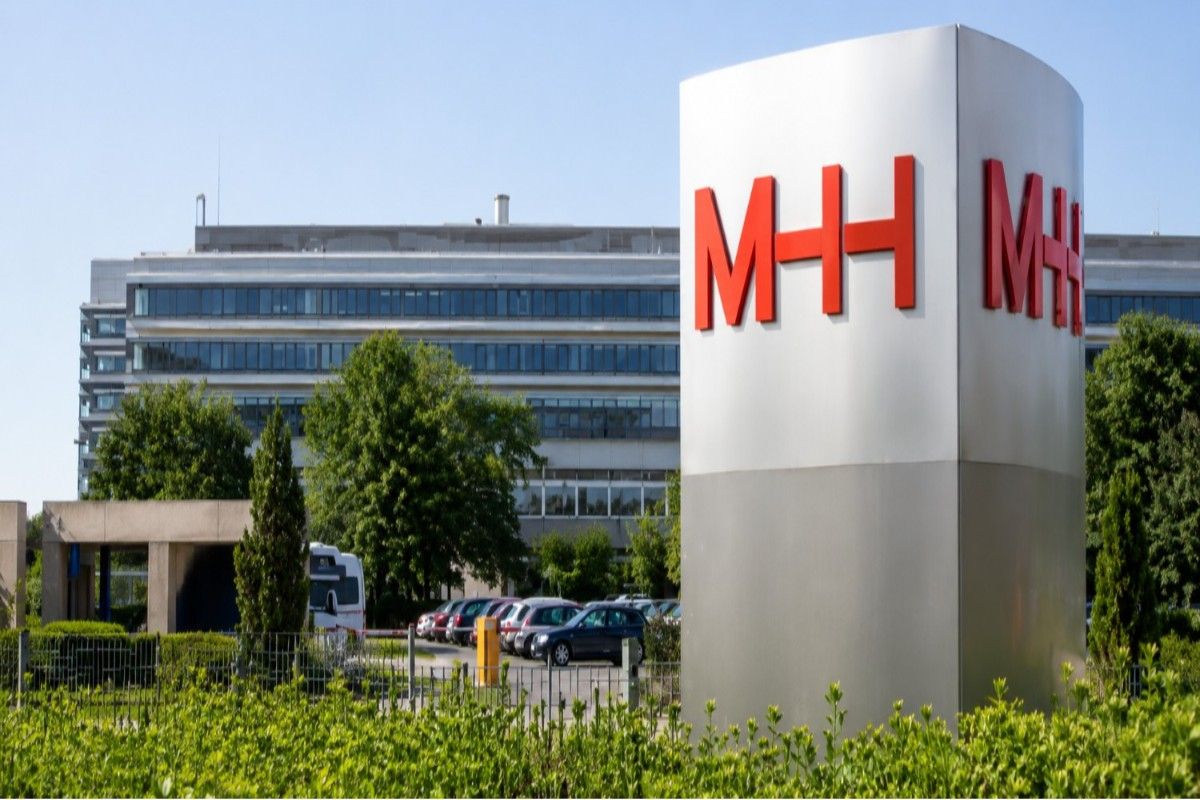
MHH sits in Groß-Buchholz, a district in the north-east of Hannover, on one compact, purpose-built site rather than scattered across the city. Clinics, research institutes, lecture halls, and student housing all sit within walking distance of each other, which is exactly what that 1963 planning trip was aiming for.
The teaching hospital attached to MHH, the Klinikum der MHH, runs 34 clinics and 41 institutes with roughly 1,520 hospital beds. It is classed as a Maximalversorger, Germany's top tier of hospital care, with patients referred in from well beyond the local region. In 2024 it treated over 53,000 people as inpatients and more than 280,000 as outpatients. So, when MHH says its students train inside a full-scale hospital, that is not marketing language, it is one of the busiest clinical sites in the country.
MHH is also Germany's largest transplant centre across every solid-organ type, carrying out 300 to 400 transplants a year, with lung-transplant programmes ranking among the world's best. On research money, the DFG's national Förderatlas (funding atlas) has repeatedly placed MHH among the top three German university medical institutions for third-party research funding per professor, with particular strength in infection and immunity, transplantation and regeneration, and biomedical engineering. So, a school younger than most of its rivals out-funds many older, bigger medical faculties.
One curricular priority stands out here too: HannibaL builds a research training module into every year of study rather than bolting it on as an elective near the end. So, students get structured exposure to how the research going on next door actually gets done, not just what its results are.
Human Medicine at MHH is a Staatsexamen (state examination) degree, the same legal category used across Germany, with a standard length of twelve semesters, about six years and three months, ending in the Approbation, the licence to practise medicine.
Admission runs through the national portal Hochschulstart.de under Germany's three-lane system: Abiturbestenquote (best grades, 30%), Zusätzliche Eignungsquote (extra aptitude quota, 10%), and Auswahlverfahren der Hochschulen (university selection, 60%), where MHH weighs Abitur grade alongside the TMS aptitude test and bonus points for relevant training. The programme is capped by numerus clausus rules, and past capacity disputes have pushed the first-year intake toward roughly 300 to 320 places.
On money, Lower Saxony currently charges no general tuition fee and no separate non-EU tuition fee for its public universities, MHH included. Students still pay a semester contribution that covers student-services charges, the student union fee, an administration fee, and a regional transport ticket, adding up to a few hundred euros each term, not thousands.
Parameter | Details |
Established | Founding order 1963; formal founding ceremony 17 May 1965 |
Institution Type | Standalone public medical university (state of Lower Saxony) |
Location | Groß-Buchholz, Hannover, Germany |
Programme | Human Medicine (Staatsexamen), Model Curriculum HannibaL |
Duration | 12 semesters (approx. 6 years 3 months) |
Medium of Instruction | German (Staatsexamen programmes) |
Foreign Quota Note | Non-EU applicants generally apply outside Hochschulstart; a national pre-quota reserves some places for special applicant groups |
Teaching Hospital | Klinikum der MHH, ~1,520 beds, Maximalversorger, on-campus |
Fee Component | Amount | Notes |
Tuition Fee | None | Lower Saxony charges no general tuition for public university study |
Non-EU Student Fee | None confirmed | Lower Saxony does not currently levy a separate non-EU fee |
Semester Contribution | Roughly €300–€410 | Covers student services, student union, admin fee, and transport ticket; exact current figure not independently cross-verified |
Living Costs | Approx. €800–€1,100/month | Rent, food, insurance, transport in Hannover |
Approx. Total Programme Cost | Living costs dominate | No tuition; total cost is mainly 6+ years of living expenses |
Most rival pages describe MHH as just another German medical faculty. It isn't. MHH is one of the only universities in the country that teaches nothing but medicine and closely related sciences, with its own governance, campus, and funding line, instead of being one department inside a larger institution. So, decisions on curriculum, hospital priorities, and research direction get made by people whose whole job is medicine.
Most guides list MHH's age or student numbers and stop there. What they skip is DFG Förderatlas data showing MHH among the top three German university medical institutions for research funding per professor, with real depth in transplant medicine, where it runs the country's largest transplant centre. So, a school that looks mid-sized on paper punches well above its weight in the labs and operating theatres that train its students.
MHH teaches almost entirely in German, so students without strong, certified German skills will struggle from day one, and there is no English-taught route into the Staatsexamen medicine degree. The intake is also small, roughly 300 places a year, so competition through the national NMC system stays intense regardless of nationality. And because MHH teaches only medicine-adjacent subjects, students wanting a broad multi-faculty campus life won't find that here.
Students who thrive here tend to want early, hands-on patient contact rather than years of pure lecture theory, are comfortable in fluent German, and care about training inside a genuinely high-volume hospital. Those wanting a large multi-faculty campus, an English-medium degree, or lighter admissions should look elsewhere.
No hidden charges, no donation. The full picture of costs at MBBSS in Hannover Medical School.
Tuition Fee
€780 annually
None — Public Lower Saxony institutions charge no tuition for medicine
Hostel Fee
€196 to €289 per month
€196 to €289 per month
Food & Meals
EUR 350 to 450
Per month
Insurance
EUR 100 to 120
Per month, mandatory
Donation
No Donation
No Capitation Fees
Total Estimated Cost
Confirm directly with the university — Living costs form the bulk of total spending, not tuition
6 year
25–35%
Average FMGE first-attempt pass rates for students from many overseas medical universities. Students from structured programs consistently score higher.
Students returning to India need to clear the FMGE/NExT exam. MBBSS in Hannover Medical School integrates exam-oriented coaching into the regular curriculum so students are prepared from day one.
A structured program that takes you from foundational sciences to clinical mastery.
Foundational science (anatomy, physiology, biochemistry) taught alongside early, supervised patient contact from semester one. Delivered in HannibaL's quintile blocks rather than classic long semesters.
• Combines Anatomy, Physiology, and Biochemistry with structured propaedeutic modules, clinical ward rounds, and diagnostic training from year one.
Students sit the written first state examination (roughly around the fourth year of the standard national schedule) covering core medical science. Clinical skills training continues to run in parallel rather than waiting until after this exam.
• Covers Internal Medicine, Surgery, Paediatrics, and related specialities.
Rotations through core specialties (internal medicine, surgery, and others) inside the Klinikum der MHH and partner teaching hospitals. Group sizes shrink from around the third year onward, giving closer supervision and mentoring.
• A 48-week block of supervised clinical rotations across major departments.
Remaining blocks are chosen electives, with at least part of the year set in outpatient/ambulatory care under current national rules.
A full year of supervised clinical work, split into blocks that must include internal medicine and surgery.
Passing it, plus completing all required coursework and the Praktisches Jahr, qualifies graduates for the Approbation, Germany's licence to practise medicine.
A final state examination, combining written and clinical/practical assessment, closes the degree.
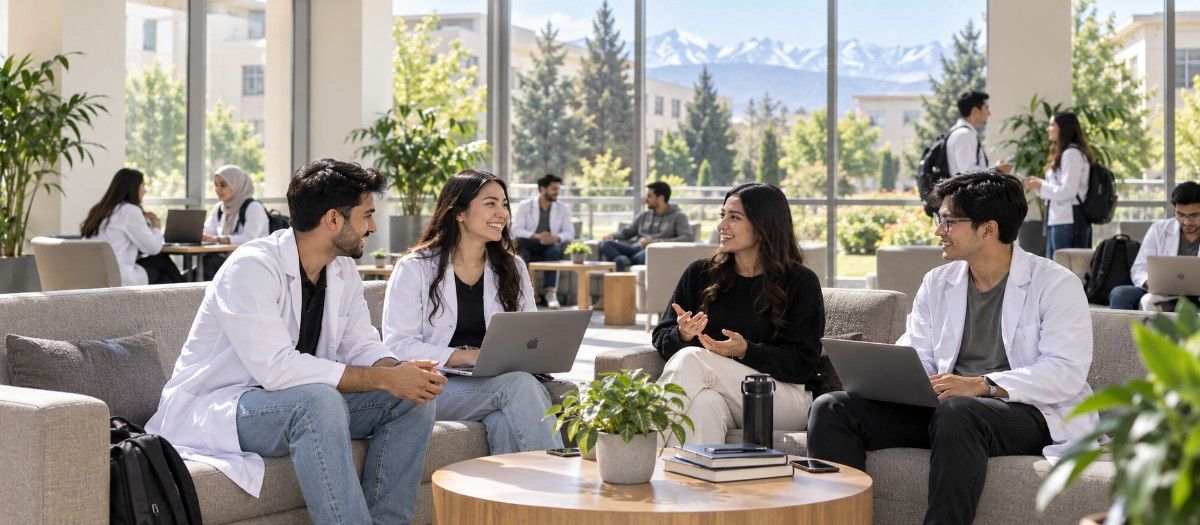
Furnished hostel rooms with Wi-Fi, laundry, 24/7 security, and Indian mess on or near campus.
Indian restaurants and mess facilities serving vegetarian and non-vegetarian home-style food daily.
Strong Indian community with cultural events, festival celebrations, and peer support groups.
Students get hands-on clinical training in government and private hospitals affiliated with the university.
Practical information for students planning to study at MBBSS in Hannover Medical School.
Prepare for all seasons. Thermal wear for winters, light clothing for summers. University provides heating in hostels.
Student visa processed with university invitation letter. Direct and connecting flights from major Indian cities.
Health insurance included in fees. Medical facility on campus plus city hospitals easily accessible.
Local SIM cards available. WhatsApp and video calls keep you connected with family back home.
Average monthly expenses of $150–$250 covering food, transport, and personal needs.
University library, online databases, and study groups. Seniors mentor juniors through academic challenges.
Our team guides you through every step — from application to arriving on campus.
Begin German lessons as early as possible, ideally alongside Class 11–12, targeting B1 within 12 months and progressing toward the required B2–C1 level.
Submit Class 10, 12, and any higher-education transcripts for verification. Processing typically takes 3–5 weeks; apply early, since this gates every subsequent step.
portal and apply to the correct track, the M-Kurs for medical aspirants, at your shortlisted Studienkolleg institutions.
Complete the roughly 10–12 month M-Kurs program covering Biology, Chemistry, Physics, and German, then pass the Feststellungsprüfung (FSP), the qualifying exam for university entry.
Submit applications to your shortlisted universities. Uni-assist fees run €75 for the first program and €30 for each additional program in the same semester.
University decisions follow Uni-assist’s document evaluation and forwarding; final admission is always the university’s own decision.
Deposit €11,904 into a blocked account (via Fintiba, Expatrio, or a similar provider) and arrange either public (€140–€160/month) or private health insurance; both are mandatory prerequisites for the visa stage.
Submit your visa application at the German consulate in India (Delhi, Mumbai, Bengaluru, or Chennai), with your admission letter, APS certificate, language proficiency proof, blocked account confirmation, and insurance proof. Realistic processing time is 6–12 weeks.
Bring originals of every document submitted digitally. Be prepared to discuss your study plans, financial arrangements, and reasons for choosing Germany.
Book travel around your intake date (October for Winter, April for Summer), and complete formal university enrollment on arrival. Medical study then begins with the Pre-Clinical phase.
Admission Helpline — Contact our counsellors for step-by-step assistance.
“The faculty here is incredibly supportive. The clinical training during hospital rotations has given me real confidence in patient care.”
“Affordable fees without compromising on quality. The campus facilities and hostel life made my transition abroad very smooth.”
“English medium instruction and WHO-recognized curriculum were the deciding factors for me. No regrets so far — excellent experience overall.”
“The university helped with everything from visa to accommodation. Hospital exposure from year three has been invaluable for my FMGE prep.”
“Just cleared my licensing exam on the first attempt. The structured coaching and mock exams during final year were a game-changer.”
“Safe campus, good food options, and a strong Indian student community. The teaching methodology is very practical and hands-on.”
It was founded in 1965 as Germany's first fully independent medical university.
Approximately six years in total, including the practical year.
No. Humanmedizin is taught almost entirely in German, and a certified strong German level is required beforehand.
No. Seats go through Germany's centralised admission body, Stiftung für Hochschulzulassung.
No tuition applies at Lower Saxony's public institutions, though a semester contribution is required.
Graduates receive a Staatsexamen and, after registration, the Approbation, Germany's medical practice licence.
MHH's own Hochschulklinikum, integrated directly into the institution rather than a separate affiliated hospital.
Not automatically. Indian graduates would still need to clear India's usual foreign-degree licensing route, such as NExT.
It is a public, state-funded institution, run as an independent medical university under Lower Saxony.
Its HannibaL model curriculum builds structured, early patient contact into the first two years of study, well before most German medical students traditionally begin clinical training.


Our expert counsellors will guide you through the complete admission process — from documents to airport pickup.