Most people hear "James Cook University" and think of the Great Barrier Reef. They don't think of medical school. But JCU's College of Medicine and Dentistry runs two distinctive health degrees. Both share one goal. They train doctors and dentists who want to work in rural, remote, and tropical areas. They do not just pass through these areas on the way to a city career.
The college offers two separate degrees. The first is the six-year Bachelor of Medicine, Bachelor of Surgery (MBBS). This is based mainly in Townsville. The second is the five-year Bachelor of Dental Surgery (BDS). This is based at the Smithfield campus in Cairns. Both are direct-entry programs. Students can join straight after Year 12. This includes international students. Neither program needs a prior bachelor's degree. This sets JCU apart from graduate-entry schools like Flinders or UQ. At those schools, a finished degree is the starting point, not the finish line.
JCU was founded in 1970. This makes it younger than most established Australian medical schools. But its regional focus has become a real strength. The World Health Organisation has a name for this. They call it "socially accountable medical education." This means a school that points its teaching and research at the health needs of its own community. For JCU, that means small towns. It means remote Indigenous settlements. It means the tropical regions of Northern Australia. Graduates from bigger southern universities rarely stay and work in these areas long-term.
Globally, JCU sits at 440th in the 2026 QS World University Rankings. This is a modest spot by world standards. JCU does not hide from this fact. But JCU wins where it counts most for a working doctor. The 2026 Good Universities Guide ranks JCU first in Queensland for median graduate salary in medicine. It ranks second nationally, too. JCU also ranks first in Queensland for full-time graduate employment. It ranks first in Queensland for teaching quality in postgraduate medicine. These rankings matter more to a working doctor than a global prestige score.
The MBBS runs for six years. It does not stick to one campus. The first three years happen mainly in Townsville. Cairns is also an option early on. Year 1 covers integrated medical studies. Students learn how the body works at a cellular level. Also, they learn about the impact of social conditions on health. In Year 2, anatomy, physiology and common disease patterns are covered. Clinical skills training is directed towards rural, remote and tropical health issues. Year 3 goes deeper into clinical knowledge. It gives special focus to immunology and preventive medicine. From Year 4, about 60% of students move to clinical sites in Cairns, Mackay, or Darwin. The rest stay in Townsville. The final years sharpen clinical pathology skills. Students train fully in hospitals and communities. The program ends with a clear path into an internship.
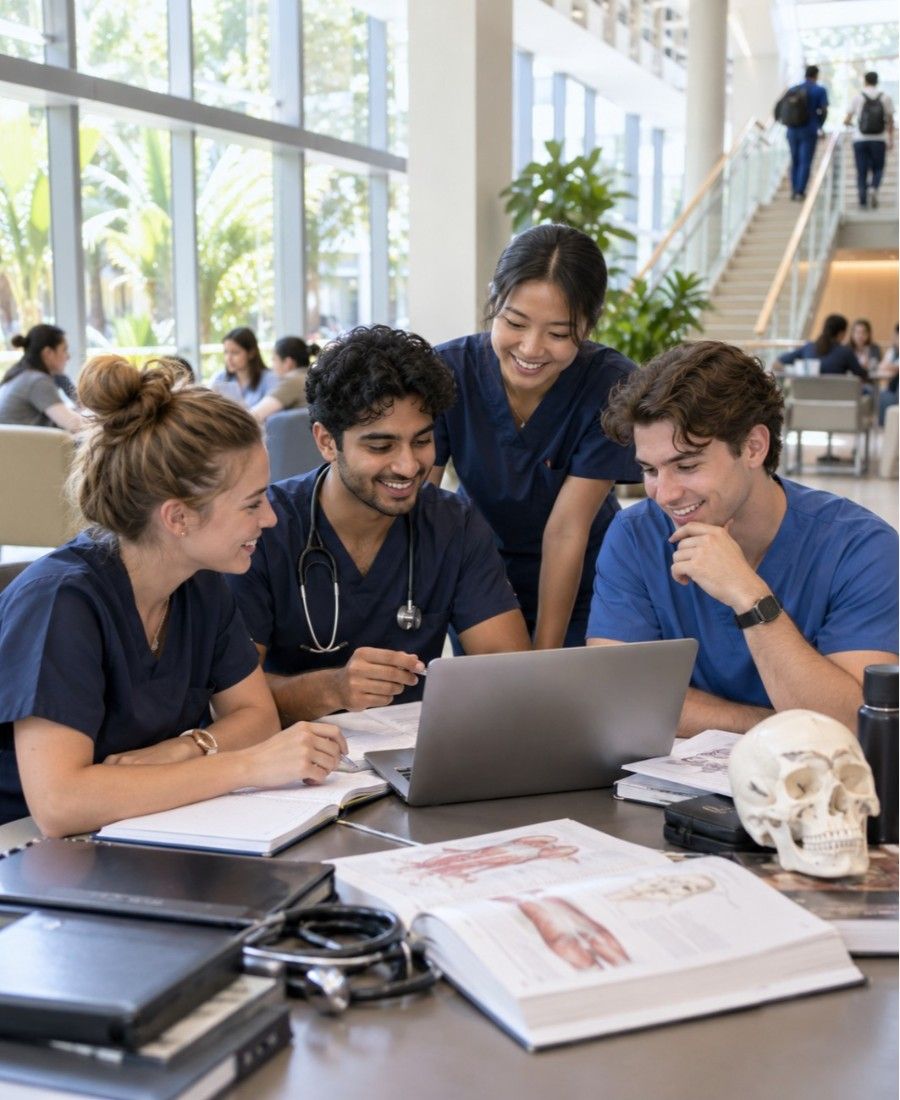
Clinical exposure at JCU starts early. It stays hands-on throughout. The Townsville anatomy labs are humidity-controlled. They hold North Queensland's largest cadaver, pathology, and skeletal teaching collection. This is rare outside Australia's big cities. Students work through mock scenarios with volunteer patients early on. By graduation, they log more than 4,000 hours of clinical practice. Every student also spends at least 20 weeks in rural and remote towns. These placements are spread across Years 2, 4, and 6. JCU also favours applicants from rural, remote, and Indigenous backgrounds during selection. This policy links to stronger rates of doctors staying in these regions after they qualify.
The Bachelor of Dental Surgery takes a similar regional approach. But it sits in a different city. It is based at Cairns' Smithfield campus. JCU's dental school is one of only three in Australia outside a capital city. The federal government gave $52.5 million to build it. This funded an 80-seat dental simulation lab. It also funded prosthodontics labs, science labs, and student home-group rooms. The five-year BDS blends basic science with dental clinical training. Preventive oral health strategies run through the whole degree. Students start working in the simulation clinic in their very first semester. Many other dental programs wait much longer to offer this.
Across the degree, BDS students complete more than 2,000 hours of clinical work. This spans private practices, JCU's own public dental clinics, and rural and remote clinics across Northern Queensland. The program ends with placements in regional and rural Australia. Students can also choose an international placement before they graduate. Strong students can go further, too. The Bachelor of Dental Surgery (Honours) adds a personal research project and thesis.
Both programs share JCU's wider research strength. This sits well outside the usual capital-city path. JCU rates world-class or better in 83% of its research fields. Its work spans tropical medicine, rural health, and Indigenous health. This gives both medical and dental students real research ties to the people they will serve. International students also gain access to the Northern Queensland Regional Training Hubs (NQRTH). This connects medical students and junior doctors with clear career paths. It builds a lasting regional health workforce. It bridges the gap between finishing a degree and building a real regional career.
JCU admissions work differently from most Australian schools in one key way. JCU skips the UCAT entirely. Both the MBBS and BDS, instead, look at ATAR or equivalent Year 12 results. Recommended subjects include English, Mathematical Methods, and Chemistry. A written personal statement matters too. So do letters of support and an interview for shortlisted students. Medicine's overall acceptance rate sits near 40%. Recent successful MBBS applicants often score above 97 ATAR in both Townsville and Cairns. This runs well above JCU's stated minimum score.
Life in Townsville and Cairns looks nothing like life in Sydney or Melbourne. For many students, that's the whole appeal. Both cities sit on Australia's tropical coast. Both sit close to the Great Barrier Reef and the Wet Tropics rainforest. Both cost noticeably less to live in than the bigger southern cities. Students who want their training ground to match their future patients often love this fit. A free afternoon near the reef beats city traffic for most people.
Graduates of both programs move straight into Australian registration. MBBS graduates gain provisional registration with the Medical Board of Australia. They must also finish a supervised internship year. The Australian Dental Council accredits graduates with a BDS and they are eligible to register with the Dental Board of Australia or the equivalent body in New Zealand. After this there are many possible career paths. MBBS graduates can go into general practice, rural medicine and hospital specialities. BDS graduates can go into private practice, community health, hospital dentistry, the defence force or research. If you are an international student planning to return home after graduating you should check the regulations of your home country first. These rules shift over time and vary a lot by country.
In short, JCU suits a certain kind of student in both fields. This student is a strong school leaver. They often care about rural, remote, or Indigenous health. They want to start right after Year 12 without sitting the UCAT. They see tropical and regional practice as a real speciality, not a fallback option. This path won't suit everyone chasing prestige rankings. But for the right student, few Australian universities train graduates this close to the communities they will serve.