
Q1. How old is the University of Trieste?
+It dates to 1924, building on an even older 1877 commercial school, and marked its centenary in 2024.
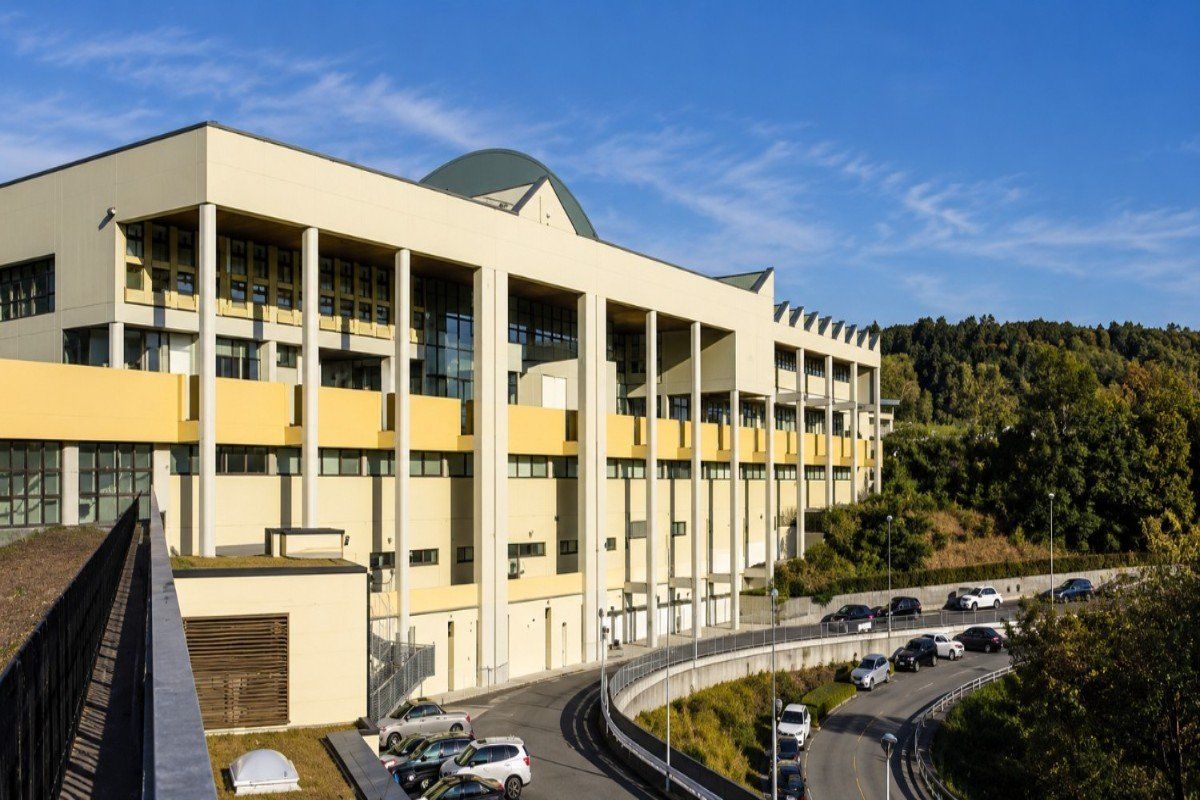
 Italy | Est. 1924
Italy | Recognised under Italy's national MUR framework, and holds Department of Excellence status. A confirmed World Directory of Medical Schools listing could not be verified in this research. | Entirely in Italian medium
Expert will call you within 2 hours
The University and What Makes It Different
Trieste's university has a slightly unusual founding story worth knowing upfront. It began in 1924 as the Regia Università degli Studi Economici e Commerciali, built on top of an even older commercial school, the Scuola Superiore di Commercio, founded back in 1877 under Austro-Hungarian rule. It only became a full, general-purpose university in 1938, once a law faculty was added. The whole institution marked its hundredth anniversary in 2024.
Medicine came later still, and for a genuinely political reason rather than an academic one. Trieste itself only returned to Italian administration in 1954, after years as a contested Free Territory following the Second World War. Once that settled, new faculties, medicine included, opened up over the following decade, with medicine specifically dated to around 1965 by most accounts, though it's worth flagging that this exact year comes from secondary sources rather than something pulled directly off the university's own archives.
One naming detail that trips people up. The old "Facoltà di Medicina e Chirurgia" doesn't formally exist anymore. It was dissolved under Italy's 2010 university reform and its work absorbed, from November 2012, into what's now called the Dipartimento Universitario Clinico di Scienze Mediche Chirurgiche e della Salute, a mouthful usually shortened to DSMCS. So if a page or an old document refers to a "faculty" here, that's historical language, not the current structure.
The degree itself is the standard Laurea Magistrale a Ciclo Unico in Medicina e Chirurgia, and here's a point genuinely worth stating plainly. Trieste doesn't run an English-taught or IMAT-based international track for medicine. The university's own list of English-medium programmes covers things like neuroscience and molecular biomedicine, but medicine and surgery isn't on it. Anyone specifically hunting for an English-language route into an Italian MD should look
elsewhere on this list.
Trieste's Layout and Where Teaching Actually Happens
Teaching is split by year across a few different sites, which is worth mapping out. The first two years happen mainly at the university's central campus. From year three onward, students move to Cattinara, the main teaching hospital site at Strada di Fiume 447, with additional clinical time at Ospedale Maggiore on Via Manzoni, home to the anatomy teaching facilities, and at IRCCS Burlo Garofolo, a specialised paediatric and maternal-care research hospital.
Trieste as a city has a genuinely distinctive character among Italian university towns, shaped heavily by its Austro-Hungarian past and its position right at Italy's northeastern edge, closer to Slovenia than to most of Italy proper. That border-city feel, and a slightly more Central European atmosphere than you'd get in Rome or Naples, is part of what makes it stand out on a list like this one.
DSMCS itself carries some real institutional weight beyond just teaching. It holds recognition as a Department of Excellence under Italy's national research-funding scheme, and its stated research strengths cover a genuinely broad range: clinical epidemiology, oncology, surgery, obstetrics and gynaecology, diagnostic imaging, occupational medicine, infectious disease, cardiovascular disease, haematology, paediatrics, and dermatology. That's a wide spread for a department this size.
Cost of living here runs on the more affordable end for Italy, though solid official figures are thin on the ground. Third-party estimates put a shared flat somewhere around 150 to 400 euros a month per person, a single room from about 230 euros, and a studio flat starting near 600 euros, with total monthly costs excluding rent estimated around 921 euros. Treat those as ballpark figures rather than confirmed numbers.
Course Structure, Cost, and Practical Details
On structure: six years, the standard Italian single-cycle format. Since the 2020 national reform, the degree itself is the qualifying credential, and what replaced the old State Exam is a Tirocinio Pratico-Valutativo worked into the degree itself, 15 credits' worth, roughly five credits a month across surgical, medical, and general-medicine placements, rather than a separate internship tacked on after graduation.
Admission for the 2025/26 cycle runs through Italy's new semestre filtro system: open enrolment into the first semester, no upfront entrance test, then three national exams in chemistry and biochemistry, physics, and biology that rank applicants nationally for continuation into semester two. Trieste's own course pages confirm this is exactly the model in use here now.
Tuition follows Italy's standard ISEE-based sliding scale, and Trieste happens to have one of the more clearly published fee structures on this list, at least for the general student body. Full exemption applies up to an ISEE of 30,000 euros. Between 30,000 and 75,000 it scales up gradually, roughly 527 euros plus just over five percent of whatever sits above the 30,000 mark, and above 75,000, or with no ISEE submitted at all, the flat rate is 2,820 euros. Non-EU students pay a flat 600 or 720 euros depending on their academic progression. One important catch, though. Trieste's own fee documentation explicitly excludes first-year Medicine and Dentistry students from that general table, pointing instead to a separate admissions bando for those specific figures, which wasn't something this research turned up cleanly, so treat the numbers above as broadly indicative rather than the confirmed first-year medicine cost.
Given the department's genuine research depth and Trieste's distinctive, border-city character, this is a solid pick for someone comfortable with Italian-only instruction who wants a slightly different Italian university experience than the more obvious choices, though the fee-table gap for first-year medicine specifically is worth chasing down directly with admissions before committing to anything.
Quick Overview
Parameter | Details |
Founded | University founded 1924 (building on an 1877 commercial school); medicine faculty dated to around 1965 |
Institution Type | Public university |
Location | Trieste, Friuli-Venezia Giulia, Italy |
Programme | Laurea Magistrale a Ciclo Unico in Medicina e Chirurgia (LM-41) |
Duration | 6 years, 360 credits |
Medium of Instruction | Italian only; no English-taught track for medicine |
Admission Route | Semestre filtro (national reform, from AY 2025/26) |
Teaching Hospital | Cattinara (main site), plus Ospedale Maggiore and IRCCS Burlo Garofolo |
Fee Structure
Fee Component | Amount | Notes |
Tuition Fee (general, ISEE-based) | EUR 0 up to ISEE 30,000; scaling to EUR 2,820 flat above 75,000 | First-year Medicine/Dentistry students follow a separate bando; figures not confirmed for them specifically |
Non-EU Student Fee | Flat EUR 600 or 720 per year | Depending on academic progression |
Regional Tax and Stamp Duty | EUR 120 to 160 + EUR 16 | Standard additional charges |
Living Costs (rent) | Approx. EUR 150 to 400 per month (shared); from EUR 600 (studio) | Third-party estimates, not official |
Total Cost | Best obtained from the university itself | First-year medicine fee figures were not confirmed |
Why Trieste's Medical Programme Deserves a Harder Look Than You've Given It
A faculty Shaped by a Political History
Trieste only returned to Italian administration in 1954, after years as a contested Free Territory, and medicine opened roughly a decade later, younger than the university's 1924 founding date suggests.
One Department, Two Hospital Site
Trieste dissolved its old Facoltà in the 2010 Gelmini reform and now runs medicine through a single clinical department, DSMCS, with students splitting time between Cattinara Hospital and the Burlo Garofolo children's hospital.
Honest Assessment
There's no English-taught route, and medicine-specific tuition isn't cleanly separated from the general fee table, so confirm costs directly. What you get is a compact, well-resourced department with a distinctive history and early hospital access.
No hidden charges, no donation. The full picture of costs at MBBS in University of Trieste Faculty of Medicine and Surgery.
Tuition Fee
€3,195 per year
— EUR 0 to 2,820 depending on ISEE — First-year medicine fees follow a separate,
Hostel Fee
Approx. EUR 150 to 400 per month (shared) — Third-party estimate
Approx. EUR 150 to 400 per month (shared) — Third-party estimate
Food & Meals
€110 and €120 per month
per month
Insurance
€12 to €35 per month
per month
Donation
No Donation
No hidden fee
Total Estimated Cost
Best obtained from the university itself — Confirm medicine-specific first-year fees directly
6 year
25–35%
Average FMGE first-attempt pass rates for students from many overseas medical universities. Students from structured programs consistently score higher.
Students returning to India need to clear the FMGE/NExT exam. MBBS in University of Trieste Faculty of Medicine and Surgery integrates exam-oriented coaching into the regular curriculum so students are prepared from day one.
A structured program that takes you from foundational sciences to clinical mastery.
• Builds toward the move to hospital-based sites from year three.
• Foundation medical sciences taught primarily at the university's central campus.
• A 15-credit Tirocinio Pratico-Valutativo runs across surgical, medical, and general-medicine placements, integrated into the degree itself.
• Clinical training at Cattinara, Ospedale Maggiore, and IRCCS Burlo Garofolo for paediatric and maternal care.
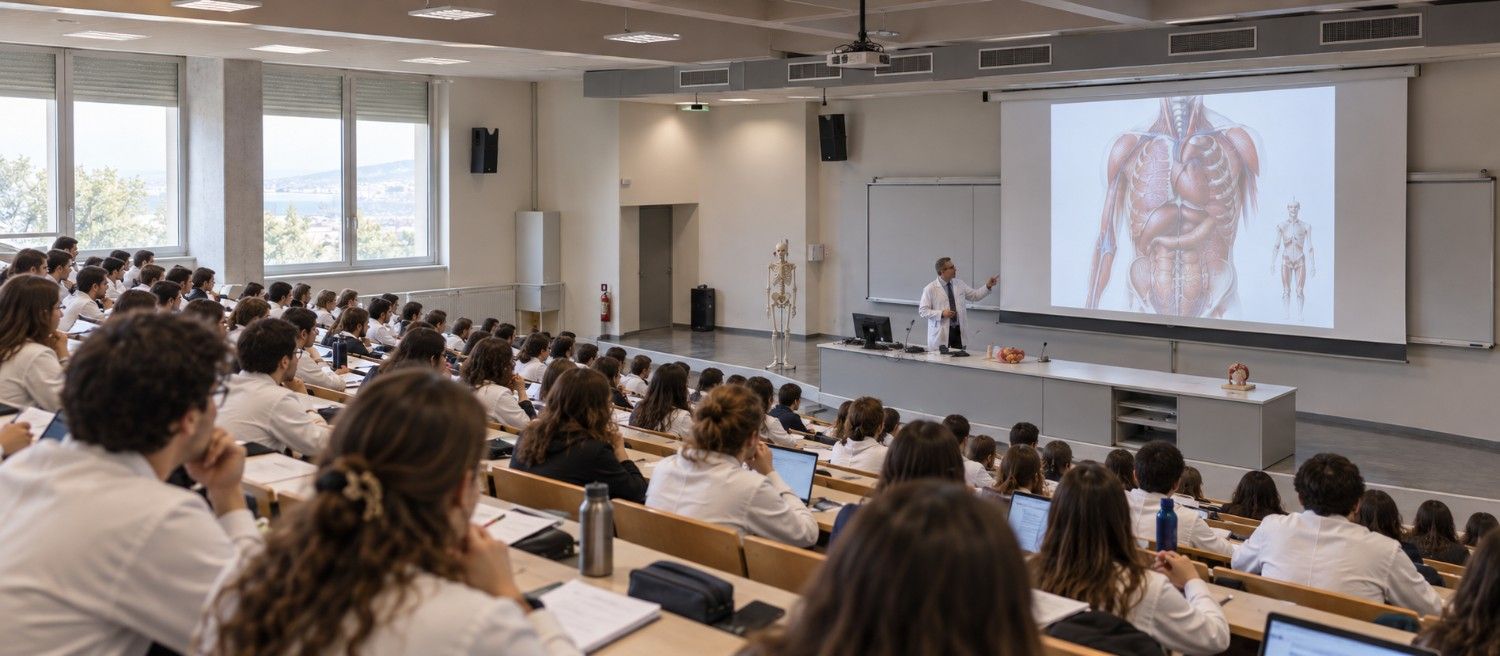
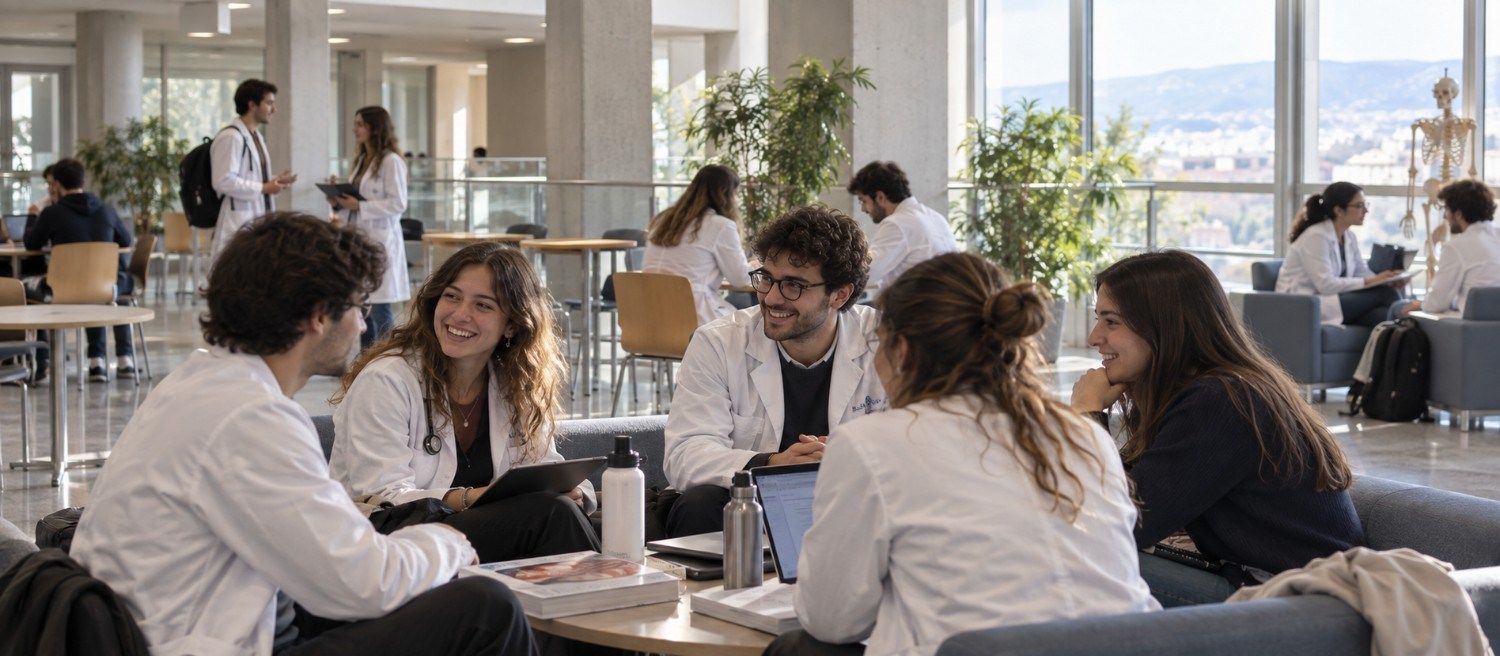
Furnished hostel rooms with Wi-Fi, laundry, 24/7 security, and Indian mess on or near campus.
Indian restaurants and mess facilities serving vegetarian and non-vegetarian home-style food daily.
Strong Indian community with cultural events, festival celebrations, and peer support groups.
Students get hands-on clinical training in government and private hospitals affiliated with the university.
Practical information for students planning to study at MBBS in University of Trieste Faculty of Medicine and Surgery.
Prepare for all seasons. Thermal wear for winters, light clothing for summers. University provides heating in hostels.
Student visa processed with university invitation letter. Direct and connecting flights from major Indian cities.
Health insurance included in fees. Medical facility on campus plus city hospitals easily accessible.
Local SIM cards available. WhatsApp and video calls keep you connected with family back home.
Average monthly expenses of $150–$250 covering food, transport, and personal needs.
University library, online databases, and study groups. Seniors mentor juniors through academic challenges.
Our team guides you through every step — from application to arriving on campus.
Our Italy specialist explains the IMAT process, the income-based fee system, Bologna vs Rome vs other universities, and a total cost comparison with Hungary and Poland.
Our team registers you for IMAT (September test) and begins structured coaching. Biology, Chemistry, Physics, Maths, Critical Thinking. Begin preparation at least 6 months before the test.
Full Italian visa and IMAT application document set academic certificates, income documentation if applicable.
IMAT taken at designated test centres. We provide post-test analysis and guidance on university rankings.
Following IMAT ranking, the Italian university issues an admission confirmation. Our team can help with this process.
Full documentation submitted to the Italian Embassy or Consulate. Begin immediately after receiving the admission letter.
Our team advises qualifying families on the income-based fee reduction process.
Bologna /Rome orientation, accommodation, portico culture, Italian transport, Trenitalia app, banking, SIM card.
Our local team in Bologna (BLQ) or Rome (FCO) meets you and manages the first-week settlement.
We manage the Permesso application at the local Post Office within 8 days of arrival with our support, which is renewed annually.
Admission Helpline — Contact our counsellors for step-by-step assistance.
“The faculty here is incredibly supportive. The clinical training during hospital rotations has given me real confidence in patient care.”
“Affordable fees without compromising on quality. The campus facilities and hostel life made my transition abroad very smooth.”
“English medium instruction and WHO-recognized curriculum were the deciding factors for me. No regrets so far — excellent experience overall.”
“The university helped with everything from visa to accommodation. Hospital exposure from year three has been invaluable for my FMGE prep.”
“Just cleared my licensing exam on the first attempt. The structured coaching and mock exams during final year were a game-changer.”
“Safe campus, good food options, and a strong Indian student community. The teaching methodology is very practical and hands-on.”
It dates to 1924, building on an even older 1877 commercial school, and marked its centenary in 2024.
Around 1965, roughly a decade after Trieste returned to Italian administration in 1954, though the exact year isn't confirmed against a primary source.
Not formally. It was dissolved under a 2010 reform; the current structure is called DSMCS.
No. Medicine and surgery is not on the university's list of English-taught programmes.
Through the national semestre filtro system since 2025/26: open enrolment, then three common exams determining national ranking.
General ISEE-based bands range from free to a EUR 2,820 flat rate, but first-year medicine fees follow a separate bando not confirmed in this research.
Mainly at Cattinara, with additional sites at Ospedale Maggiore and IRCCS Burlo Garofolo.
No, not automatically. India's standard foreign-degree licensing route, including NExT, would still apply.
Public, operating under Italy's national higher education framework.
Its Austro-Hungarian history and position near the Slovenian border give it a noticeably different character from most Italian university cities.

Our expert counsellors will guide you through the complete admission process — from documents to airport pickup.