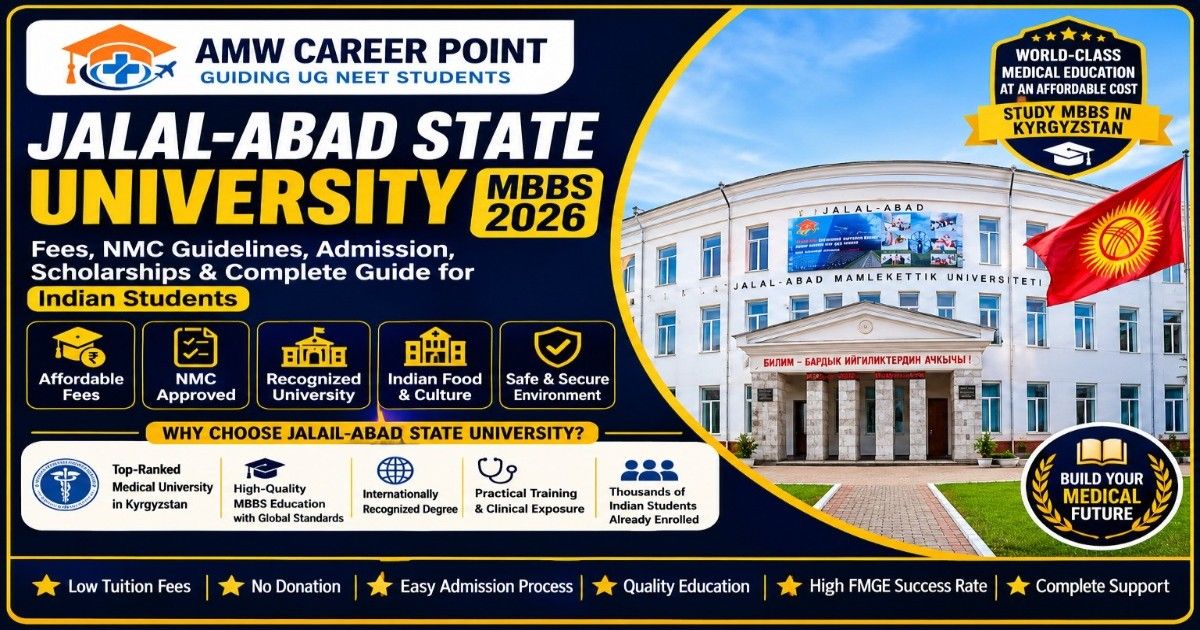
Every year, several Indian MBBS aspirants shortlist Jalal-Abad State University (JASU) in Kyrgyzstan based primarily on one data point: it is a government university, and its tuition is lower than many alternatives. That starting point is legitimate. But it is not sufficient for a decision that involves 6 years and ₹18–28 Lakh.
This guide covers every dimension that should inform that decision: the university’s WDOMS listing status, the NMC compliance framework that applies to every Indian student who wants to practice in India after graduating, the realistic fee and living-cost picture, the clinical exposure at affiliated teaching hospitals, the language of instruction beyond the classroom, a comparison with other Kyrgyz medical universities, and an honest assessment of who should choose JASU and who should look elsewhere.
No marketing language. No inflated claims about FMGE pass rates that cannot be independently sourced. Everything verifiable is identified as such; everything that requires independent verification before enrollment is flagged clearly.
Jalal-Abad State University: Quick Highlights 2026
University Type | Government (Public) state-funded university under the Ministry of Education and Science of the Kyrgyz Republic |
Established | 1993 (Jalal-Abad State University as a multidisciplinary institution; Medical Faculty launched as part of its faculty expansion) |
Location | Jalal-Abad city, Jalal-Abad Region, southwestern Kyrgyzstan |
MBBS / Medicine Program Duration | 6 years (5 years academic + 1 year internship). Verify the current program structure with the university registrar before enrollment. |
Medium of Instruction | English (for the international student program). Russian and Kyrgyz are used in clinical settings and patient interaction. |
WDOMS Listing | Verify directly at wdoms.org by searching for the exact institution name before enrollment. WDOMS status can change. |
NMC Status | Indian students must independently verify current NMC eligibility criteria (FMGL Regulations 2021) against the specific program. NMC does not ‘approve’ individual foreign university students; students must satisfy NMC’s own conditions. |
NEET Requirement | Required for Indian students who intend to practice in India after graduation (for NMC Eligibility Certificate). Not required by JASU for admission. |
Annual Intake | September–October (confirm the specific year’s intake date with the university or AMW) |
Hostel | Available on or near campus. Confirm current room availability and fees directly. |
Approximate Total 6-Year Cost | ₹18–28 Lakh (tuition + hostel + living). Verify current fee structure before budgeting. |
Indian Student Community | Present; smaller than at Bishkek-based universities. Verify current numbers with returning students. |
About Jalal-Abad State University
Jalal-Abad State University is a public, government-funded multidisciplinary university established in 1993 in Jalal-Abad city, the administrative center of the Jalal-Abad Region in southwestern Kyrgyzstan. The university operates under the Ministry of Education and Science of the Kyrgyz Republic and offers undergraduate and postgraduate programs across multiple faculties, including medicine, economics, pedagogy, law, and engineering.
The Medical Faculty at JASU is one of several departments within the broader university structure; this is an important distinction for Indian students to understand. Unlike a standalone medical university (such as the Kyrgyz State Medical Academy or the International School of Medicine in Bishkek), JASU is a general university that includes medicine as one of its departments. This means the medical faculty shares infrastructure, administrative resources, and campus facilities with other faculties of the broader institution. Neither classification is inherently superior, but the distinction matters when evaluating clinical infrastructure and the depth of medical-specific support systems.
Jalal-Abad city itself has a population of approximately 100,000–120,000 people and is located in the Fergana Valley region, close to the
border. It is a quieter, smaller city compared to Bishkek (the capital, where most Kyrgyzstan-based MBBS universities are concentrated). This factor cuts both ways: a lower cost of living and a calmer environment, but a smaller Indian student community and fewer peer support structures than Bishkek universities offer.
The international student program at JASU, including the English-medium MBBS track for Indian and other international students, operates under the university’s international department. The program structure covers pre-clinical and clinical phases of medical education across 5 academic years, followed by a mandatory 12-month clinical internship.
Why Indian Students Choose Jalal-Abad State University
The reasons Indian students choose JASU are real, but they need to be evaluated against the full picture rather than taken in isolation.
Reason | What Is Genuinely True | What Needs Independent Verification |
Government University Status | JASU is a state-funded public university under Kyrgyzstan’s Ministry of Education. Government status provides a degree of institutional permanence that privately funded institutions may not have. | Government status does not automatically mean better clinical infrastructure or NMC compliance. Both must be verified separately. |
Lower Tuition Than Many Alternatives | Annual tuition at JASU is typically in the lower range of Kyrgyzstan’s medical university options, reflecting government subsidy for domestic students and competitive international pricing. | Verify current fee structure directly. The total cost including hostel and living must be calculated against FMGE outcomes data — a cheaper university, and neither should be minimized, may not be the better financial decision overall. |
English-Medium Programme | JASU offers an English-medium international program for MBBS. Lectures and academic assessments are conducted in English. | Clinical environments (hospitals, wards, patient interaction) primarily operate in Russian and Kyrgyz. Verify the language of instruction certificate covers all 6 years, not just pre-clinical academics. |
WDOMS Listing | WDOMS listing is a prerequisite for NMC Eligibility Certificate eligibility. Verify the current listing at wdoms.org at the time of application. | WDOMS status must be verified at the time of enrollment, not at the time of reading this guide. Status can change. |
Smaller City Environment | Jalal-Abad’s smaller size means a lower cost of living, fewer urban distractions, and a quieter study environment for students who prefer this over capital city life. | A smaller city also means a smaller Indian student peer community, fewer Indian restaurants and cultural amenities, and fewer study group networks that are critical for FMGE preparation. |
Jalal-Abad State University Ranking & Academic Standing
Jalal-Abad State University does not currently appear in major international university ranking systems (QS World University Rankings, Times Higher Education, or Shanghai ARWU). This is typical for regional public universities in Central Asia, most of which are not large enough or research-output-intensive enough to appear in global ranking indices that heavily weight research output, citations, and international faculty ratios.
At the national level within Kyrgyzstan, JASU is one of several regional state universities, distinct from the flagship institutions concentrated in Bishkek (including the flagship Kyrgyz National University, Kyrgyz Technical University, and the medically focused KRSU and KSMA).
Global Rankings (QS, THE, ARWU) | Not currently ranked in major international indices |
National Standing (Kyrgyzstan) | Regional state university; one of several government institutions outside Bishkek |
WDOMS Listing | Verify directly at wdoms.org for current status. |
Ministry of Education Recognition | Accredited by the Ministry of Education and Science of the Kyrgyz Republic |
Medical Faculty Accreditation | Part of Kyrgyzstan’s national higher medical education accreditation system. Verify current accreditation status with the university registrar. |
Recognition & Accreditation What Every Indian Student Must Verify
Recognition claims are the most commonly misrepresented area in MBBS-abroad consultancy content, and the consequences of misunderstanding them are severe: a student who graduates from an institution that does not satisfy NMC’s conditions cannot sit FMGE/NExT and cannot practice medicine in India.
Accreditation Body | Status | What It Means for Indian Students |
Ministry of Education and Science, Kyrgyz Republic | Accredited (as a national public university) | Confirms JASU is a legally operating, state-recognized university in Kyrgyzstan. Required but not sufficient for NMC purposes. |
WDOMS (World Directory of Medical Schools) | Verify directly at wdoms.org | WDOMS listing is the primary NMC eligibility criterion for foreign medical graduates. If not listed, FMGE/NExT eligibility is blocked regardless of any other recognition. Check by exact institution name. |
NMC India (National Medical Commission) | NMC does not ‘approve’ individual foreign universities | NMC issues an Eligibility Certificate to Indian students who (a) hold a qualifying NEET score, (b) graduated from a WDOMS-listed institution, and (c) satisfy all six FMGL Regulation 2021 conditions. NMC compliance is the student’s individual responsibility to verify — not the university’s to guarantee. |
ECFMG / FAIMER | Listed in FAIMER (Foundation for Advancement of International Medical Education and Research) database where WDOMS-listed | ECFMG recognition (for USMLE eligibility) follows from WDOMS listing for most institutions. Verify per AMW guidance if USMLE is a career target. |
WHO Recognition | Often cited in consultancy materials; verify per current WHO/AVICENNA directory. | WDOMS has largely superseded the WHO/AVICENNA directory as the reference standard. NMC uses WDOMS. WHO recognition claims without WDOMS confirmation are insufficient for NMC eligibility purposes. |
NMC Guidelines & Indian Students: The 2026 Compliance Framework
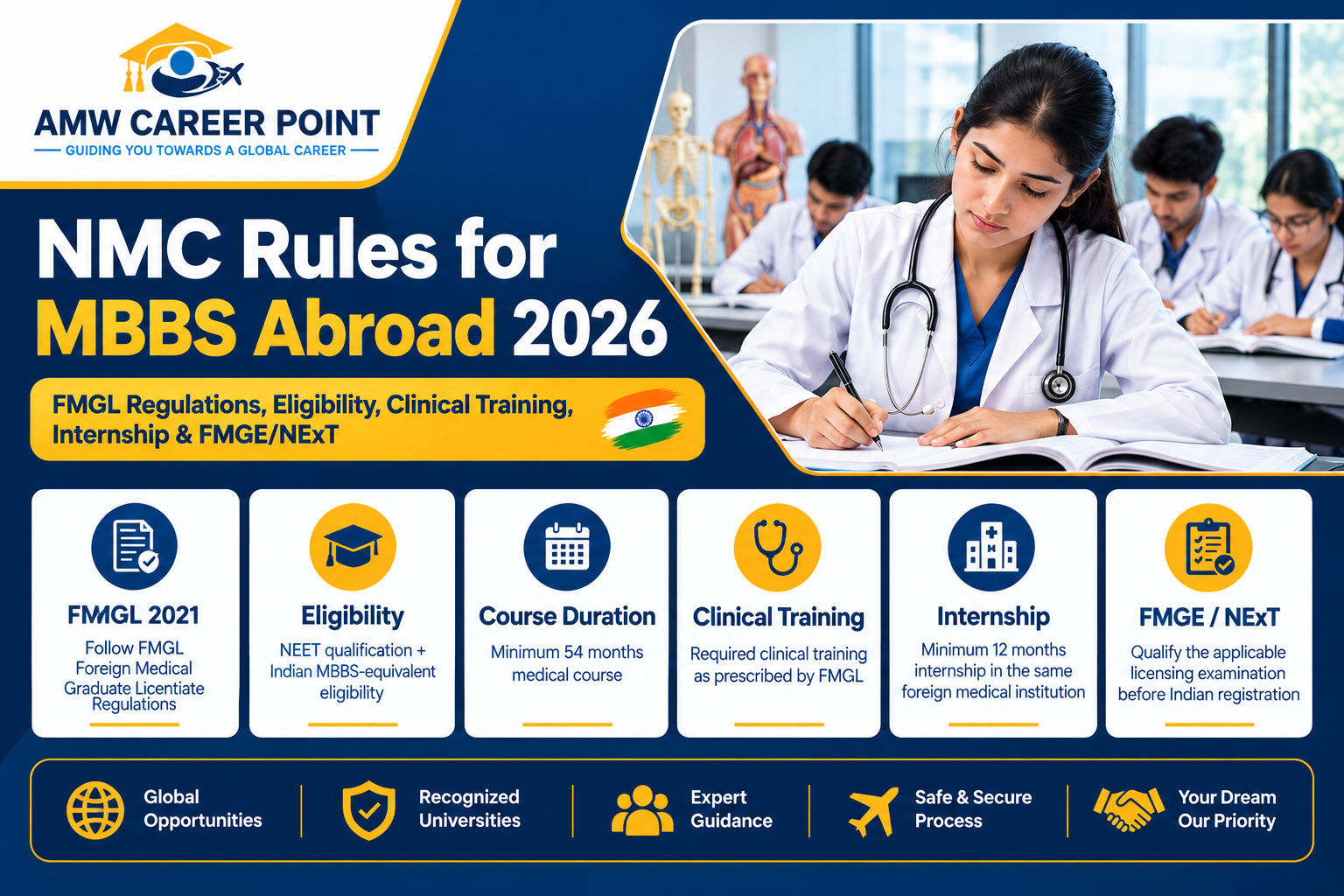
India’s National Medical Commission governs whether a foreign medical degree can be used to practice medicine in India. The governing document is the Foreign Medical Graduate Licentiate (FMGL) Regulations 2021. Every Indian student who plans to return to India after MBBS at JASU must independently verify that the specific program satisfies all six conditions below.
NMC Condition | What It Requires | How to Verify at JASU |
1. WDOMS Listing | The institution must be listed in the World Directory of Medical Schools at the time of enrollment and graduation. | Search wdoms.org. Confirm current listing. Do not rely on historical screenshots. |
2. 100% English-Medium Instruction | All lectures, practicals, clinical rotations, and university assessments must be delivered in English throughout the entire 6-year program. Bilingual programs are not NMC-compliant for NExT purposes. | Request a Language of Instruction Certificate from JASU’s registrar in writing. Confirm it covers all 6 years including clinical years, not just pre-clinical Years 1–3. |
3. Minimum 54-Month Academic Duration | The academic program (excluding the internship) must run for at least 54 months. | Request an official curriculum structure document confirming semester count and duration. |
4. NMC Schedule-I Mandatory Subjects | The curriculum must cover all subjects listed in Schedule-I of the NMC notification dated 18 November 2021. | Request a subject-by-subject curriculum map from the JASU registrar and compare against NMC Schedule-I. |
5. 12-Month Internship at the Same Institution | The mandatory internship must be completed at the same university or its directly affiliated teaching hospital in Kyrgyzstan. Completing an internship in India does not satisfy this requirement. | Confirm in writing in the offer letter or student agreement that the internship is at JASU’s affiliated hospital in Jalal-Abad, not an unaffiliated facility. |
6. Certificate of Registrability | The university must be able to issue a certificate confirming the graduate is eligible for professional registration in Kyrgyzstan. | Request written confirmation from the JASU registrar that this certificate is issued to all MBBS graduates. |
After satisfying all six NMC conditions and graduating, Indian students must:
Hold a valid qualifying NEET UG score (obtained before or during the program)
Apply to NMC India for the Eligibility Certificate
Pass FMGE (Foreign Medical Graduate Examination) or NExT (National Exit Test, as per NMC rollout timeline) to receive a license to practice medicine in India
Register with the relevant State Medical Council
Courses Offered at Jalal-Abad State University
Programme | Duration | Medium | Notes |
MBBS / General Medicine (International Program) | 6 years (5 academic + 1 internship) | English | Primary program for Indian and other international students. Verify current intake numbers and program structure with the university. |
Dentistry (BDS) | 5 years | English / Russian | Available at the Faculty of Dentistry. International student intake varies. Verify NMC/DCI recognition for Indian students. |
Pharmacy | 5 years | Kyrgyz / Russian (primarily) | Limited English-medium track. Verify language of instruction for international applicants. |
Paediatrics | 6 years | Russian (primarily) | Largely in Russian. Not typically recommended for Indian students without prior Russian proficiency. |
Postgraduate Medical Programs | 2–3 years | Russian (primarily) | Limited international PG track. Most Indian students return to India for PG after completing MBBS abroad. |
MBBS Curriculum at Jalal-Abad State University — Year by Year
Year | Phase | Core Subjects | Notes |
Year 1 | Pre-Clinical / Basic Sciences | Human Anatomy, Physiology, Biochemistry, Medical Biology, Histology, Medical Chemistry, Latin for Medical Terminology | High FMGE/NExT weightage. Anatomy, Physiology, and Biochemistry directly overlap NEET Biology topics. Engage deeply from Day 1. |
Year 2 | Pre-Clinical | Pathological Anatomy, Pathological Physiology, Microbiology & Immunology, Pharmacology (introductory), Propaedeutics of Internal Medicine | Continued high FMGE overlap. Microbiology and Pharmacology are consistently high-yield on FMGE. |
Year 3 | Para-Clinical | Pharmacology (advanced), Pathology, Microbiology, Community Medicine (introductory), Forensic Medicine | First clinical exposure typically begins in Year 3. Hospital attachment starts — Russian/Kyrgyz language functional importance grows here. |
Year 4 | Clinical | Internal Medicine, General Surgery, Obstetrics & Gynecology, Pediatrics (introductory) | Core clinical clerkships. Ward rounds, patient presentations, and clinical documentation are largely in Russian. |
Year 5 | Advanced Clinical | Advanced Internal Medicine, Advanced Surgery, Neurology, Psychiatry, ENT, Ophthalmology, Dermatology, Orthopedics | Final academic year. Clinical load is highest. FMGE preparation should be running in parallel with all clinical subjects from Year 4. |
Year 6 | Internship | Rotating clinical internship across major departments at JASU-affiliated teaching hospital(s) | Must be completed at JASU’s affiliated hospital in Jalal-Abad. Completing internship in India does not satisfy NMC’s same-institution requirement. |
Teaching Methodology & Learning Environment
JASU’s MBBS program combines lecture-based teaching in the pre-clinical years with ward-based clinical training in Years 3–6. The teaching approach follows a structure broadly similar to other Kyrgyzstan public medical universities, reflecting the post-Soviet academic tradition of structured lecture schedules, practical sessions, and hospital rotations.
Teaching Method | Where It Applies | Notes for Indian Students |
Didactic Lectures | Years 1–5 | Primary delivery mechanism for theoretical content. English-medium for international students. Note-taking skills and active lecture engagement are important. |
Practical / Laboratory Sessions | Years 1–3 (pre-clinical and para-clinical) | Anatomy dissection, histology slides, biochemistry labs, microbiology culture. Hands-on component that reinforces lecture content. Directly relevant to FMGE laboratory-question categories. |
Problem-Based Learning (PBL) | Selected clinical subjects | Some clinical year subjects use case-based problem solving. Less common in Kyrgyz public universities than in European or American medical schools, but increasing. |
Clinical Rotations / Ward-Based Learning | Years 3–6 | Bedside teaching, patient history-taking, examination, and presentation. This is where Russian/Kyrgyz language is essential for effective learning — not optional. |
Seminars and Tutorials | All years | Small-group discussion sessions complementing lectures. International students are integrated with domestic students in some seminars, requiring functional Russian. |
Self-Directed Study | Critical throughout all years | The MBBS program’s academic load leaves significant responsibility on the student for self-directed FMGE/NExT-aligned revision. This requires stronger self-discipline than many students expect. |
Affiliated Teaching Hospitals & Clinical Exposure
Clinical exposure is the dimension of MBBS abroad that matters most for both FMGE outcomes and long-term clinical competence. It is also the dimension most commonly oversimplified in university marketing.
Jalal-Abad State University conducts clinical training at hospitals affiliated to the university in Jalal-Abad city and the surrounding Jalal-Abad Region. The primary clinical base is in a regional city rather than a national capital, which has specific implications for patient volume and specialty breadth.
Clinical Factor | Jalal-Abad Context | Why It Matters |
Patient Volume | Jalal-Abad’s regional hospitals serve the Jalal-Abad Region’s population. Regional hospitals typically see high volumes of primary and secondary care cases. | Patient volume and case diversity in the clinical years are among the strongest predictors of practical medical competence. Verify OPD numbers directly with current students at JASU. |
Specialty Breadth | Regional hospitals provide strong exposure in general internal medicine, general surgery, obstetrics, and pediatrics. Subspecialty exposure (cardiology, neurology, oncology) may be more limited than at capital city tertiary hospitals. | FMGE/NExT tests across all specialties. Where hospital-based specialty exposure is limited, students must compensate with textbook and video-based FMGE preparation. |
Language of Clinical Work | Russian is the primary language of clinical communication in Jalal-Abad’s hospitals. Kyrgyz is also used. English is used in the classroom, not consistently on the ward. | Students who do not develop functional Russian find clinical rotations academically limiting; they can observe but cannot fully participate in history-taking, examination discussions, or bedside teaching. |
Internship at Same Institution | NMC requires the 12-month internship to be completed at the same institution’s affiliated hospital. JASU’s internship is completed at Jalal-Abad-based affiliated hospitals. | Confirm in writing that the internship is at JASU’s affiliated hospitals in Jalal-Abad, not an unaffiliated institution. This is a hard NMC requirement. |
Medium of Instruction: the Honest Picture
The answer to ‘Is the medium of instruction English?’ at Jalal-Abad State University is: yes for academic teaching, and no for the clinical environment. Both halves are true simultaneously, and neither should be minimized.
Setting | Primary Language | What This Means in Practice |
Lectures (Years 1–5) | English | All formal lecture content for international students is delivered in English. Textbooks are in English. University assessments are in English. |
Practical / Lab Sessions | English (with some Russian terms) | Most practical sessions use English instructions. Laboratory equipment and reagent labels may be in Russian or Kyrgyz. Functional familiarity with Cyrillic script helps. |
Hospital Wards (Years 3–6) | Russian (primary); Kyrgyz (common) | Patient interaction, ward rounds, supervisor-student discussions, nursing handovers, and clinical documentation are predominantly in Russian. Patients in Jalal-Abad, as in most of Kyrgyzstan outside Bishkek’s international community, do not speak English. |
Clinical Assessments (OSCEs / Clinical Exams) | English (university); Russian (practical skill demonstrations) | University clinical examinations are conducted in English. Practical demonstrations with patients require Russian. |
Daily Life (City) | Kyrgyz and Russian | Shopping, transport, local services, and social interaction are in Kyrgyz and Russian. Basic Russian significantly eases daily life in Jalal-Abad. |
Eligibility Criteria for MBBS at Jalal-Abad State University 2026
10+2 Subjects | Physics, Chemistry, Biology (PCB), which is mandatory |
Minimum PCB Marks | 50% aggregate in PCB (General category, per NMC norms); 40% (SC/ST/OBC) |
NEET UG | Not required by JASU for admission. Mandatory for NMC Eligibility Certificate if the student intends to practice in India after graduation. |
Minimum Age | 17 years as of 31 December of the year of admission |
Maximum Age | No upper age limit specified by JASU for international students. |
Passport | Valid for a minimum of 6 months from the travel date |
Language Test (IELTS/TOEFL) | Not required |
Medical Fitness Certificate | Required for Kyrgyzstan student visa processing. HIV, Hepatitis B/C, and tuberculosis tests required. |
Academic Gap | No specific restriction from JASU. NMC eligibility norms apply. |
Admission Process for JASU MBBS 2026 Step by Step
The admission process at JASU follows the standard document-based Kyrgyzstan university pathway. There is no separate entrance exam. Applications are typically submitted from June onward after NEET results, with intake in September–October.
Step | Action | Timeline | Notes |
1 | Initial Counselling with AMW | June–July (after NEET results) | Compare JASU against other Kyrgyz options using FMGE data, fees, and NMC compliance checklist. This step determines whether JASU is the right choice for your specific profile. |
2 | Document Collection | June–July | Class 10 and 12 marksheets (attested), NEET scorecard, passport copy, birth certificate, passport photographs, medical fitness certificate with required blood tests. |
3 | Application Submission | July–August | Application submitted to JASU International Admissions Department (via AMW). Include all required document copies. |
4 | Offer / Acceptance Letter | Within 7–21 days of complete application | JASU issues an offer letter confirming admission. Verify that the letter specifies the programme, duration, language of instruction, and internship terms. |
5 | Apostille of Documents | Begin early — allow 3–4 weeks | All academic certificates must be apostilled through MEA India. JASU may also require notarised translations of key documents. Begin this process before the offer letter arrives. |
6 | Kyrgyzstan Student Visa Application | After offer letter; allow 4–6 weeks | Apply at the Kyrgyz Embassy in New Delhi (or consulate in your region). Required documents: offer letter, apostilled certificates, medical fitness certificate, financial proof, passport-size photos, visa fee. |
7 | Fee Payment Confirmation | Before travel | Pay the initial tuition and hostel fee installment directly to JASU’s official account. University fees should never be paid through a consultant’s account. Retain all receipts. |
8 | Travel to Jalal-Abad | September–October (per intake date) | Nearest international airport: Osh Airport (OSS), approximately 100 km from Jalal-Abad. Some students route through Bishkek (FRU) with onward domestic travel. AMW coordinates local arrival support. |
9 | Migration Card & Registration | Within 3 days of arrival in Kyrgyzstan | Migration card issued on entry; registration with local OVIR (migration authority) is mandatory within 3 working days of arrival. JASU’s international office typically assists with this. Failure to register carries a fine. |
10 | University Registration & Hostel Allocation | First week | Complete university registration, receive student ID, and move into allocated hostel. Attend orientation week. |
JASU MBBS Fee Structure 2026 Complete Cost Breakdown
Cost Component | Annual Estimate (USD) | Annual Estimate (₹ Approx.) | Notes | ||
Tuition Fees | USD 2,500–3,200 | ₹2.1–2.7 Lakh | Verify current tuition directly with JASU. Government university tuition is typically at the lower end of Kyrgyzstan’s range. Tuition may increase year-on-year. | ||
Hostel Fees | USD 500–900 | ₹42K–75K | On-campus or university-affiliated hostel. Double-occupancy is standard; single rooms may be available at higher cost. | ||
Food / Mess | USD 900–1,400 | ₹75K–1.17L | University canteen (mess) or self-cooking. Indian food options are more limited in Jalal-Abad than in Bishkek. Budget for occasional self-cooking supplies. | ||
Medical Insurance | USD 150–250 | ₹12.5K–21K | Mandatory for Kyrgyzstan student visa. International student insurance is typically purchased through the university or a certified insurer. | ||
University Registration / Miscellaneous Fees | USD 100–250 | ₹8.4K–21K | Annual re-registration, library, student card, and similar institutional fees. | ||
Personal Expenses (communication, transport, toiletries) | USD 500–800 | ₹42K–67K | Varies significantly by individual lifestyle. Jalal-Abad’s cost of living is lower than Bishkek. | ||
Total Annual Estimate | USD 4,750–6,800 | ₹4–5.7 Lakh/year | Estimated range; verify all components with JASU and AMW before finalizing budget. | ||
Total 6-Year Estimate | USD 28,500–40,800 | ₹24–34 Lakh (6-year all-in) | Exchange rate fluctuation affects rupee cost. Plan with a 10–15% currency buffer across a 6-year program. | ||
One-Time Initial Costs (Year 1 Only) | Estimate (USD) | Estimate (₹) | |||
Kyrgyzstan Student Visa Fee | USD 55–80 (approximately) | ₹4,600–6,700 | |||
Flight (Jaipur / Delhi to Osh or Bishkek, return) | USD 350–600 (return) | ₹29K–50K | |||
MEA Apostille for documents | ₹3,000–8,000 depending on document count | ₹3,000–8,000 | |||
Initial hostel deposit (if applicable) | Varies; typically 1 month hostel fee | ₹42K–75K | |||
Initial NEET FMGE preparation materials | ₹10,000–30,000 (online subscriptions, books) | ₹10,000–30,000 | |||
Winter clothing (Jalal-Abad winters reach −10°C) | ₹15,000–30,000 | ₹15,000–30,000 | |||
Cost of Living in Jalal-Abad Monthly Student Budget
Jalal-Abad is more affordable than Bishkek as one of the genuine advantages of being located in a smaller regional city. Food, transport, and accommodation costs are lower. The tradeoff is fewer amenities, a smaller international community, and limited Indian food options.
Accommodation (hostel, included in fees above) | USD 42–75/month (₹3,500–6,300) |
Food (canteen + occasional self-cooking) | USD 75–120/month (₹6,300–10,000) |
Local Transport (shared taxis, marshrutka) | USD 15–25/month (₹1,260–2,100) |
Internet (SIM card + data plan) | USD 5–10/month (₹420–840) |
Personal Hygiene / Toiletries | USD 20–40/month (₹1,680–3,360) |
Miscellaneous (stationery, entertainment) | USD 30–60/month (₹2,520–5,040) |
Estimated Monthly Total | USD 187–330/month (₹15,700–27,700) |
Estimated Annual Living Cost (exc. tuition & hostel) | USD 2,244–3,960 (₹1.9–3.3 Lakh) |
Hostel & Accommodation at Jalal-Abad State University
Hostel accommodation is available to international students at JASU, either on-campus or in university-affiliated facilities in the city. The hostel infrastructure is typical of government university facilities in regional Kyrgyz cities — functional rather than modern, with basic amenities.
Feature | Status / Details | Notes |
Room Type | Typically double or triple occupancy for international students | Single rooms may be available at higher cost. Confirm current availability at time of enrollment. |
Basic Amenities | Shared bathrooms, common kitchen facilities, electricity, central heating | Heating is essential during Jalal-Abad winters (−10°C to −15°C in January–February). Verify heating adequacy with current students. |
Internet / Wi-Fi | Available in most hostels; speed varies | An independent SIM card with a data plan (Beeline, Megacom, or O! Kyrgyzstan) provides a reliable backup internet option. |
Security | Hostel entry is typically supervised; warden/caretaker present | Jalal-Abad is generally considered safe for international students. Standard common-sense personal safety practices apply. |
Food / Mess | University canteen (cafeteria) available on or near campus; Indian food options very limited in Jalal-Abad | Indian students who maintain strict dietary preferences will need to cook most meals themselves. Indian grocery staples (rice, lentils, spices) are available but require sourcing from larger markets. |
Laundry | Shared laundry facilities or self-service hand-washing | A small personal bucket washing setup is common among students. Laundry services are available locally at low cost. |
Proximity to University | Hostel is on-campus or within walking distance. | Confirm specific location of hostel relative to the medical faculty building at enrollment. |
Indian Student Life in Jalal-Abad What to Realistically Expect
Life in Jalal-Abad as an Indian medical student is materially different from life in Bishkek, and also materially different from life at most other major MBBS-abroad destinations. Setting accurate expectations before arrival prevents the adjustment difficulties that affect students who arrive with brochure expectations.
Aspect | Reality | How to Prepare |
Indian Student Community | Smaller than at Bishkek universities. The Indian student community at JASU exists but is not as large or well-organized as at KRSU, KSMA, or ISM in Bishkek. Study groups, cultural support networks, and FMGE peer preparation are more self-organized. | Connect with existing Indian students at JASU through AMW alum network before arrival. WhatsApp groups and online FMGE preparation communities supplement the in-person peer network. |
Indian Food | Very limited dedicated Indian restaurant options in Jalal-Abad city. Self-cooking is the practical solution for students who prefer Indian food. | Learn basic Indian cooking before departure. Rice, dal, and basic spices are available in Jalal-Abad markets. A rice cooker and a basic cooking set are recommended first-week purchases. |
Climate | Four distinct seasons. Winters are cold (−10°C to −15°C in January–February). Summers are hot (30–38°C). Spring and autumn are pleasant. | Students from Rajasthan, UP, or other warm-climate states find the winter a significant adjustment. Invest in proper winter clothing before the first winter hits (October–November). |
Safety | Jalal-Abad is generally safe for international students. The city has a predominantly Muslim demographic; cultural and religious norms of the local community should be respected. | Standard safety practices: avoid late-night solo travel, travel in groups when unfamiliar with an area, keep the Indian Embassy emergency number saved. |
Festivals & Cultural Life | Diwali, Holi, and other Indian festivals are typically celebrated within the Indian student community at JASU, though on a smaller scale than at larger Indian communities in Bishkek. | The student community creates its own cultural calendar. Opportunities exist for cultural exchange with local Kyrgyz students and staff. |
Internet & Communication | Local SIM cards (Beeline, Megacom, O!) provide 4G connectivity—WhatsApp and video calling work well for regular communication with family in India. | Purchase a local SIM card in the first week. International roaming on Indian SIMs is expensive; switch to a local plan immediately on arrival. |
Scholarships & Financial Support at JASU
Scholarship availability for international MBBS students at Jalal-Abad State University is limited compared to the scholarship ecosystems available at Italian public universities (DSU) or some European institutions. This section states what is known and flags where independent verification is required.
Scholarship Type | Availability at JASU | Notes |
Government of Kyrgyzstan Scholarships | Limited seats for international students through bilateral agreements between Kyrgyzstan and other countries. Medicine may be included in some agreements. | Apply through the Kyrgyz Embassy in New Delhi. Availability varies annually. Treat as a bonus application, not the primary plan. |
University Merit Award | Some Kyrgyz universities offer partial tuition reduction for students with outstanding academic credentials (NEET 450+ or 90%+ board marks). Verify whether JASU specifically offers this. | Ask JASU’s international admissions office directly at the time of application whether any merit reduction applies to your profile. |
Indian Government Scholarships (ICCR) | ICCR (Indian Council for Cultural Relations) scholarships cover some countries and disciplines. Medicine in Kyrgyzstan may be covered in some bilateral agreements. | Check iccr.gov.in for current Kyrgyzstan / medicine availability. Competition is high. Treat as a supplementary application. |
External Private Scholarships | Several Indian private foundations and state government schemes provide education support for students studying abroad. Eligibility varies by family income and state of origin. | Research your state government’s overseas scholarship scheme (many Indian states have them). Also check the National Overseas Scholarship for SC/ST candidates (nospb.nic.in). |
Advantages of Jalal-Abad State University for MBBS
Advantage | Details |
Government University Status | State-funded institution with regulatory oversight from the Ministry of Education and Science. Institutional permanence is typically stronger than at privately funded institutions. |
Lower Fee Structure | Among the lower-cost options within Kyrgyzstan’s MBBS landscape. Total 6-year all-in cost estimate of ₹24–34 Lakh is competitive. |
English-Medium International Programme | Academic lectures, tutorials, and university assessments in English. No IELTS or TOEFL required for admission. |
WDOMS Listing (Verify Current Status) | Subject to independent verification, WDOMS listing is the gateway requirement for NMC Eligibility Certificate eligibility after graduation. |
No Entrance Exam | Traditional document-based admission — no IMAT, UCAT, or equivalent exam required. Accessible to students with a NEET qualifying score and required academic credentials. |
Quieter Study Environment | Smaller city with fewer urban distractions than Bishkek. Some students find Jalal-Abad’s pace more conducive to focused study. |
Regional Clinical Exposure | Jalal-Abad’s regional hospitals provide exposure to primary and secondary care patients with conditions that are clinically relevant for FMGE preparation. |
Lower Cost of Living vs Bishkek | Monthly living costs in Jalal-Abad are lower than in Bishkek, producing meaningful savings over a 6-year program. |
What You Should Know Before Choosing JASU
This section is the most important in the guide for students who have already decided they want JASU. These are not reasons to rule out the university — they are factors to prepare for and verify before committing.
Limitation | Honest Assessment | Mitigation |
FMGE Pass-Rate Data Is Not Published for JASU Specifically | Unlike KRSU (39.66% FMGE), KSMA (31.56%), or ASMI (26.27%), there is no independently published, NBEMS-sourced FMGE pass rate specific to Jalal-Abad State University that AMW can cite as of mid-2026. This is not unusual for smaller regional universities, but it means you are deciding without one of the most important data points. | Ask AMW to connect you with recent JASU graduates who have sat FMGE. Ask the university directly for their FMGE pass rate with an NBEMS source. If no data is available, weigh this limitation against the university’s cost advantage honestly. |
Smaller Indian Student Community | The Indian student peer community at JASU is smaller than at Bishkek’s major MBBS universities. Peer support networks, study groups, and FMGE preparation culture are less developed. | Build your own FMGE preparation structure before arrival. Online FMGE coaching (Marrow, PrepLadder, DAMS online) supplements what the peer environment provides. Connect with JASU’s Indian student community via AMW before arrival. |
Clinical Environment Is in Russian | Ward rounds, patient interaction, and hospital communication in Jalal-Abad are in Russian and Kyrgyz. Students who do not develop functional Russian have a limited clinical learning experience in Years 3–6. | Begin Russian language preparation before arrival. Even A2–B1 Russian significantly improves clinical year engagement. Use Duolingo, Pimsleur, or a basic Russian course in the 3–6 months before departure. |
Limited Specialty Exposure at Regional Hospital Level | Jalal-Abad’s affiliated hospitals are regional facilities, not national tertiary centers. Subspecialty exposure may be more limited than at hospitals in Bishkek or other capital cities. | Supplement clinical exposure gaps with FMGE-focused reading and online clinical case resources. Plan FMGE preparation to compensate for areas with less clinical reinforcement. |
Cold Winter Climate | January–February temperatures in Jalal-Abad can reach −10°C to −15°C. Students from warm-climate Indian states often underestimate this. | Budget ₹15,000–30,000 for proper winter clothing before the first winter arrives. Arrive in October before the temperature drops significantly. |
Limited Indian Food & Amenities | Jalal-Abad has significantly fewer Indian restaurants, Indian grocery options, and cultural amenities than Bishkek. | Develop basic cooking skills before departure. Stock familiar ingredients from Bishkek on initial arrival. |
Accreditation Status Requires Independent Current Verification | University accreditation status, WDOMS listing, and NMC compliance conditions should be verified at the time of enrollment for the current academic year, not based on historical blog posts. | Use wdoms.org and the current NMC notification, not third-party sources, for current status confirmation. |
Jalal-Abad State University vs Other Medical Universities in Kyrgyzstan
Parameter | ISM (Bishkek) | ||||
University Type | Government (public) | Government (public) | Government (public) | Private | Private |
Location | Jalal-Abad city | Bishkek (capital) | Bishkek (capital) | Kant (near Bishkek) | Bishkek (capital) |
FMGE Pass Rate (Recent) | Not independently published; verify with AMW / NBEMS | 39.66% — highest in Kyrgyzstan | 31.56% | 26.27% | ~28–32% (trend estimate) |
Annual Tuition (Approx.) | USD 2,500–3,200 | USD 2,500–3,500 | USD 2,800–3,800 | USD 3,000–4,000 | USD 3,500–4,500 |
Indian Student Community | Smaller; regional city | Very large; capital | Large; capital | Moderate | Large; capital |
Hospital Affiliation | Regional hospitals in Jalal-Abad | University clinical base in Bishkek | Large clinical complex in Bishkek | Affiliated hospitals near Kant | Bishkek hospital affiliations |
City Size & Amenities | ~100,000 pop.; smaller city; lower cost of living | ~1 million pop.; full capital city amenities | ~1 million pop. | ~25,000 pop.; suburb of Bishkek | ~1 million pop. |
WDOMS Status | Verify at wdoms.org | Listed (verify current status) | Listed (verify current status) | Listed (verify current status) | Listed (verify current status) |
Jalal-Abad State University vs Private Medical Colleges in India
Factor | JASU (Kyrgyzstan) | Indian Private Medical College |
Total 6-Year Cost | ₹24–34 Lakh (estimated all-in) | ₹40L–1.2Cr+ (tuition alone at many; bond conditions at some) |
NEET Rank Required | Qualifying score only (50th percentile Gen / 40th percentile reserved). No rank competition for JASU admission. | Competitive rank; NEET counseling seat allocation; management quota available at higher cost |
Post-MBBS Licensing in India | FMGE/NExT required after graduation + NMC Eligibility Certificate | No licensing exam required; State Medical Council registration only |
Clinical Patient Load | Regional hospital in smaller city; decent primary/secondary care exposure; limited subspecialty | Varies widely; government-affiliated private colleges may have high patient load; standalone colleges may have limited attachment. |
Donation / Capitation Fee | None at JASU (government university; no donation model) | Present at many Indian private colleges; can add ₹20–50L or more |
Bond Obligation | None at JASU | Present at some Indian private colleges; rural service bond ₹10–25L penalty for non-compliance |
NMC Compliance | Must verify independently for FMGE/NExT eligibility | Assumed (NMC-regulated Indian institutions); verify NMC approval of specific college |
International Career Pathway (USMLE/PLAB) | Available after FMGE/NExT with additional exam preparation | Available after Indian MBBS with additional exam preparation; no structural difference |
Career Opportunities After MBBS from Jalal-Abad State University
Career Pathway | What It Requires | Feasibility for JASU Graduates |
Practice in India | NMC Eligibility Certificate + FMGE/NExT pass + State Medical Council registration | Fully accessible with qualifying NEET, NMC compliance, completed internship in Kyrgyzstan, and FMGE/NExT pass. Standard pathway for most JASU graduates. |
NEET PG (India Postgraduate) | FMGE/NExT clearance first; then NEET PG eligibility | Available to FMGE/NExT-cleared JASU graduates on same basis as any other foreign MBBS graduate. |
USMLE (USA) | ECFMG certification (requires WDOMS-listed institution + Step 1, Step 2 CK); then residency match | Available if JASU is WDOMS-listed. USMLE preparation is independent of where you did MBBS. Requires 3–4 years additional preparation post-graduation. |
PLAB (UK) | PLAB 1 + PLAB 2; then GMC Full Registration | Open to graduates of recognized foreign medical universities. PLAB 1 (MCQ) and PLAB 2 (OSCE) are taken post-graduation. |
AMC (Australia) | AMC Part 1 (MCQ) + AMC Part 2 (OSCE); then AHPRA registration | Available to JASU graduates with a WDOMS-listed degree. Competitive; requires preparation beyond MBBS. |
Gulf Countries (UAE, Saudi, Qatar) | HAAD (Abu Dhabi), DHA (Dubai), SCFHS (Saudi), QCHP (Qatar) licensing exams | Open to foreign MBBS graduates. Licensing exams are in English. Good career pathway for JASU graduates who pass FMGE and have Indian or directly UAE/Saudi practice experience. |
Kyrgyzstan (Local Practice) | Kyrgyz medical licensing process; language proficiency in Russian/Kyrgyz required | Possible but requires Russian/Kyrgyz language proficiency. Most Indian JASU graduates target India practice or international licensing rather than local Kyrgyz practice. |
Who Should Choose Jalal-Abad State University?
JASU Is a Good Fit For:
Students with a NEET qualifying score who cannot access an Indian government seat and for whom Indian private MBBS fees are prohibitive (₹40L–1.2Cr)
Students comfortable with a smaller-city environment and willing to self-organize their peer study network and FMGE preparation structure
Students who are willing to learn basic Russian before arrival for clinical environment integration
Budget-first students whose binding constraint is total program cost and who have verified WDOMS listing and NMC compliance for JASU’s specific program
Students who have received independent confirmation (from AMW alum contacts at JASU, not from consultancy brochures) that the clinical exposure and teaching hospital access are adequate for their FMGE preparation
Students Who Should Consider Alternatives:
Students for whom FMGE pass-rate data is the primary evaluation criterion: KRSU (39.66%) and KSMA (31.56%) have independently published and NBEMS-verifiable FMGE data. JASU does not have a publicly available specific pass rate at the time of writing.
Students who need a large, established Indian peer community for cultural support and group FMGE preparation: Bishkek-based universities (KRSU, KSMA, ISM) offer a significantly larger and more structured Indian student ecosystem.
Students whose career ambition specifically targets the USMLE pathway and who want a curriculum explicitly aligned with American board exams: the Philippines (American-influenced curriculum) and Italy (ECFMG-eligible with strong biomedical science depth) are stronger strategic choices.
Students who want the European city experience and a globally recognized degree at manageable cost: Italy’s IMAT + DSU scholarship pathway delivers this with a better-published track record.
Final Verdict: Is Jalal-Abad State University the Right Choice for You?
Jalal-Abad State University is a legitimate, government-funded medical university in Kyrgyzstan with a working English-medium MBBS program, WDOMS listing (verify current status), and a total program cost that is competitive within Kyrgyzstan’s MBBS landscape. These are real, verifiable advantages.
The honest counterweight is also real: there is no independently published, NBEMS-sourced FMGE pass rate for JASU at the time of writing, the single most important data point for a student whose primary career goal is practicing medicine in India. KRSU (39.66% FMGE) and KSMA (31.56%) both have this data; JASU does not, at least not in any source AMW can independently verify as of mid-2026.
The students for whom JASU makes the most sense are those who:
Have a budget constraint that makes Bishkek-based universities financially difficult
Are prepared to verify NMC compliance through the six-point FMGL checklist independently
Are willing to invest in basic Russian before arrival for clinical year integration
Can establish contact with current JASU students through AMW’s alum network to get a ground-level picture of clinical exposure
Understand that the absence of published FMGE data means building a strong self-directed FMGE preparation framework from Year 1, not waiting for the institution to provide one
The students who should look carefully at alternatives before committing to JASU are those for whom FMGE outcome data is the primary evaluation criterion. For that profile, KRSU remains the strongest verified choice in Kyrgyzstan, and Georgia’s top universities offer the strongest FMGE outcomes of any major MBBS-abroad destination.
Contact AMW Career Point for a personalized assessment that compares JASU against the full landscape of NMC-compliant options within your budget and NEET profile.
Frequently Asked Questions (30+ Questions Answered)
Q1. Is Jalal-Abad State University a government university?
Yes. JASU is a state-funded public university established in 1993 under the Ministry of Education and Science of the Kyrgyz Republic. It is not a private institution.
Q2. Is Jalal-Abad State University listed in WDOMS?
Verify current status directly at wdoms.org by searching the institution’s exact name. Do not rely on historical claims in any guide, including this one, as WDOMS status can change. Screenshot the confirmation with the date at the time of your inquiry.
Q3. Is NEET compulsory for JASU admission?
JASU does not require NEET for admission. NMC India requires it for the Eligibility Certificate that allows Indian graduates to sit FMGE/NExT and practice in India. Students who intend to return to India after graduation should qualify for NEET before or during the JASU program.
Q4. What is the medium of instruction at JASU?
English for the international MBBS program (lectures, tutorials, and university assessments). Russian and Kyrgyz in clinical settings from Year 3 onward (ward rounds, patient interaction, hospital communication). Students who do not develop functional Russian will have a limited clinical learning experience in the ward environment.
Q5. What are the hostel fees at JASU?
Approximately USD 500–900 per year (~₹42,000–75,000), depending on room type and current fee schedule. Verify current hostel fees directly with JASU or through AMW before budgeting. Fees may increase year on year.
Q6. Is Kyrgyz language compulsory for MBBS at JASU?
No language test or proficiency requirement is imposed for admission. However, students who develop functional Russian (and, to a lesser extent, Kyrgyz) will have a materially better clinical learning experience from Year 3 onward. This is practical preparation, not an admission requirement.
Q7. Can Indian students appear for FMGE/NExT after graduating from JASU?
Yes, provided all NMC FMGE Regulation 2021 conditions are satisfied: WDOMS listing, 100% English-medium instruction, 54-month academic duration, NMC Schedule-I subjects, same-institution 12-month internship, Certificate of Registrability, and a qualifying NEET score. Each condition must be independently verified before enrollment.
Q8. Is Jalal-Abad city safe for Indian students?
Jalal-Abad is generally considered safe for international students. It is a mid-sized regional city in a predominantly Muslim region of Kyrgyzstan. Indian students have studied there without significant safety incidents reported. Standard precautions apply: avoid late-night solo travel, respect local cultural norms, and register with the Indian Embassy after arrival.
Q9. What is JASU’s FMGE pass rate?
No independently verified, NBEMS-sourced FMGE pass rate is available for Jalal-Abad State University specifically as of mid-2026. This is the most significant information gap in this guide. Before enrolling, ask JASU’s international admissions office directly for their FMGE pass rate with an NBEMS report reference, and ask AMW to connect you with recent JASU graduates who have sat the exam.
Q10. What is the total cost of MBBS at JASU for 6 years?
Estimated ₹24–34 Lakh all-in over 6 years, including tuition, hostel, food, insurance, and living expenses, but excluding one-time costs (flights, visa, winter clothing, initial setup). Verify current fee schedule with JASU or AMW before finalizing. Exchange rate fluctuation can affect the rupee cost by 10–15% over 6 years.
Q11. How do I travel from India to Jalal-Abad?
Osh Airport (OSS) is the nearest airport to Jalal-Abad, approximately 100 km away. Flights from Delhi typically route via Bishkek (Manas International Airport) with a domestic connection or road transfer to Jalal-Abad. Bishkek (FRU) is also an option with a longer overland journey. AMW coordinates arrival logistics and local reception for enrolled students.
Q12. Is Jalal-Abad State University better than private medical colleges in India?
For budget-constrained students, JASU’s all-in 6-year cost (₹24–34 Lakh estimated) compares favorably to most Indian private MBBS programs (₹40L–1.2Cr+ in tuition alone, often with additional donation or bond requirements). The tradeoff is the requirement to pass FMGE/NExT after graduation for Indian practice. The comparison is more nuanced than a simple cost comparison — clinical exposure quality and FMGE pass rate at the specific Indian private college and at JASU should both be factored in.
Q13. What affiliated hospitals does JASU use for clinical training?
JASU’s clinical training is conducted at affiliated hospitals in Jalal-Abad city and the Jalal-Abad Region. These are regional-level healthcare facilities. Verify the specific hospital name(s), bed count, OPD volume, and specialty departments with JASU’s registrar or with current students at JASU before enrolling. This is one of the most important due-diligence steps.
Q14. Is there an Indian food option in Jalal-Abad?
Dedicated Indian restaurants are rare in Jalal-Abad. Self-cooking is the practical solution. Rice, lentils (masoor dal, chana dal), spices, and basic Indian staples are available at local bazaars, though the variety is narrower than in larger cities. Students should develop basic cooking skills before departure and bring a small initial supply of specific spices from India.
Q15. Can I practice medicine in countries other than India after JASU MBBS?
Yes. USMLE (USA) is available if JASU is WDOMS-listed (which enables ECFMG certification). PLAB (UK), AMC (Australia), and Gulf licensing exams (HAAD, DHA, SCFHS) are also available to graduates of recognized foreign medical universities. Each requires separate post-graduation examination preparation.