NEET results day is one of the most stressful twenty-four hours in any Indian household with a medical aspirant. The score comes in. The seat calculator runs. And for hundreds of thousands of students every year, the calculation doesn’t work: the score qualifies but doesn’t reach a government seat, and the private alternative costs ₹70 Lakh to ₹1.5 Crore. The traditional choices have been to take a drop year and try again, or to accept a private seat and find the money somehow.
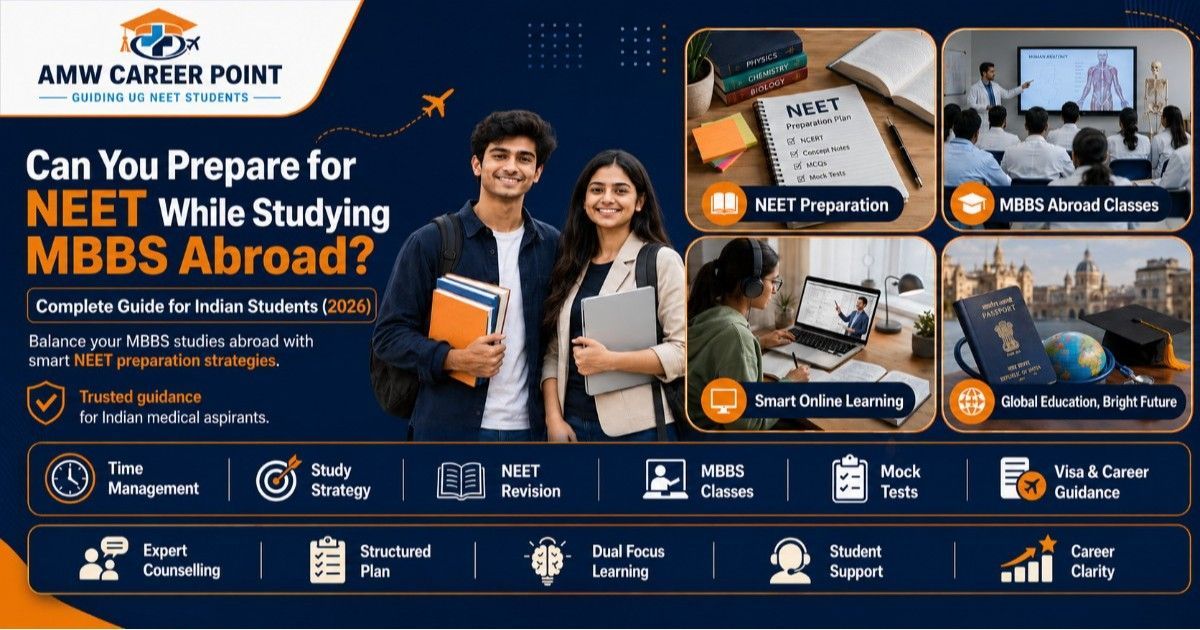
There is a third option that is increasingly serious, increasingly common, and rarely discussed honestly in one place: start MBBS at an NMC-compliant university abroad, and continue preparing for NEET simultaneously. If a better rank arrives the following year, transfer to India. If not, continue the 6-year programme abroad and graduate as a licensed doctor.
This guide covers everything required to evaluate that option in 2026: the legal position on giving NEET while enrolled abroad, the NMC regulations that govern the entire framework, a real analysis of which countries make the dual strategy most manageable, the Philippine curriculum’s specific alignment with NEET subjects, a detailed drop-year versus MBBS-abroad comparison, and a 17-section decision framework built around real student scenarios — not brochure language.
Section 1. Can You Study MBBS Abroad and Prepare for NEET at the Same Time?
Quick Answer: Yes. There is no NTA rule, NMC regulation, or Indian law that prohibits a student enrolled in a foreign medical university from appearing for NEET. Students studying MBBS abroad can and do register for and sit for NEET while continuing their foreign programme. The strategy is legal, increasingly practised, and the specific degree to which it is manageable depends significantly on which country you choose and how structured your preparation routine is. |
The rationale for this strategy is straightforward. A student who secures NEET qualifying marks but cannot access a government seat or afford Indian private college fees is, in a drop year, spending twelve months and ₹1.5–2.5 Lakh in coaching fees with no guarantee of improvement — and zero professional progress during that year. The MBBS-abroad-plus-NEET strategy converts that year into Year 1 of a recognised medical degree, while preserving the option to re-enter India if the score improves.
Who This Strategy Is Designed For
Student Profile | Does This Strategy Apply? | Why |
Qualified NEET but no government seat | Strong fit | Active medical studies abroad provide structure, subject continuity, and a guaranteed outcome regardless of NEET results. |
Cannot afford ₹70L–1.5Cr private MBBS in India | Strong fit | NMC-compliant MBBS abroad at ₹18–40L is a substantive alternative; NEET re-attempt adds optionality |
Second or third drop year with declining scores | High relevance | Continued drops often reflect anxiety and study environment; international medical studies provide structure, peer support, and real clinical exposure that may improve both NEET focus and long-term confidence. |
Wants an Indian government college specifically | Evaluate carefully | Strategy works if NEET improvement is realistic; it works less well if the gap to a government seat is very large. |
Genuinely undecided about medicine as a career | Re-evaluate first | Starting MBBS abroad is a 6-year, ₹18–40 Lakh commitment. Career uncertainty should be resolved before starting any MBBS, not during it. |
Is It Legal to Appear for NEET While Already Studying MBBS Abroad?
The short answer is yes. The detailed answer matters more.
What the NTA Rules Say
The National Testing Agency (NTA), which conducts NEET UG, publishes eligibility criteria in the official information bulletin each year. The 2026 bulletin confirms that NEET eligibility requires a candidate to have qualified Class 12 with Physics, Chemistry, and Biology/Biotechnology, meet the minimum marks criteria (50% PCB for General; 40% for SC/ST/OBC), and hold Indian nationality or OCI status. No clause disqualifies a student from being enrolled in a foreign medical programme. A student studying Year 1 MBBS in Russia, Georgia, or the Philippines can register for NEET, travel to India to sit the exam, and receive results all without any conflict with their foreign enrolment status.
What the NMC Rules Say
NMC’s position is complementary rather than conflicting. The Foreign Medical Graduate Licentiate (FMGL) Regulations 2021 require that any Indian student who completes MBBS at a foreign university must have a valid, qualifying NEET UG score to receive an Eligibility Certificate from NMC, the document that permits them to sit FMGE/NExT after graduation. NMC does not prohibit enrolling abroad before NEET; it simply requires that a qualifying NEET score be in place at the time of applying for the Eligibility Certificate upon return. Students who enrol abroad before qualifying for NEET must therefore qualify for NEET at some point before graduation not necessarily before starting Year 1.
Practical Logistics
Can I register for NEET from abroad? | Yes — NEET registration is done online on the NTA portal—no restriction on applicants enrolled in foreign universities. |
Can I travel to India for NEET? | Yes, your student visa for the country of the university does not restrict travel to India. Plan to arrive in India approximately 2 weeks before the exam date for re-acclimatisation and last-minute revision. |
When is NEET typically held? | NEET UG is usually conducted in May. With a September or October MBBS start abroad, you have approximately 7–8 months of Year 1 before the next NEET sitting. |
Do I need to inform my foreign university? | Most universities do not require notification. However, check your university’s attendance policy — some require a minimum percentage (75–80%) that may be affected by a 2–3 week India trip. |
What documents prove existing enrolment? | A university ID card, an enrollment confirmation letter, and a student visa are typically sufficient if NTA ever requires additional verification (which is uncommon). |
Is there a risk of losing my foreign seat if I clear NEET? | No risk of forfeiture from the foreign university side — you choose to leave or continue. The financial implication is forfeiture of the portion of tuition paid for the semester or year in progress. |
The MBBS Abroad + NEET Again Pathway How It Actually Works
The pathway has two endpoints and a structured decision point at the one-year mark. Understanding this helps evaluate it honestly rather than romantically.
Stage | Timeline | What Happens | Decision Point |
NEET Result | May–June 2026 | Score received; no government seat accessible at current rank; private college cost is prohibitive. | Consider the MBBS abroad + NEET re-attempt strategy. |
Counselling & University Selection | June–July 2026 | Shortlist NMC-compliant universities with verified FMGE data; select a country that balances cost, academic quality, and NEET prep manageability | Critical: Choose a university and country that supports the dual strategy. |
MBBS Begins Abroad | September–October 2026 | Year 1 commences: Anatomy, Physiology, Biochemistry. These subjects directly overlap NEET Biology topics. | Begin structured NEET preparation alongside Year 1 studies from Day 1 |
NEET Preparation (Months 1–8) | Oct 2026–April 2027 | Evening and weekend NEET revision runs parallel to university academic work. Pre-medical MBBS subjects have a high overlap with NEET. | — |
Travel to India for NEET | April–May 2027 | Travel 2 weeks before the exam for revision and acclimatisation. Attend NEET 2027. | Exam performance determines the next step. |
Outcome A: Improved Rank Government Seat Accessible | June–July 2027 | Apply through NEET counselling. Transfer/withdraw from a foreign university. Begin MBBS in India. | Financial assessment: What is the net cost of Year 1 abroad + Indian MBBS vs Indian private MBBS? |
Outcome A: Improved Rank Not Enough for Government Seat | June–July 2027 | Is the improvement sufficient to access an affordable private seat? If yes, evaluate. If no, continue abroad. | Compare private seat cost vs continuing abroad. |
Outcome B: No Meaningful Improvement | June–July 2027 | Continue MBBS abroad, now entering Year 2 with a full year’s medical foundation. | Commit fully to the abroad programme; begin FMGE/NExT preparation framework with AMW. |
Drop Year vs MBBS Abroad The Complete Comparison
This is the section most NEET aspirants need, and most consultancy blogs never provide. Here is the full comparison across every dimension that matters.
Academic Comparison
Factor | Drop Year | MBBS Abroad |
Academic Progress | Zero. Twelve months produce no academic qualification. | Year 1 MBBS completed. Anatomy, Physiology, and biochemistry are studied in depth. |
NEET Subject Reinforcement | Intensive all preparation is NEET-focused | Partial but substantial Year 1 MBBS directly reinforces Biology (70% of NEET). Physics and Chemistry require dedicated evening sessions. |
Medical Exposure | None | Clinical orientation, lab practicals, and hospital visits begin from Year 1 in most countries. Real medical context improves NEET Biology retention for many students. |
Academic Qualification if NEET Fails Again | None another year lost | Year 1 MBBS certificate and a progression into Year 2 of a recognised medical programme |
Risk of Another Wasted Year | Statistically, most drop-year students do not significantly improve their rank. | Low medical education continues regardless of NEET outcome. |
Financial Comparison
Cost Component | Drop Year (12 Months) | MBBS Abroad Year 1 (Philippines Example) |
Coaching / Tuition | ₹1.2–2.5 Lakh (NEET coaching fees) | ₹3–5 Lakh (Year 1 tuition at a Philippine private college) |
Study Materials | ₹20K–40K | Largely covered by the university; minimal additional cost |
Living Expenses | ₹1.5–2.5 Lakh (at home or PG in a coaching city) | ₹1.5–3.5 Lakh (₹25K–30K/month in Cebu/Davao) |
Travel | Minimal | ₹30K–60K (India–Philippines return; NEET travel to India) |
Total Year 1 Cost | ₹3–5.5 Lakh (with zero academic outcome if NEET fails) | ₹6–10 Lakh (with full Year 1 MBBS completed and NEET option preserved) |
Cost if NEET Fails for a Second Time | Another ₹3–5.5 Lakh for Year 2 of dropping | Year 2 of MBBS progresses; no additional dropout cost |
Mental Health Perspective
This section deserves honesty that most consultancy content avoids. Drop years carry a specific psychological burden: a full year in which professional identity is on hold, peer comparison is constant, and the sole metric of success or failure is a single exam score. The data on repeat NEET attempts is not encouraging — studies of NEET repeaters suggest that fewer than 40% of students who drop one year achieve a materially improved rank in the subsequent attempt, and the anxiety profile of second- and third-year droppers is significantly more acute than first-year droppers.
Starting MBBS abroad does not eliminate the pressure of a NEET re-attempt, but it changes its nature. The reattempt becomes a genuine option the student can pursue from a position of active professional progress, rather than a make-or-break exit from a gap year. Clinical exposure, peer community, and the lived reality of doing medical work tend to either confirm the student’s commitment to medicine or clarify that the pressure behind their NEET attempts was parental or social rather than personal.
Career Timeline Comparison
Scenario | Age at MBBS Completion | Pathway |
Drop year (1 year) + Indian Government MBBS | 23–24 | Best financial and career outcome if successful; only appropriate if the NEET gap is closeable in one attempt |
Drop year (1 year) + Indian Private MBBS | 23–24 | Achieves similar timeline but at ₹70L–1.5Cr cost; financial burden often extends 15–20 years |
Drop year (2 years) + Indian Government MBBS | 24–25 | Two years of gap at increasing psychological and financial cost; outcome uncertainty extends significantly |
MBBS abroad (Philippines / Russia / Georgia) | 23–24 | Same timeline as a single drop year + Indian government MBBS, but with Year 1 medical education already completed. |
MBBS abroad + successful NEET next year + India transfer | 23–24 | Best of both worlds: medical education from Year 1; NEET improvement option preserved; transfers to Indian MBBS with 6–12 months of medical foundation already gained |
Who Should Consider This Strategy?
Persona 1: The Qualifying Candidate Who Just Missed a Government Seat
NEET score: 380–480. Government seat cutoff: 500+. Private MBBS: ₹75L–1.3Cr. This student has demonstrated a real capacity for NEET preparation. The gap to a government seat is real but not enormous. MBBS abroad with a structured NEET reattempt is the strongest available option: Year 1 Anatomy and Physiology directly reinforces Biology, and a 30–50-point improvement in a single year is achievable for a student who is already scoring in this range.
Persona 2: The Family That Cannot Afford ₹75 Lakh to ₹1.5 Crore
NEET score: 400–550. Private MBBS: financially impossible. Government seat: out of reach this year. This family’s genuine options are a drop year (with its costs and uncertainties) or MBBS abroad. The financial comparison in Section 4 shows that MBBS abroad at a solid Philippine or Russian university costs ₹18–32 Lakh over 6 years, less than two years of Indian private MBBS tuition. The NEET re-attempt is the optionality layer; the primary outcome is an affordable, NMC-compliant medical degree.
Persona 3: The Second-Time Dropper
NEET score: similar to the previous year or lower. This is the profile where continuing to drop carries the highest risk. A second drop year has a lower statistical probability of significant improvement, a higher psychological cost, and a growing opportunity cost. For this student, MBBS abroad with an honest NEET continuation plan is the most rational path available: it ends academic stagnation. It creates a medical career regardless of the NEET outcome.
Persona 4: The Student Seeking International Exposure
NEET score: 350–500. Career goal: open to practising abroad or pursuing PG outside India. This student should evaluate MBBS abroad on its own merits, not primarily as a NEET reattempt platform. The Philippines’ English-medium curriculum and USMLE alignment, Russia’s established medical system, and Georgia’s high FMGE results all offer genuine value beyond the Indian licensing pathway. For this persona, the NEET re-attempt is secondary; the international medical career is the primary frame.
Persona 5: The Student Unsure Whether to Repeat NEET
NEET score: 300–450. Pressure: primarily from family rather than personal conviction. For this student, beginning MBBS abroad may resolve the ambiguity more effectively than another year of coaching. Clinical exposure in Year 1 — labs, anatomy, ward visits consistently clarifies whether medicine is the right direction. Students who genuinely want to be doctors find their motivation strengthened by this exposure; students who are primarily responding to external pressure often develop clarity about a different direction. Either outcome is better than a third year of NEET coaching without a clinical context.
Can You Actually Manage MBBS Studies and NEET Preparation Together?
The honest answer is: yes, but not by accident. The students who succeed at this dual strategy are the ones who build a structured routine before they land at their foreign university, not after. The ones who “plan to figure it out” once they arrive rarely do.
What MBBS Year 1 Abroad Actually Looks Like
Most MBBS Year 1 programmes abroad (Philippines, Russia, Georgia, Kyrgyzstan, Kazakhstan) run approximately 6–8 contact hours per day of lectures and practicals, Monday through Friday, with clinical or lab practicals typically in the afternoon. Evenings and Saturday mornings are genuinely available for structured study. This is a tighter schedule than a coaching-city drop year, but it is manageable with the right approach.
Time Slot | Weekday Activity | NEET Focus |
06:00–08:00 | Morning routine, breakfast, commute to university | Optional: 30-minute Biology flashcard review (Anki / physical cards) |
08:00–14:00 | University lectures — Anatomy, Physiology, Biochemistry in Year 1 | These ARE NEET Biology. Study actively, not passively. Take NEET-aligned notes. |
14:00–15:30 | Practical / lab sessions or self-directed study | Review practical notes. Map lab content to NEET question types. |
15:30‖17:00 | University library or hostel study: consolidate the day’s lectures | NEET Biology revision: same topics covered in the lecture that day. Do 15–20 NEET MCQs on those topics. |
17:00–19:00 | Break, food, exercise | Mental reset. Do not study during this window. |
19:00–21:30 | NEET-specific preparation: Physics and Chemistry | Dedicated 2.5 hours on Physics and Chemistry only — these are not covered by MBBS Year 1 and need independent preparation. |
21:30–22:30 | Light Biology revision / NEET practice MCQs | 30–60 NEET questions: Biology focus. Build question-answering speed. |
Weekend (Saturday) | Half-day rest + 4–6 hours full NEET mock practice | Full NEET mock test (timed, 3.5 hours) every 2nd Saturday. Review all errors within the following hour. |
Weekend (Sunday) | Rest and recovery | Concept revision based on mock test errors. No new topics. |
Monthly Preparation Planner (Months 1–8, October to May)
Month | University Focus | NEET Preparation Focus |
Month 1 (Oct) | Orientation + beginning Anatomy | Establish the daily routine. Biology: Cell biology, genetic material. Physics: Units and dimensions, motion. Chemistry: Some atomic structure. |
Month 2 (Nov) | Anatomy: bones, muscles, nervous system basics | Biology: Plant kingdom, animal kingdom. Physics: Laws of motion. Chemistry: Periodic table, bonding. |
Month 3 (Dec) | Physiology introduction + Biochemistry begin | Biology: Morphology, cell division. Physics: Work, energy. Chemistry: States of matter, thermodynamics. First full NEET mock. |
Month 4 (Jan) | Physiology: blood, heart, respiratory | Biology: Human physiology — directly aligned with the university's Physiology. Physics: Gravitation, mechanical properties. Chemistry: Equilibrium. |
Month 5 (Feb) | Biochemistry: macromolecules, metabolism | Biology: Biomolecules — directly aligned. Physics: Oscillations, waves. Chemistry: Redox, hydrogen. |
Month 6 (Mar) | End-of-semester university exams preparation | Reduce new NEET topics. Consolidate and revise completed material. 2 full mocks per week. |
Month 7 (Apr) | Inter-semester / vacation period in most countries | Intensive NEET preparation: 8–10 hours/day. All three subjects. Daily mocks. |
Month 8 (May) | Travel to India for NEET (arrive 10–14 days early) | Final revision + past paper practice. Focus on Biology (highest weightage). Chemistry organic. Physics key formulae. |
The critical insight in the schedule above is that MBBS Year 1 Anatomy, Physiology, and Biochemistry are not competitive for NEET preparation. They are NEET Biology preparation done with the depth of a medical degree. Students who make this mental shift from “I’m studying MBBS and also trying to prepare for NEET” to “My MBBS Year 1 is my NEET Biology preparation, and I’m adding Physics and Chemistry on top” reports the dual strategy as more manageable than they expected.
Section 7. Which Countries Are Best for Students Planning Another NEET Attempt?
Not every MBBS abroad destination equally supports the NEET reattempt strategy. The factors that matter are schedule flexibility, academic workload in Year 1, English-medium delivery (which reduces cognitive load), and proximity to the university city for the Indian student community. Here is the comparison.
Country | English Medium | Year 1 Workload | NEET Prep Manageability | Total Cost (6 Yrs) | Best For |
Yes — 100% | Moderate | Very High Anatomy/Physiology/Biochem in Year 1 directly overlaps NEET Biology | ₹18–35L | NEET re-attempt candidates: the highest subject overlap of any destination with NEET | |
Yes (at NMC-approved universities) | High | High same Year 1 subjects; slightly higher lab intensity in some universities | ₹22–40L | Students who want a well-established ecosystem and are confident in managing heavier Year 1 lab schedules | |
Yes | Moderate–High | High strong English medium; compact campuses aid time management | ₹18–35L | Students who want the highest national FMGE rate alongside NEET optionality | |
Yes | Moderate | High similar Year 1 structure; Almaty-based universities have large Indian communities for study group support | ₹20–32L | Budget-conscious students in the NEET re-attempt category | |
Yes | Moderate | High 5.5-year programme saves one semester; Bishkek ecosystem is well-developed | ₹18–32L | Students who want the shortest total programme duration, alongside the re-attempt option | |
Yes | Moderate | Moderate newer ecosystem; smaller Indian study communities for peer support | ₹16–28L | Budget-first students: a smaller Indian community may reduce the availability of NEET study groups. | |
Yes | Moderate | High (academically) closest curriculum alignment with India; verify current safety situation independently | ₹28–45L | Students are comfortable with the current political situation in Bangladesh; geographically, it is the closest. | |
Yes | High | Low. IMAT requires its own preparation; MBBS Year 1 in Italy is demanding; not recommended for simultaneous NEET re-attempt | ₹30–75L | Not recommended for this dual strategy; better evaluated as a standalone MBBS destination |
Section 8. Why the Philippines Is One of the Most Preferred Choices for This Strategy
Of all MBBS abroad destinations available to Indian students in 2026, the Philippines offers the strongest structural alignment with the NEET re-attempt strategy, for reasons that go beyond mere geography or cost.
Philippines MBBS Key Facts for Indian Students in 2026
Embassy Advisory Status | Embassy of India, Manila, confirmed NMC FMGL compliance on 17 June 2026 — the most recent country-level regulatory endorsement of any MBBS destination in this guide. |
Programme Structure | Pre-medical bridge (1–2 years for most Indian students) + 54-month MD + 12-month internship. Confirm bridge year requirements with your specific university. |
Medium of Instruction | 100% English throughout no language switching at any stage |
Year 1 Core Subjects | Human Anatomy, Physiology, Biochemistry, and Medical Biology the four subjects with the highest overlap with NEET Biology |
NEET Biology Overlap in Year 1 | Approximately 65–70% of NEET Biology content is directly reinforced by Philippine MBBS Year 1 subjects. |
FMGE Track Record | National average 18–27%; top performers (Manila Central University, Southwestern University PHINMA) post 40–56%. University selection is critical. |
Total Cost | ₹18–35 Lakhs all-in over the full programme at established private universities |
USMLE Pathway | The Philippines’ American-influenced curriculum is the strongest preparation for the USMLE among MBBS destinations in this guide relevant to students with international career ambitions. |
Indian Student Community | Approximately 9,000+ Indian students across Manila, Cebu, and Davao the second-largest Indian medical student community abroad after Russia |
English as a Daily Language | The Philippines is the third-largest English-speaking country in the world; English is used in everyday life, not just in classrooms. |
Cities, Climate, and Student Life
Aspect | Manila | Cebu | Davao |
Climate | Tropical, 25–35°C year-round; typhoon season June–Nov | Similar to Manila, less typhoon exposure | Warmest, most typhoon-sheltered |
Indian Food Availability | Widely available in Manila’s Indian community areas | Indian restaurants present in Cebu City | Limited; home cooking is common |
Cost of Living | ₹35–45K/month | ₹30–40K/month | ₹28–38K/month |
Indian Study Community | Largest; multiple study groups per university | Large, particularly active around UV Gullas and SWU | Smaller but well-established; historically the longest-running Indian MBBS community |
Internet Connectivity | Good; fibre available in hostels and university libraries | Good | Good |
How the Philippine MBBS Curriculum Helps NEET Preparation
This is the section that makes the Philippines specifically compelling for the NEET re-attempt strategy, as distinct from other MBBS abroad destinations.
NEET Subject Area | NEET Weightage (Approx.) | Philippine MBBS Year 1–2 Subject | Overlap Level | Strategic Implication |
Cell Biology & Cell Division | High (7–10% of Bio) | Human Biology, Histology | Very High | University lectures effectively serve as NEET preparation for this topic |
Genetics & Molecular Biology | High (8–12% of Bio) | Biochemistry, Molecular Biology | Very High | DNA, RNA, and protein synthesis are covered in depth |
Human Physiology | Very High (15–18% of Bio) | Physiology (Year 1–2) | Extremely High | Philippine MBBS Physiology is deeper than NEET requires overpreparation for NEET in this area. |
Structural Organisation | Moderate (5–8% of Bio) | Anatomy (Year 1) | High | Gross anatomy is covered in depth; NEET requires less detail, making this section comfortable. |
Biomolecules | Moderate (4–6% of Bio) | Biochemistry (Year 1) | Very High | Carbohydrates, proteins, lipids, and enzymes directly covered |
Plant Biology | Moderate (5–8% of Bio) | Not a primary MBBS subject | Low | Requires dedicated NEET preparation; not reinforced by the Philippine MBBS curriculum |
Ecology & Environment | Low–Moderate (4–5% of Bio) | Community Medicine (Year 3+) | Low in Year 1–2 | Requires dedicated NEET preparation; ecological concepts are not covered in the medical core |
Physics (full section) | 33% of NEET | Not covered in the Philippine MBBS | Zero | Full independent preparation required. 2–3 hours daily minimum. |
Chemistry (full section) | 33% of NEET | Biochemistry covers some organic chemistry | Low–Moderate | Significant independent preparation required, especially in inorganic chemistry. |
What Happens If You Get a Better NEET Score Next Year?
This is the question parents ask most, and most consultancies avoid answering honestly. Here is the full decision framework.
Scenario A: Improved Score Government Seat Now Accessible
This is the best-case outcome. You apply through NEET 2027 counselling, receive a government seat allotment, and must now decide whether to take it. The decision comes down to a straightforward financial comparison:
Option | Remaining Cost | What You Give Up | Recommended If... |
Leave the Philippines and take the Indian government seat | ₹35–60 Lakh (5 years Indian MBBS including hostel) + loss of Year 1 Philippines fees (₹6–10 Lakh) | Year 1 Philippines tuition and living costs (non-refundable in most cases); possible partial credit recognition | The Indian government seat is accessible; family finances make the net cost manageable |
Continue Philippines MBBS | Remaining 4–5 years of Philippines MBBS (₹14–26 Lakh approx.) | Indian government college experience | The total cost of MBBS in the Philippines is still significantly below that of private MBBS in India; the FMGE pass rate at your specific university is strong. |
Scenario B: Improved Score Better Rank, but Still No Government Seat
Evaluate honestly: Is the improvement enough to secure an affordable private seat (total below ₹40 Lakh)? If yes, the financial comparison between continuing in the Philippines MBBS and transferring to an Indian private institution is close enough to require a careful individual calculation. If not, continuing with MBBS in the Philippines is the stronger financial and academic decision.
Will India Recognise or Credit My Year 1 in the Philippines?
This is the most common misconception in this entire discussion. The answer is almost always no. Indian medical colleges do not provide direct credit for foreign MBBS years. A student who transfers from the Philippines to an Indian MBBS programme will typically need to start the Indian programme in Year 1, regardless of how much of their Philippine programme they have completed. This is not a reason to avoid the strategy but it must be understood clearly before starting. The value of Year 1 abroad is the education gained, the NEET optionality preserved, and the fallback of a full 6-year programme if the transfer does not happen.
What If You Don’t Improve Your NEET Score?
The full-commitment path. This is when the quality of your original university selection becomes everything.
Question | Honest Answer |
Should I continue in the Philippines? | Yes, in almost all cases provided the university is NMC-compliant, WDOMS-listed, and has a verified FMGE track record. You are in a 6-year programme that leads to a legitimate medical degree. |
Can I transfer to another country? | Transfers between foreign medical universities are possible in principle but extremely difficult in practice. Different curricula, credit systems, and NMC compliance requirements make mid-programme transfers high risk. Avoid entering Year 1 with a transfer plan as a backup. |
What about FMGE/NExT? | From Year 1 onwards, your FMGE/NExT preparation should run in parallel with your degree not begin when you return to India. AMW’s FMGE framework helps students align their clinical years with specific NExT subject areas. |
Can I do a PG in India after an MBBS in the Philippines? | Yes, NEET PG is open to FMGE/NExT-cleared foreign medical graduates. Completing MBBS abroad and clearing NExT makes you eligible for NEET PG and residency programmes in India. |
Can I practice in India? | Yes, after clearing FMGE/NExT, completing the 12-month internship in the Philippines, obtaining the NMC Eligibility Certificate, and registering with the relevant State Medical Council. |
Can I pursue the USMLE? | Yes, the Philippines’ American-influenced curriculum is particularly well-suited to USMLE preparation. Many Filipino and Philippine-trained foreign graduates pursue US residency. |
Common Mistakes Students Make Before Choosing This Option
Choosing a Non-NMC-Compliant University: The most consequential error. A university not listed in WDOMS or not satisfying NMC’s FMGL 2021 criteria will not grant you eligibility to sit FMGE/NExT. 6 years of studies and ₹18–35 Lakhs produce no licensable outcome in India. Verify WDOMS status and NMC compliance before paying any fee to any university in any country.
Treating Year 1 Abroad as a Casual NEET Coaching Gap Year: MBBS Year 1 abroad is a full academic programme with attendance requirements, examinations, and year-end assessments. Students who treat it as a loose arrangement for NEET preparation fail both the NEET because they haven’t structured their Physics and Chemistry preparation, and Year 1 because they haven’t treated it with academic seriousness.
Ignoring Attendance Requirements: Most MBBS abroad universities require 75–80% attendance to sit year-end examinations. A student who plans to travel to India for 3 weeks for NEET and another 2 weeks for counselling must account for this against the attendance threshold.
Choosing by Tuition Fee Alone: The cheapest university is not the safest university. A university with a 15% FMGE pass rate costs less per year but produces far worse career outcomes than one with a 50% FMGE pass rate. Calculate the full 6-year cost, including living expenses, and compare it against the FMGE track record.
Assuming the NEET Improvement Will Be Significant: Statistically, fewer than 40% of NEET re-attempters achieve a materially improved rank. Enter this strategy with the expectation that the MBBS abroad programme may be your primary outcome not a placeholder for a government seat.
Not researching the Transfer Process Before Starting: Students who enter Year 1 abroad, assuming they can seamlessly transfer credits to an Indian college, are frequently surprised by the reality. Understand the transfer process including the fact that credits are rarely recognised before making the decision.
Relying Solely on Consultants for NMC Verification: AMW verifies NMC compliance as a standard process. But students should also independently check wdoms.org and the current NMC notification. For any university abroad, NMC compliance is easily verifiable by the student in minutes do not take it on faith from any single source.
NMC Regulations Every Indian Student Must Understand Before Joining MBBS Abroad
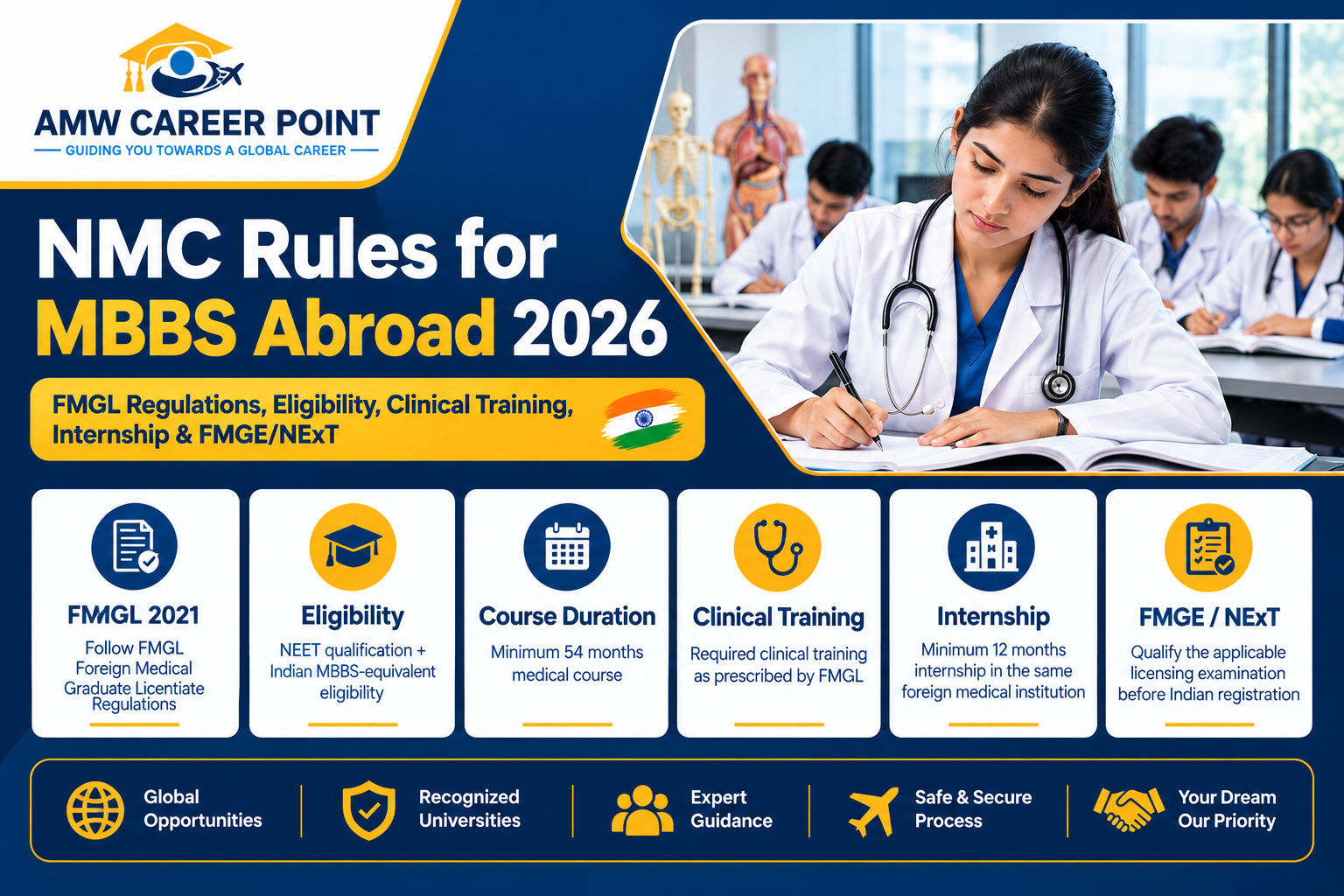
NMC’s Foreign Medical Graduate Licentiate (FMGL) Regulations 2021 are the governing framework. Every student considering MBBS abroad regardless of country needs to understand these six requirements.
NMC Requirement | Details | Philippines Compliance |
Minimum Academic Duration | 54 months of medical education (excluding internship) | Philippine MD is 54 months (pre-medical BS phase not counted). Confirmed by Embassy advisory, 17 June 2026. |
English Medium of Instruction | 100% English throughout — no bilingual programmes; must be confirmed in writing | Confirmed English-medium at all CHED-recognised institutions. Verify with the Language of Instruction Certificate from the registrar. |
Mandatory Subjects | All subjects listed in Schedule I of the NMC notification dated 18 November 2021 must be covered. | The standard Philippine MD curriculum covers Schedule-I subjects; request the curriculum map from the university registrar before enrolling. |
Internship | 12-month clinical internship at the same institution or its attached teaching hospital. An internship in India does not count. | Philippine MD programmes include a 12-month internship at the affiliated teaching hospital. Confirm same-institution policy in writing. |
Certificate of Registrability | The university must be able to issue a certificate confirming the graduate is eligible for practice registration in the country of the degree. | CHED-recognised institutions can issue this certificate. Verify per university. |
NEET Qualification | A valid qualifying NEET score is required for the NMC Eligibility Certificate. Must be held at the time of applying for the Eligibility Certificate post-graduation. | NEET is not required by Philippine universities for admission, but is required by NMC for Indian students seeking to practice in India after graduation. |
Cost Analysis Is Studying Abroad While Preparing for NEET Worth It?
The cost comparison requires including all actual expenditures, not just headline tuition figures.
Cost Component | Drop Year in India | Philippines MBBS Year 1 | Russia MBBS Year 1 | Georgia MBBS Year 1 |
Tuition / Coaching | ₹1.2–2.5L (NEET coaching) | ₹3–5L (university tuition) | ₹3–5L | ₹3–4.5L |
Hostel / Accommodation | ₹60K–1.5L | ₹1.5–2.5L | ₹1.5–2.5L | ₹1.5–2.5L |
Food | ₹60K–1.2L | ₹1.2–2L | ₹1.2–2L | ₹1–1.8L |
Travel (NEET city) | Minimal | ₹30K–60K (India return for NEET) | ₹40K–70K | ₹35K–65K |
Study Materials / Mock Tests | ₹30K–60K | ₹10K–20K (NEET material only) | ₹10K–20K | ₹10K–20K |
Total Year 1 Cost | ₹3–5.5L (with zero academic qualification) | ₹6.5–12L (with Year 1 MBBS completed) | ₹7–12.5L | ₹6.5–11.5L |
If NEET Fails Again Year 2 Cost | Another ₹3–5.5L for Year 2 of dropping | Year 2 MBBS continues — similar annual cost; no additional dropout | Similar | Similar |
Worst-Case Scenario Cost (2 drops = 0 MBBS) | ₹6–11L with no medical qualification | Not applicable — MBBS continues regardless | — | — |
The financial case for MBBS abroad vs a drop year becomes significantly more compelling when the Year 2 scenario is modelled. Two drop years at NEET coaching costs ₹6–11 Lakh with no academic output. Year 2 of MBBS abroad costs a similar amount but produces Year 2 of a recognised medical degree.
Advantages and Challenges of the Dual Strategy
Advantages | Details |
No Academic Gap | The student has been in active medical education since September 2026—no gap in academic record. |
Genuine Medical Exposure | Anatomy labs, physiology practicals, and hospital orientation in Year 1 simultaneously build both NEET content knowledge and clinical instinct. |
NEET Optionality Preserved | The student retains the option to re-enter India if NEET improves, without having lost a year to preparation alone. |
Internationally Recognised Degree as Primary Outcome | Even if NEET does not improve, the student is on track for a licensed medical degree with pathways to practice in India (via FMGE/NExT), in the degree country, or globally. |
USMLE / International Career Parallel Option | The Philippine curriculum specifically opens the USMLE pathway for students with international ambitions, regardless of NEET outcomes. |
Financial Efficiency | MBBS abroad typically costs significantly less than an Indian private MBBS while producing an equivalent or superior career outcome through FMGE/NExT. |
Challenges | How to Mitigate |
Attendance Requirements vs NEET Travel | Plan the NEET trip well in advance; inform the university administration early; ensure attendance remains above the threshold by a margin. Most universities allow a minimum of 75–80%. |
Physics and Chemistry Gap | The biggest real challenge. The Philippine MBBS curriculum does not prepare students for Physics and Chemistry in NEET. This requires genuine daily commitment (2.5–3 hours) to independent preparation. |
Financial Double Track | Paying MBBS fees while funding NEET preparation requires clear family financial planning. Model both scenarios (transfer to India OR continue abroad) before starting. |
Workload and Discipline | Year 1 MBBS plus NEET preparation is not a light schedule. Students who do not establish their routine in the first 4 weeks rarely catch up. Build the habit immediately. |
Homesickness and Adjustment | The first 6–10 weeks abroad are the most difficult. The Indian student community at major Philippine universities (such as Cebu and Davao) significantly eases this adjustment. Choose universities with established Indian communities. |
Decision Fatigue at Year End | When NEET results arrive, the decision to stay or leave is emotionally complex. Decide your criteria in advance (government seat: leave; private only: cost comparison; no improvement: continue) before the results arrive, not in the middle of them. |
Myth vs Fact Common Misconceptions About This Strategy
Myth | Fact |
“My Philippines Year 1 will be credited if I transfer to India” | Indian medical colleges almost universally do not credit foreign MBBS years. A student transferring to India must start from Year 1. This does not invalidate the strategy — but it must be understood clearly from the start. |
“Once I start MBBS abroad, I can’t give NEET” | False. NTA does not restrict NEET registration or participation based on enrolment in a foreign medical university. |
“Only students who failed NEET consider this option” | False. Many students who qualified for NEET use this strategy specifically because they cannot access or afford an Indian seat, not because they failed the exam. |
“The Philippine curriculum is too different from NEET” | The opposite is true. Philippine MBBS Year 1 (Anatomy, Physiology, Biochemistry) overlaps approximately 60–70% of NEET Biology. It is the highest-overlap MBBS abroad destination for NEET preparation. |
“You must be NEET-qualified before joining MBBS abroad” | NMC requires a qualifying NEET score to issue the Eligibility Certificate post-graduation, not pre-enrolment. Students can enrol in a foreign MBBS and qualify for NEET during the programme. |
“MBBS abroad is a backup for students who couldn’t get anywhere” | The Philippines’ Embassy-advisory-confirmed NMC compliance, Russia’s established medical system, and Georgia’s leading FMGE rates are not consolation prizes. These are substantive medical education pathways with globally recognised outcomes. |
Expert Counselling Checklist Before Making Your Decision
Use this checklist before committing to any decision dropping a year, studying MBBS abroad, or a combination of both. Every question below should have a clear, documented answer before money changes hands.
Checklist Item | Why It Matters | Status |
Have you qualified NEET with at least the NMC minimum score? | Without a qualifying NEET score before or during the foreign programme, the NMC Eligibility Certificate cannot be issued post-graduation. | Yes / In Progress / No |
Have you verified the university’s WDOMS listing? | WDOMS listing is the primary NMC eligibility criterion. Not listed = not eligible for FMGE/NExT. | Verified / Pending |
Have you confirmed English-medium instruction in writing? | Some universities that market as ‘English medium’ switch to the local language in clinical years. Get a Language of Instruction Certificate from the registrar. | Confirmed / Pending |
Have you compared all 6-year costs itemised? | Tuition + hostel + food + travel + NEET coaching + visa + one-time costs. Headline tuition is not the full number. | Done / In Progress |
Is your university’s FMGE pass rate verified from NBEMS data? | Consultancy-supplied pass rate figures are not always sourced from NBEMS. Ask for the specific NBEMS report. | Verified / Pending |
Have you checked the attendance policy against NEET travel dates? | A 3-week trip to India for NEET must fit within the university’s minimum attendance requirement. | Checked / Pending |
Can your family support both possible financial pathways? | Scenario A: MBBS abroad for the full 6 years. Scenario B: Year 1 abroad + 5 years Indian MBBS. Both scenarios must be financially viable. | Yes / Evaluate |
Have you decided in advance what rank improvement would trigger a transfer? | Decide the criteria before results arrive, not during them. Government seat only? Any private seat? A specific college? Define the threshold now. | Defined / Pending |
Have you discussed long-term career goals honestly? | Does India practice only? International career open? PG in India? USMLE? The career goal should drive country and university selection, not just this year’s NEET score. | Discussed / Pending |
Have you spoken to a current student at your shortlisted university? | Not a consultant’s reference — an independently contacted student. Ask specifically about Year 1 workload and NEET prep manageability. | Done / Pending |
Final Verdict Is Studying MBBS Abroad While Preparing for NEET the Right Choice?
The answer is not universal but the framework for finding your specific answer is.
If You Are... | Recommended Direction | Key Condition |
Qualified NEET, no government seat, cannot afford private MBBS | MBBS abroad + structured NEET re-attempt strongly recommended | Choose an NMC-compliant university with a verified FMGE track record; the Philippines is the strongest for NEET subject overlap |
Within 30–50 marks of a government seat, first drop year | A single-focused drop year is worth considering first | If it fails, begin MBBS abroad immediately without a second drop |
Second- or third-year dropper with flat or declining scores | MBBS abroad is the stronger option; further dropping has diminishing returns | Choose abroad with full commitment to the programme, and maintain NEET as an annual option |
Family cannot support ₹70L+ Indian private MBBS | MBBS abroad at ₹18–35L total is the substantive financial alternative | Verify all 6 NMC conditions; do not choose by tuition alone |
Wants international career options open (USMLE, EU, Gulf) | MBBS abroad is the primary choice regardless of the NEET outcome | Philippines for USMLE track; Georgia/Russia/Italy for European/global track |
Genuinely uncertain about medicine as a career | Resolve career direction before committing to any MBBS programme | Either a focused gap year with career counselling, or a structured MBBS abroad, with the understanding that clarity often comes from clinical exposure |
The single most important decision in this entire process is not whether to study abroad while preparing for NEET. It is the university you choose to study at. A student who chooses an NMC-compliant, WDOMS-listed, high-FMGE-performing institution and builds a structured NEET preparation routine from Day 1 has created a medical career with two possible successful outcomes. A student who chooses based on tuition fees, fails to verify NMC compliance, or fails to establish a realistic Physics and Chemistry schedule from the first month has created a situation where neither outcome is reliably good.
AMW Career Point counsels students on exactly this decision not with a country preference or a commission incentive, but with each student's specific NEET score, family budget, and career goal as the starting point. Contact AMW after your NEET 2026 results are available for a personalised session that covers every item in the Section 17 checklist before any decision is finalised.
Frequently Asked Questions (FAQs)
Q1. Can I give NEET while studying MBBS abroad?
Yes. NTA has no rule preventing students enrolled in foreign medical universities from registering for and sitting for NEET. You register online, travel to India for the exam, and receive your results like any other candidate.
Q2. Can I prepare for NEET from the Philippines?
Yes — and with the curriculum advantage described in Section 9. Philippine MBBS Year 1 subjects directly reinforce approximately 60–70% of NEET Biology. Physics and Chemistry require dedicated independent preparation (2.5–3 hours daily), but the Biology component is effectively built into your academic schedule.
Q3. Is NEET compulsory for MBBS abroad?
Foreign universities do not require NEET for admission. However, NMC requires a valid qualifying NEET score to issue the Eligibility Certificate, which permits a foreign MBBS graduate to sit for FMGE/NExT in India. Without qualifying for NEET at some point, you cannot practice medicine in India after a foreign degree.
Q4. Can I leave my foreign university after clearing NEET?
Yes. No foreign university has a legal mechanism to prevent a student from discontinuing their enrolment. You will typically forfeit the tuition paid for the current semester or academic year (universities generally do not refund fees once the term is underway), and there is no credit transfer to Indian MBBS programmes. But you can leave and join an Indian government college.
Q5. Will my first-year MBBS from the Philippines be counted in India?
Almost certainly not. Indian medical colleges do not grant credit for foreign MBBS years as a standard policy. If you transfer to India after clearing NEET, you will begin from Year 1 of the Indian programme. This is the correct way to understand the strategy: Year 1 abroad is not a shortcut to Year 2 in India; it is a year of genuine medical education that has its own value regardless of whether a transfer occurs.
Q6. Can I transfer from the Philippines to India?
You can withdraw from a Philippine university and join an Indian programme after clearing NEET counselling. This is a withdrawal and fresh admission, not a formal credit transfer. Budget for the overlap: you will have paid a full year’s Philippine tuition, then pay the full Indian MBBS fees from Year 1.
Q7. Which country is best for preparing for NEET while studying medicine?
The Philippines offers the strongest curriculum overlap with NEET Biology in Year 1, combined with 100% English-medium instruction, an established Indian student community, and the June 2026 Embassy advisory confirming NMC compliance. Russia, Georgia, and Kyrgyzstan are also strong options. Italy (IMAT) and Bangladesh (safety situation) require separate evaluation considerations.
Q8. Does NMC allow this studying abroad while planning to take NEET again?
NMC does not address this scenario as a specific policy position — there is no notification approving or prohibiting it. The NMC requires that, at the time a foreign MBBS graduate applies for the NMC Eligibility Certificate, they hold a valid NEET score. When that qualifying score was achieved (before or during the foreign MBBS programme) is not specified as a requirement.
Q9. Is a drop year better than MBBS abroad?
Statistically, a single drop year results in meaningful rank improvement for fewer than 40% of candidates. MBBS abroad produces a Year 1 medical qualification regardless of the NEET outcome. The financial cost in Year 1 is broadly comparable. The academic output is not. For students within 50–100 marks of a government seat, a single, highly focused drop year remains a reasonable option. For all others, MBBS abroad with a NEET re-attempt is the better-structured choice.
Q10. What happens to my fees if I leave?
Most foreign universities operate a semester-based or year-based fee structure. If you leave mid-semester, the semester fee is typically not refunded. If you leave between semesters after completing Year 1, you have paid for Year 1 in full and will not receive a refund. Some universities allow a leave of absence rather than full withdrawal — check the specific policy of your university before making any decision.
Q11. Is this option suitable for third-year NEET repeaters?
Yes — and arguably more appropriate than another drop year. Three drops with declining returns indicate a pattern that a fourth attempt is unlikely to break. MBBS abroad ends academic stagnation, provides a clinical context that may actually improve understanding of NEET, and guarantees a medical career outcome. The third-year dropper is the student for whom this strategy often yields the greatest material improvement in life.
Q12. What NEET score do I need for this strategy?
The NMC minimum for Eligibility Certificate purposes is the 50th percentile (General) or the 40th percentile (SC/ST/OBC). For most NMC-approved mid-tier universities abroad, a NEET score of 150–300 is sufficient for enrolment. The strategy makes the most sense for students scoring 250–500 who either lack access to government seats or cannot afford private Indian fees.
Q13. How do I manage NEET Physics and Chemistry without coaching while in the Philippines?
Structured self-study using NCERT (Class 11 and 12) as the base, supplemented by online NEET coaching platforms (Unacademy, Physics Wallah, Allen online modules) that can be accessed from the Philippines. Allocate a dedicated 2.5–3-hour daily block for Physics and Chemistry, separately from university study. Bi-weekly timed NEET mock tests (available online) track progress. Peer study groups with other NEET-parallel students in your university building are one of the most effective tools.
Q14. Can I practice in India after an MBBS from the Philippines without going to India for NEET again?
No. FMGE/NExT eligibility requires a qualifying NEET score (for the NMC Eligibility Certificate) in addition to graduation from an NMC-compliant foreign university and completion of the 12-month Philippines internship. If you enrolled abroad without qualifying for NEET, you must qualify for it at some point before applying for the Eligibility Certificate. This is why qualifying NEET during the foreign programme — whether in Year 1 or later — is important.
Q15. Is an MBBS from the Philippines NMC-approved in 2026?
The Embassy of India, Manila, issued an advisory on 17 June 2026 confirming that the MD degree from CHED-recognised institutions in the Philippines complies with NMC FMGL Regulations, subject to five specific conditions (54-month MD, English medium, NMC mandatory subjects, 12-month same-institution internship, Certificate of Registrability). This is a country-level regulatory confirmation. Verify NMC/WDOMS status for each specific university independently before enrolling