Most of the advice on medical courses in the UK never mentions Ulster University in their recommendations, and the reason behind that is clear: the university's School of Medicine was established in August 2021.
This was when the first 70-strong cohort began attending classes at the Magee campus in Derry~Londonderry as part of the Northern Ireland Executive plan to tackle a severe lack of doctors in the area.
It is therefore currently the newest medical school in the UK and Ireland, newer than all other medical institutions any agent might showcase to a prospective family, including those that were founded decades ago in Eastern Europe or the Caribbean.
But then comes a rather obvious question – what if the school fails to gain recognition for its degree? And again, Ulster thought of that ahead of time.
Throughout its four-year history, the school worked in partnership with City St George's, University of London – a graduate-entry medical school as a precautionary measure.
If the General Medical Council's degree-awarding quality assurance process had not been satisfied, it would be the latter that would have awarded the final degree. But such measures were unnecessary, and in April 2025 the GMC granted the Ulster School of Medicine full degree-awarding powers for Primary Medical Qualification.
The first cohort graduated in June 2025 as MBBS holders eligible for provisional registration just like any other UK medical graduates.
The course itself is graduate-entry only; there is no school leaver entry. The applicants need a minimum 2:1 honours degree in any discipline, a good GAMSAT result, and the MMI interview.
The programme is structured around PBL teaching model with Year 1 covering the foundational biomedical sciences, communication and clinical skills along with the first GP placement.
According to the opinion that GP-based training should begin right away and not be left for later stages, Year 2 involves a 17-week problem-based learning block relating the science to primary and secondary care management.
These weeks are interrupted by three five-week clinical rotations as the students move on to more hospital-related experience. Years 3 and 4 include placements in each of Northern Ireland's five Health and Social Care Trusts and GP practices throughout the country.
Finally, there are finals and the same Medical Licensing Assessment as for any other UK medical graduate.
A cohort of 70 a year is relatively small by UK standards, much smaller than those in UCL and Manchester. Most of the clinical training takes place through Altnagelvin Area Hospital and MedEdWest education unit, Western Trust in Derry.
There is also training through South West Acute Hospital in Enniskillen, and placement sites as far away as Belfast.
But before applying it is important to remember that since the course is graduate entry and uses PBL small groups for teaching instead of dissection, students wishing to dissect the body of a deceased person should consider other options.
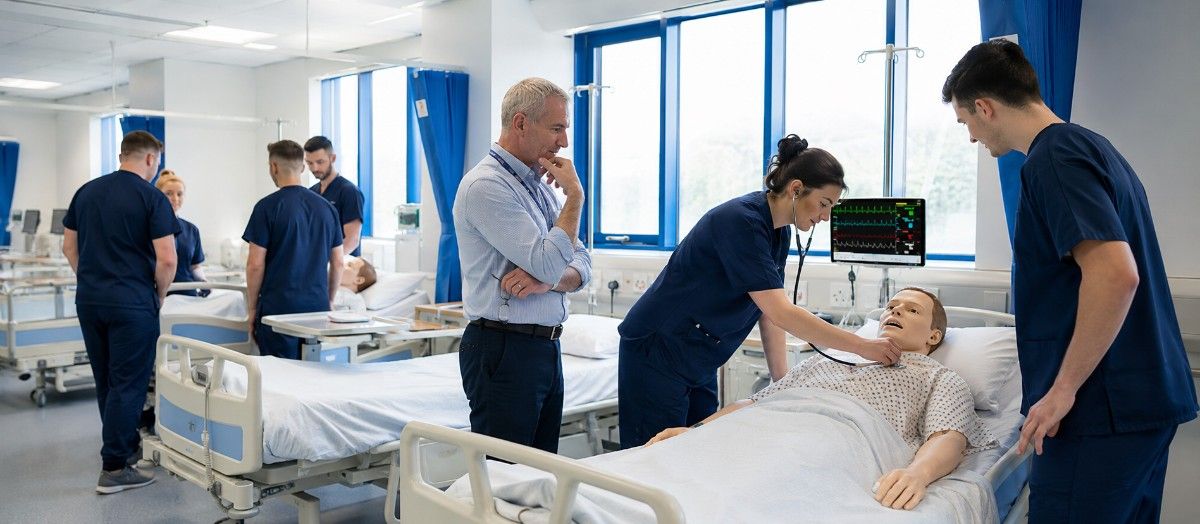
Ulster uses prosection, imaging and simulation methods to teach anatomy.
In financial terms, Ulster's 2026/27 tuition fees for Medicine are £39,630 per annum, which is notably lower than at Oxford, Cambridge, UCL or Imperial.
However, international students should be ready for another particular fee specific to both medical schools in Northern Ireland - Clinical Placement Levy, fixed at £12,133 per year for 2026/27.
It is paid in addition to the tuition fees each year and is necessary to pay for access to the region's Health and Social Care placements.
International students can neither access UK tuition fee loans nor NHS scholarships, so they have to cover the whole four years of the course themselves.
And while the tuition is subject to annual increase like with all UK universities, there is one thing where Ulster gets some compensation - the cost of living.
Derry~Londonderry is one of the more affordable university towns in the UK with halls of residence renting for substantially less than in London or even Belfast.
None of the above replaces the reputation that a two-hundred-year-old medical school can bring. Ulster does not have subject-specific medical ranking because it takes QS and similar tables a few years to collect sufficient graduate/research statistics.
But the overall QS position in the high 500s reflects an institution still growing in its research profile rather than an established brand.
What Ulster provides instead is a course created from scratch with problem-based learning and community-based care in mind, guaranteed placements in all of Northern Ireland instead of one city and a small cohort allowing the faculty to know every single student by name.
This is quite an experience that is hard to get at a 300-plus student intake school in London.