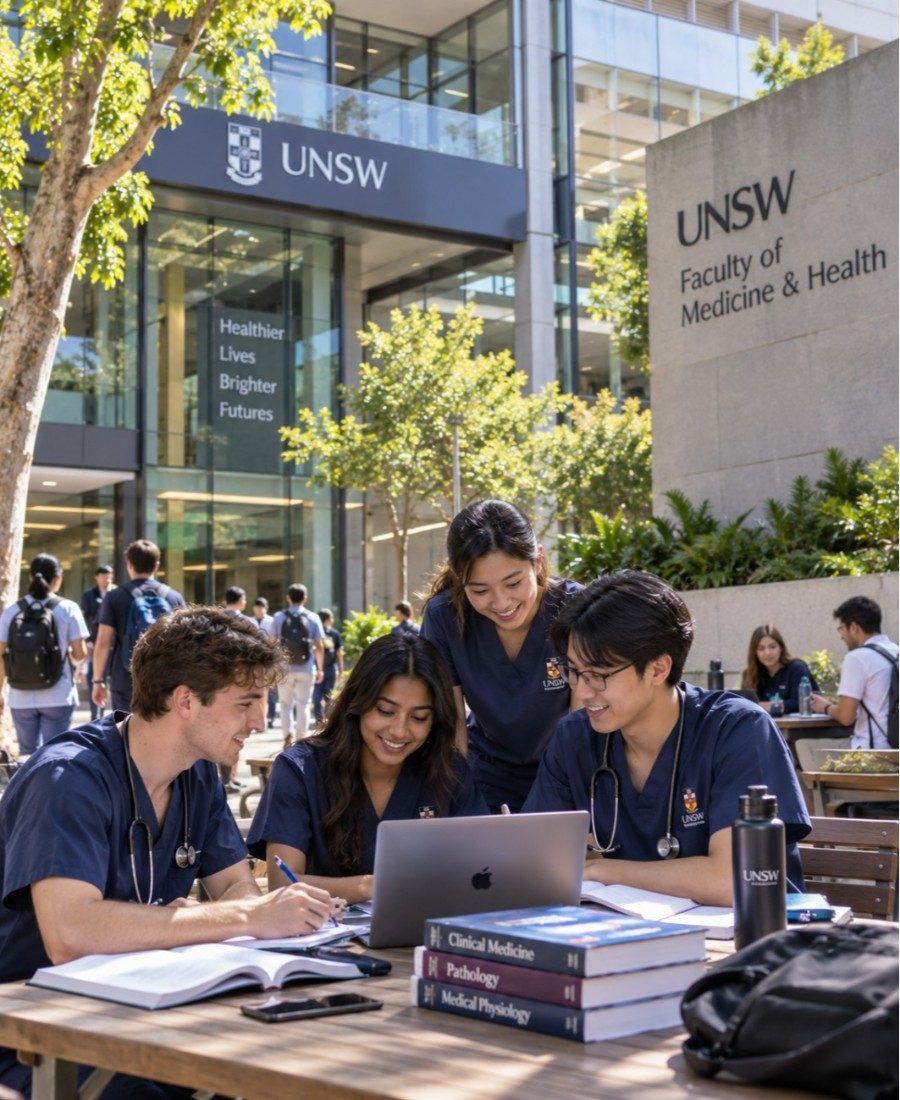
The University of New South Wales runs one of Australia's most research-heavy medical programs. It also takes a different shape from other Group of Eight schools. UQ needs a prior bachelor's degree. Monash offers both direct and graduate entry. UNSW runs just one combined path. This is the six-year Bachelor of Medical Studies/Doctor of Medicine (BMed/MD). It opens directly to school leavers. This includes international students straight out of Year 12. UNSW has no separate graduate-only entry point. Every applicant joins the same six-year track. You cannot join the program for just the MD part. For Indian families, this means something simple. A strong Class 12 student can start medicine right away. They skip the need for an unrelated degree first. This feels close to Monash's direct-entry option. But UNSW delivers it through one single structure, not two separate paths.
UNSW's Faculty of Medicine & Health began in June 1960. Professor Frank Rundle served as founding dean. The next year, Prince Henry and Prince of Wales Hospitals joined under one management. They became the medical school's first teaching hospitals. This partnership has since grown. It now spans Sydney and rural New South Wales. The faculty today holds nine schools. It stands as one of the largest and most active health faculties in the country.
UNSW sits at 20th place in the 2026 QS World University Rankings. This makes it one of the top-ranked Group of Eight universities. It sits just behind Melbourne among Australian schools, with its life sciences and medicine programs ranked in the world’s top 60. This comes from QS Subject Rankings. The university has also been named Australia's most employable university. It has held this title for seven years straight. Six UNSW subjects sit in the global top 20. The university has also produced Nobel laureates. This includes chemistry professor Sir Fraser Stoddart. This strong employability record matters for medicine too. Graduates often report some of the highest starting salaries among Go8 schools. UNSW also runs industry advisory boards. Many members come from major teaching hospitals. This helps keep the curriculum matched to real hospital needs.
The BMed/MD program follows three phases. This differs from simple year-by-year steps. Phase 1 covers the first two years. It happens mostly on the Kensington campus. It starts with a Foundations course. Then come seven eight-week courses. These cover basic medical science tied to the human life cycle. They also cover social, ethical, and legal issues in health care. Clinical sessions in hospitals start even in this early phase. Students from different year levels work together in small groups. This means first- and second-year students learn side by side. They take turns acting as both learner and mentor.
Phase 2 covers years three and four. It shifts the focus firmly toward clinical work. Hospital sessions rise to three days a week. Campus teaching fills the other two days. This phase also holds something unique to UNSW. Every student completes a compulsory Independent Learning Project (ILP) or an Honours year. This is a supervised research project of the student's own choosing. It is not optional. It reflects UNSW's stance that graduates need real research training. Clinical skill alone is not enough.
Phase 3 covers years five and six. It deepens clinical training even further. It ends with a clinical transition course. This spans internal medicine, surgery, psychiatry, primary care, obstetrics, gynaecology, and paediatrics. These are the fields a new intern must be ready to handle from day one.
Clinical training runs through a large network. Four metro clinical campuses anchor most Sydney-based teaching. The Randwick Clinical Campus hosts Prince of Wales Hospital, Sydney Children's Hospital, and the Royal Hospital for Women. The St Vincent's Healthcare Campus sits beside the Garvan Institute, the Victor Chang Institute, and St Vincent's Centre for Applied Medical Research. The South West Sydney campuses span Liverpool, Bankstown, Campbelltown, and Fairfield. The St George and Sutherland campuses round out the metro group. Beyond Sydney, the Rural Clinical School launched in 2000. It runs full clinical campuses in Albury, Coffs Harbour, Griffith, Port Macquarie, and Wagga Wagga. Every student spends at least four weeks in a non-metro setting. About a quarter of students complete one to two full years training rurally. This gives graduates real exposure to regional health care before they qualify.
Entry into the program is genuinely tough. International applicants pick one of two admissions tests. The first is the University Clinical Aptitude Test (UCAT ANZ). Most Australian medical schools use this test. The second is the International Student Admission Test (ISAT). This is a three-hour test measuring critical and quantitative reasoning. It runs at test centres worldwide. Once you submit one test, you cannot switch to the other later. Offers rest on three factors together. These are academic merit, the test score, and an interview. These scores are not averaged. A strong result in one area cannot cover for a weak one elsewhere. So applicants must perform well across all three at once. Competition for places runs high. Most successful applicants say the interview stage surprises them most. It is not a simple chat about motivation. It is a structured test of judgment, communication under pressure, and quick reasoning through unfamiliar situations.
International students should know one key fact about the end of the degree. On completion of the BMed/MD, all graduates receive provisional registration with the Medical Board of Australia and are eligible to commence the compulsory one-year hospital internship. Full registration follows this internship. Local graduates get a guaranteed internship spot. International graduates do not get this guarantee. They must check availability directly with the state health department. This is a key detail to factor into any long-term plan around studying at UNSW.
UNSW's Kensington campus sits in a lively, mixed inner-city suburb. It falls between Sydney's CBD and its eastern beaches. Light rail gets students to the city centre in about 20 minutes. Coogee Beach sits just eight minutes away by bus. The university draws more than 60,000 students from over 130 countries. On-campus housing includes residential colleges and self-catered apartments. An alumni network of more than 300,000 graduates spans 170-plus countries. This network offers mentorship and career referrals well past graduation. For medical students, this scale brings a real benefit too. Cohorts stay large enough to support active peer-mentoring groups and student-run medical societies. Newcomers rarely train alone, even through the tough clinical years.
Research strength runs deep across the faculty. Direct links exist with the Garvan Institute of Medical Research & the Victor Chang Cardiac Research Institute. Both sit right next to UNSW's St Vincent's clinical campus. This closeness, paired with the compulsory ILP or Honours work, means something clear. UNSW medical graduates often leave with more structured research experience. This beats programs where research stays purely optional.
In short, UNSW suits ambitious school leavers well. They want one clear six-year path into medicine at a truly world-ranked university. They also get research infrastructure that most direct-entry programs elsewhere skip. This is a demanding, single-track program, not a menu of choices. Applicants should prepare for a tough, all-round selection process. They should also expect a curriculum that treats research training as core, not extra.