I.K. Akhunbaev Kyrgyz State Medical Academy, universally referred to as KSMA, is the oldest medical university in Kyrgyzstan, founded on September 1, 1939, decades before any other institution covered in this blog series. It started with 200 students. It now trains 15,000+ students across all faculties, including 250+ Indian students in the General Medicine programme alone. For Indian families evaluating Kyrgyzstan as an MBBS destination, KSMA usually appears on the shortlist for one straightforward reason: it has the second-best FMGE 2024 pass rate in the country, behind only KRSU, at a noticeably lower fee.
Here are the numbers that matter in 2026: KSMA’s annual tuition is approximately USD 4,000–4,500, which is ₹3.88–4.35 lakh/year. Hostel fees range from USD 500 to 1,000/year. The total 6-year all-in cost lands at ₹24–28 Lakhs, depending on lifestyle. Set against KRSU’s ₹26–30 Lakhs for a 39.66% FMGE rate, KSMA’s 31.56% FMGE rate at a ₹2–3 Lakh lower price point is one of the strongest cost-to-outcome ratios in Kyrgyzstan.
The honest part: KSMA is located in Bishkek itself, not a satellite town like Kant, and not a regional city 600 km away like Osh or Jalalabad. This means direct access to Manas International Airport, Bishkek’s larger Indian community, and the city-level infrastructure that comes with being Kyrgyzstan’s capital. It is also the most historically established institution, founded by professors from Moscow, St. Petersburg, Kharkiv, and Kyiv, with 87 years of continuous medical education behind it by 2026.
This guide covers the complete picture, the NMC compliance checklist, the FMGE/NExT data and what it means for KSMA students, the 6-year course breakdown, Bishkek as a study city, and an honest comparison with KRSU, OSMU, AMI, and JASU so Indian students can make a properly informed decision for 2026.
KSMA Quick Facts 2026: Established September 1, 1939. Government (public) university. Located in Bishkek, the capital of Kyrgyzstan. NMC + WHO + WDOMS + ECFMG + FAIMER + WFME approved. English-medium MBBS.
Annual tuition: USD 4,000–4,500 (₹3.88–4.37 lakh)
Total 6-year all-in: ₹24–28 Lakhs at ₹97/USD. 15,000+ total students; 250+ Indian students in MBBS. 900+ faculty. FMGE 2024: 31.56%, 2nd highest in Kyrgyzstan. Two intakes: September & February.
Key Decision Factors for Indian Students
1: Oldest, Most Established Medical University in Kyrgyzstan: KSMA was founded in 1939, 53 years before KRSU (1993) and decades before any other Kyrgyzstan institution covered in this blog series. Founded by professors from Moscow, St. Petersburg, Kharkiv, and Kyiv, it carries 87 years of continuous medical education history. This translates into established academic systems, faculty depth (900+ teachers), and a track record that newer institutions cannot replicate.
2: FMGE 2024 Second-Best in Kyrgyzstan: KSMA recorded a 31.56% FMGE pass rate in 2024, the second-highest in Kyrgyzstan after KRSU’s 39.66%, and well above the national aggregate of 25.80%. This is a verified, citable, NBEMS-sourced figure with no discrepancy across multiple independent sources, a meaningfully more reliable data point than some other Kyrgyzstan institutions in this series.
3: Cost: Strong Value at ₹2–3 Lakhs Below KRSU: Annual tuition USD 4,000–4,500 (₹3.88–4.37 lakh at ₹97). Total 6-year all-in: ₹24–28 Lakhs. This is meaningfully lower than KRSU (₹26–30 Lakhs) while delivering the second-best FMGE outcome in the country, arguably the strongest cost-to-FMGE-outcome ratio of any government university in Kyrgyzstan.
4: Located in Bishkek: Capital City Infrastructure: Unlike OSMU (Osh, 600 km away) or JASU (Jalalabad, 600 km away), KSMA is physically located in Bishkek, Kyrgyzstan’s capital. This means direct access to Manas International Airport, the country’s largest Indian expatriate and student community, better healthcare access, and city-level infrastructure (malls, restaurants, hospitals, transport) that smaller regional cities cannot match.
5: Broad International Recognition Beyond NMC: KSMA holds recognition not just from NMC and WHO but also ECFMG (enabling USMLE eligibility for US licensing), FAIMER, and WFME. While the primary pathway for Indian students remains NMC/NExT, this breadth of recognition is a genuine differentiator for students who may consider international licensing pathways beyond India in the future.
What is Kyrgyz State Medical Academy? An Overview for Indian Students
I.K. Akhunbaev Kyrgyz State Medical Academy (KSMA) is a government-owned medical university located in Bishkek, the capital of Kyrgyzstan. It was established on September 1, 1939, making it the oldest medical educational institution in the country by a wide margin, more than five decades older than KRSU and several decades older than most other Kyrgyzstan universities recruiting Indian students today.
The academy is named after I.K. Akhunbaev, and operates under the Ministry of Health and the Ministry of Education and Science of the Kyrgyz Republic. It started with just 200 students in 1939 and has grown into one of Central Asia’s major medical education hubs, currently enrolling 15,000+ students (local Kyrgyz and international combined) across faculties, including General Medicine, Paediatrics, Dentistry, Pharmacy, Public Health, Nursing, and Preventive Care. The General Medicine faculty is the primary MBBS-equivalent track for Indian students.
KSMA holds one of the broadest recognition portfolios among Kyrgyzstan’s medical universities: NMC (India), WHO, WDOMS listing, ECFMG (enabling USMLE eligibility for graduates pursuing US licensing), FAIMER, and WFME. The Ministry of Health of Kyrgyzstan also accredits the institution directly. For Indian students, the relevant pathways remain NMC recognition and NExT eligibility. Still, the breadth of international recognition reflects an institution with longer-standing academic credibility than most newer entrants in the Kyrgyz MBBS market.
Currently, more than 250 Indian students are enrolled in KSMA’s MBBS programme, taught entirely in English. The university has produced notable alums, including Mitalip Mamytov, a recognised neurosurgeon and Hero of the Kyrgyz Republic, reflecting KSMA’s historical role in training Kyrgyzstan’s own medical leadership, not just international fee-paying students.
Kyrgyz State Medical Academy (KSMA) At a Glance 2026
Particulars | Details |
Full Name | I.K. Akhunbaev Kyrgyz State Medical Academy (KSMA) |
Established | September 1, 1939 |
Type | Government (Public) University |
Location | Bishkek, capital of Kyrgyzstan |
Governing Body | Ministry of Education & Science + Ministry of Health, Kyrgyz Republic |
Programme for Indian Students | General Medicine (MBBS equivalent) Doctor of Medicine |
Course Duration | 6 Years 5 years academic (54 months) + 1 year of mandatory internship |
Medium of Instruction | English (100% for international students) |
NEET Requirement | Mandatory 50%+ PCB marks (40% for SC/ST/OBC) + valid NEET qualification |
NMC Approval | Yes, NMC-approved and WDOMS-listed. |
Other Recognitions | WHO, ECFMG, FAIMER, WFME |
Total 6-Year All-In Cost | ₹24–28 Lakhs, depending on lifestyle |
Annual Tuition | USD 4,000–4,500 (₹3.88–4.37 lakh/year) |
Hostel Fees | USD 500–1,000/year (₹48,500–97,000/year) |
Monthly Living (food, transport, personal) | ₹15,000–20,000/month (Bishkek city pricing) |
Total University Students | 15,000+ (across all faculties, local + international) |
Indian Students in the MBBS Programme | 250+ |
Faculty Strength | 900+ teachers |
FMGE 2024 Pass Rate | 31.56%, which is the 2nd highest in Kyrgyzstan after KRSU |
UniRank Country Ranking | 7th in Kyrgyzstan (cited across multiple ranking portals; some cite 1st among medical-specific institutions) |
Intakes | September (primary) and February (secondary) |
City Airport | Manas International Airport (FRU), Bishkek, direct city access |
Is Kyrgyz State Medical Academy NMC-approved?
Yes, KSMA is approved by the National Medical Commission (NMC, India), listed on WDOMS, and additionally recognised by WHO, ECFMG, FAIMER, and WFME. Indian students who complete the full 6-year programme (5 years of academics + 1 year of mandatory internship) are eligible to appear for NExT (the National Exit Test, which replaced FMGE from 2026) to practise medicine in India.
The compliance checklist below covers every verification point that Indian students and parents should independently confirm before finalising admission, as part of standard due diligence, regardless of how well-established an institution is.
NMC Compliance Checklist for Kyrgyz State Medical Academy
WDOMS Listing: Verify at wdoms.org that KSMA and its General Medicine programme are currently listed. KSMA is consistently listed across multiple independent sources and will be re-verified at the time of your 2026 enrollment.
English Medium Throughout: KSMA’s General Medicine programme for international students is 100% English-medium for academics, examinations, and labs. Confirm this in writing in your admission offer letter.
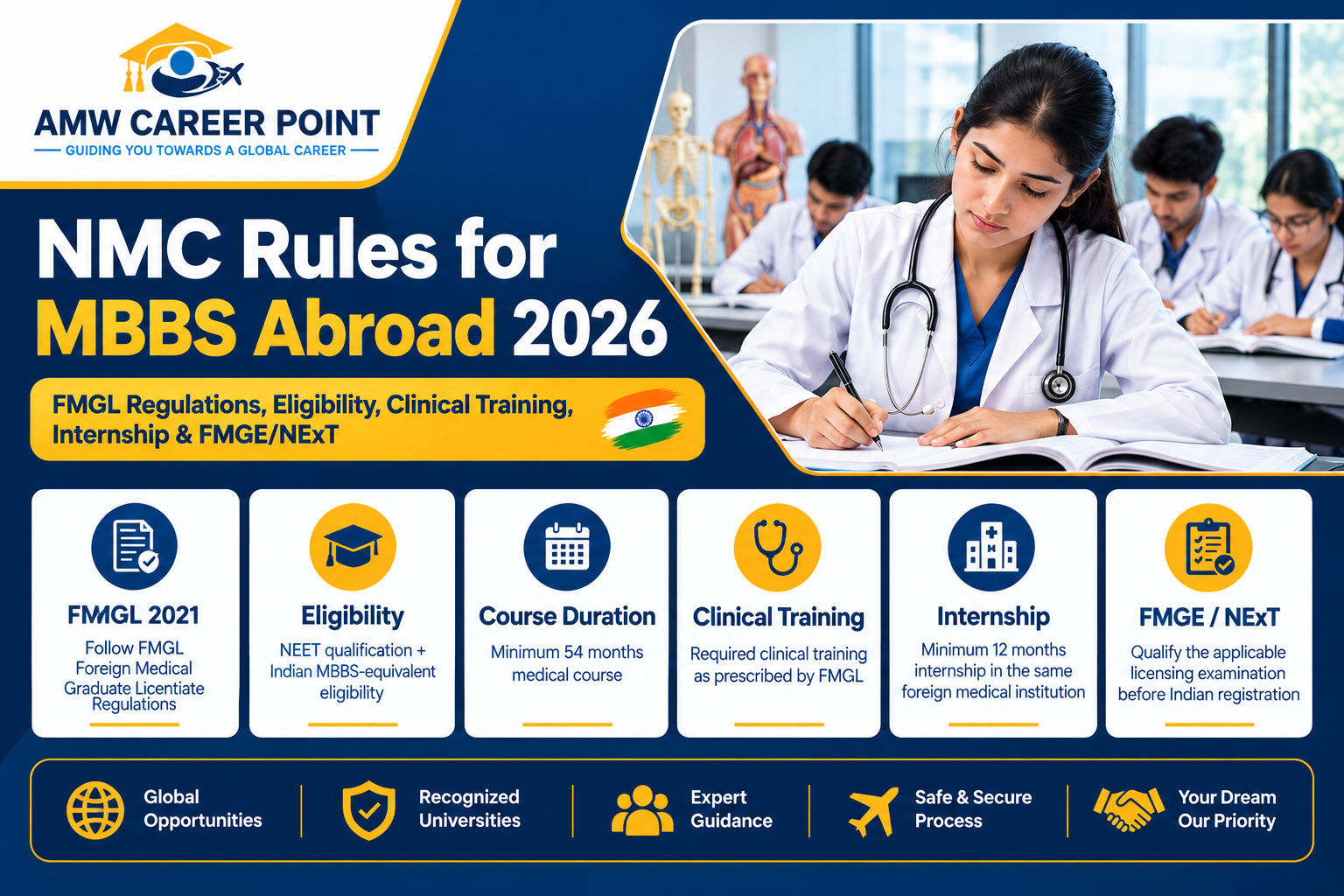
Course Duration 54 Months Academic + 12-Month Internship: NMC FMGL Gazette 2021 requires a minimum of 54 months (4.5 years) of academic study plus a 12-month mandatory internship. KSMA’s 5+1 structure satisfies this requirement.
Internship at KSMA-Affiliated Hospitals in Bishkek: The mandatory 12-month internship must be completed at KSMA’s affiliated teaching hospitals in Bishkek — it cannot be transferred to India. Confirm in writing which hospitals your internship will be conducted at.
NEET Qualification: Valid NEET UG score mandatory. Minimum 50% PCB marks in 12th (40% for SC/ST/OBC). NEET score must be from 2024, 2025, or 2026 (3-year validity window).
NMC Eligibility Certificate: Indian students must obtain an NMC Eligibility Certificate before departure. Apply to NMC after receiving KSMA’s offer letter. Processing time: 10–15 working days.
Local Licensure Eligibility: Graduates must be eligible to register and practise medicine in Kyrgyzstan upon completion. KSMA graduates receive a Doctor of Medicine degree recognised by the Kyrgyz Ministry of Health, satisfying the NMC FMGL local licensure requirement.
Migration Card Registration: All international students must register their migration card with local authorities within 5 days of arrival in Kyrgyzstan. KSMA’s international student office assists with this. Missing the deadline creates legal and visa complications.
Compliance Note: NMC approvals and WDOMS listings are subject to change. Verify KSMA’s current NMC and WDOMS status independently at nmc.org.in and wdoms.org at the time of your 2026 admission, not exclusively through a consultancy. NMC compliance is verified at graduation, not just at enrollment.
FMGE 2024 & NExT Data for KSMA Students
This is one of the more straightforward FMGE sections in this blog series because KSMA’s data is consistent across multiple independent, credible sources, unlike at some institutions, where data discrepancies require extensive flagging.
NBEMS’s 2024 country-wise FMGE performance report places I.K. Akhunbaev Kyrgyz State Medical Academy at 31.56%, the second-highest pass rate among Kyrgyzstan’s medical universities, behind only KRSU’s 39.66%, and well above Kyrgyzstan’s national aggregate FMGE rate of approximately 25.80%. This figure is cited consistently across multiple independent aggregator sources without contradiction, which gives it reasonable reliability.
Why does KSMA perform second-best in Kyrgyzstan? The structural reasons are consistent with what determines FMGE/NExT outcomes across MBBS-abroad destinations generally: English-medium academic instruction removes the translation layer for theory subjects; Bishkek’s larger, more developed teaching hospital network provides higher patient volume and case diversity than smaller regional cities; and KSMA’s 87-year institutional history has produced more refined academic systems, more experienced faculty, and stronger structured exam preparation culture than newer institutions.
The honest caveat that applies to every Kyrgyzstan university, including KSMA: clinical-year patient interaction happens in Kyrgyz and Russian. Even at KSMA, with its stronger overall FMGE performance, students who invest in basic clinical-language proficiency from Year 3–4 onward report measurably better bedside learning and clinical reasoning development heading into NExT.
FMGE 2024 Kyrgyzstan University Comparison (Where KSMA Sits)
University | FMGE 2024 Pass % | Type | Annual Tuition (USD) | Total 6-Yr All-In (₹97/USD) | City | Honest Verdict |
39.66% | Government | USD 4,500–5,000 | ₹26–30 Lakh | Bishkek | Best FMGE in Kyrgyzstan. The highest cost among government options, the strongest NExT trajectory. | |
31.56% | Government | USD 4,000–4,500 | ₹24–28 Lakh | Bishkek | Second-best FMGE in Kyrgyzstan at ₹2–3 Lakhs, lower cost than KRSU. Oldest, most established institution. Strong overall value. | |
~25–32% est. (aggregate KG) | Government | USD 3,500–4,000 | ₹22–28 Lakh | Osh | Good clinical infrastructure. Lower cost than the KSMA regional city, not the capital. | |
26.27% (NBEMS) / discrepancy flagged in other sources | Private | USD 3,400–4,500 | ₹20–26 Lakh | Kant (near Bishkek) | Lowest cost. Data inconsistency exists; verify independently at a private institution. | |
~22–30% est. | Government | USD 3,500–4,200 | ₹22–28 Lakh | Jalalabad | Comparable cost to OSMU—smaller, more remote city than the Bishkek-based options. | |
~25.80% | — | — | — | — | KSMA sits meaningfully above this national average. | |
71.43% (2024) | Government | ₹10–12 lakh/yr | ₹45–68 Lakh | Dharan, Nepal | Best FMGE per rupee globally. Far higher cost. Limited seats. | |
|
|
|
|
|
|
FMGE/NExT Key Insight: KSMA’s 31.56% FMGE 2024 figure is well-documented and consistent across sources, which is a meaningfully more reliable data point than some lower-cost Kyrgyzstan alternatives. Students choosing between KRSU and KSMA face a genuine trade-off: KRSU’s FMGE rate is ~8 percentage points higher, but KSMA costs ₹2–3 Lakhs less and is Kyrgyzstan’s oldest, most institutionally established medical university. For students with a firm budget ceiling of around ₹28 Lakhs, KSMA offers the strongest FMGE-per-rupee value among Bishkek-based government universities.
What Determines NExT Success for KSMA Students
English-medium academics as the foundation: KSMA’s 100% English General Medicine programme means Indian students study directly from NExT-relevant textbooks (Guyton, Robbins, Harrison, Tripathi) without a translation layer, a real, structural advantage reflected in the 31.56% FMGE rate.
Leverage Bishkek’s larger hospital network: KSMA’s clinical training happens across Bishkek’s well-developed hospital system, with higher patient volume and case diversity than smaller regional cities. Actively seek varied case exposure during Years 4–5 rotations.
Basic Kyrgyz/Russian for clinical years: Even at KSMA, hospital patients communicate primarily in Kyrgyz and Russian. Students who learn the most common clinical phrases by Year 3 enter clinical rotations with a measurable bedside-learning advantage.
NExT MCQ practice from Year 1: Marrow, DAMS, or PrepLadder practice from Year 1, not Year 5, remains the most consistent predictor of NExT success regardless of which university a student attends, even at higher-FMGE institutions like KSMA.
Use KSMA’s established academic systems actively: An 87-year-old institution has refined exam structures, study resources, and faculty mentorship systems that newer universities are still developing. Engage with these systems office hours, structured revision sessions, and faculty consultations rather than relying purely on self-study.
Tap into the 250+ Indian student community: While smaller than OSMU’s or AMI’s Indian cohorts, KSMA’s Indian student community has its own FMGE/NExT preparation networks and senior mentorship access from Year 1.
Kyrgyz State Medical Academy Fee Structure 2026
KSMA’s total 6-year all-in cost at ₹97/USD lands at ₹24–28 Lakhs, depending on lifestyle. This is ₹2–3 Lakhs lower than KRSU while offering the second-best FMGE rate in Kyrgyzstan, a genuinely strong cost-to-outcome position. Some sources quote a single “total fee” figure around ₹25.60 Lakhs or USD 28,450 (≈₹27.6 Lakhs at current rates); these figures typically bundle tuition + hostel for the full course and should be cross-checked against the detailed year-wise breakdown below, which also accounts for living expenses, visa, and one-time costs.
KSMA fees are quoted in USD with the Living costs in Bishkek are slightly higher than in regional cities in Kyrgyzstan (Osh, Jalalabad, Kant), given the capital’s higher overall price level; budget ₹15,000–20,000/month accordingly.
Year-Wise Fee Breakdown KSMA 2026
Year | Tuition (USD) | Tuition (₹) | Hostel (USD/yr) | Hostel (₹) | Living (USD/month) | Living (₹/month) |
Year 1 | USD 4,000–4,500 | ₹3.88–4.37 lakh | USD 500–1,000 | ₹48,500–97,000 | USD 100–150 | ₹9,700–14,550 |
Year 2 | USD 4,000–4,500 | ₹3.88–4.37 lakh | USD 500–1,000 | ₹48,500–97,000 | USD 100–150 | ₹9,700–14,550 |
Year 3 | USD 4,000–4,500 | ₹3.88–4.37 lakh | USD 500–1,000 | ₹48,500–97,000 | USD 100–150 | ₹9,700–14,550 |
Year 4 | USD 4,000–4,500 | ₹3.88–4.37 lakh | USD 500–1,000 | ₹48,500–97,000 | USD 100–150 | ₹9,700–14,550 |
Year 5 | USD 4,000–4,500 | ₹3.88–4.37 lakh | USD 500–1,000 | ₹48,500–97,000 | USD 100–150 | ₹9,700–14,550 |
Year 6 (Internship) | USD 1,800–2,200 (internship fee, verify exact figure) | ₹1.75–2.13 lakh | USD 500–1,000 | ₹48,500–97,000 | USD 100–150 | ₹9,700–14,550 |
Annual All-In Cost Estimate
Cost Category | Budget Student | Average Student | Premium Student |
Annual Tuition (USD 4,000–4,500) | ₹3.88 lakh | ₹4.13 lakh | ₹4.37 lakh |
Annual Hostel (USD 500–1,000) | ₹48,500 | ₹72,750 | ₹97,000 |
Annual Living (USD 100–150/month × 12) | ₹1.16 lakh | ₹1.31 lakh | ₹1.46 lakh |
Monthly Personal Top-Up (₹4,000–6,000/month) | ₹48,000/yr | ₹60,000/yr | ₹72,000/yr |
Annual Visa & Medical Insurance | ₹20,000–25,000 | ₹20,000–25,000 | ₹20,000–25,000 |
Annual All-In (Approx.) | ₹6.7–7.1 lakh/yr | ₹7.5–7.9 lakh/yr | ₹8.3–8.7 lakh/yr |
Total 6-Year All-In Cost Estimate
Cost Component | Budget (6 Years) | Average (6 Years) | Premium (6 Years) |
Tuition (5 yrs at USD 4,000–4,500 + 1 yr internship at USD 1,800–2,200) | ₹21.7–22.5 lakh | ₹23.1–24.6 lakh | ₹24.5–26.7 lakh |
Hostel (6 years) | ₹2.91 lakh | ₹4.37 lakh | ₹5.82 lakh |
Living (6 years) | ₹6.98 lakh | ₹7.85 lakh | ₹8.73 lakh |
Personal Top-Up (6 years) | ₹2.88 lakh | ₹3.60 lakh | ₹4.32 lakh |
One-Time Initial Costs (visa, airfare, NMC cert., documents) | ₹75,000–1.0 lakh | ₹85,000–1.0 lakh | ₹1.0–1.2 lakh |
Annual Visa Renewal & Insurance (6 years) | ₹1.20–1.50 lakh | ₹1.20–1.50 lakh | ₹1.20–1.50 lakh |
Total 6-Year All-In (Approx.) | ₹24–26 Lakhs | ₹26–28 Lakhs | ₹28–30 Lakhs |
MBBS Course Structure at Kyrgyz State Medical Academy 6-Year Breakdown
KSMA’s General Medicine programme is 6 years: 5 years of academic and clinical study (54 months, satisfying NMC’s FMGL minimum) plus 1 year of mandatory rotating internship at KSMA’s affiliated teaching hospitals in Bishkek. As Kyrgyzstan’s oldest medical institution, KSMA’s curriculum structure has been refined over 87 years and follows the standard Kyrgyz state medical education framework, designed for direct compatibility with NExT.
Phase 1: Pre-Clinical (Years 1 & 2)
Foundation biomedical sciences taught in English, supported by KSMA’s long-established laboratory infrastructure. Early clinical observation postings typically begin in Year 2, ahead of full clinical rotations in Years 4 and 5.
Human Anatomy: Full dissection labs, neuroanatomy, surface anatomy, radiological anatomy, clinical correlations
Physiology: Guyton & Hall-aligned; clinical correlations integrated from Year 1
Biochemistry: Harper-Aligned; molecular biology, metabolic pathways
Histology & Embryology
Medical Biology & Genetics
Medical Physics & Biophysics
Kyrgyz/Russian Language (introductory): Basic clinical communication preparation
Phase 2: Para-Clinical (Year 3)
Para-clinical subjects with the highest NExT MCQ density after Internal Medicine and Surgery. KSMA’s long-running English-medium instruction in this phase provides Indian students with a well-trodden pathway for NExT preparation, using familiar Indian textbooks.
Pathological Anatomy (Histopathology): Robbins-aligned; highest NExT theory weightage
Pathological Physiology (Pathophysiology)
Pharmacology: Tripathi-aligned; second-highest NExT MCQ density
Microbiology & Immunology: Ananthanarayan-aligned
Forensic Medicine & Medical Deontology
Propaedeutics of Internal Medicine: introduction to clinical examination skills; early OSCE preparation
Social Hygiene & Healthcare Organisation (Community Medicine equivalent)
Phase 3: Clinical (Years 4 & 5) At Bishkek’s Teaching Hospitals
Full clinical rotations at KSMA’s affiliated teaching hospitals across Bishkek. As the capital city, Bishkek offers a larger, more diverse hospital network than regional cities in Kyrgyzstan, a meaningful clinical training advantage that contributes to KSMA’s strong FMGE performance.
Year 4: Internal Medicine (highest NExT weightage), General Surgery, Obstetrics & Gynaecology, Paediatrics, Infectious Diseases, Neurology, Radiology
Year 5: Oncology, ENT, Ophthalmology, Dermatology & Venereology, Psychiatry, Traumatology & Orthopaedics, Anaesthesiology & Intensive Care
Elective Rotation: Short elective period in a speciality or research area of the student’s choice
Phase 4: Internship (Year 6)
12-month rotating internship at KSMA-affiliated teaching hospitals in Bishkek. Covers Medicine, Surgery, Obstetrics & Gynaecology, Paediatrics, and Emergency Care. Must be completed in Kyrgyzstan before NExT Step 2 eligibility. Graduates receive the Doctor of Medicine (General Medicine) degree, recognised by the Kyrgyz Ministry of Health and carrying KSMA’s 87-year institutional reputation.
Hostel, Campus & Student Life at Kyrgyz State Medical Academy
KSMA provides on-campus and university-affiliated hostel accommodation for international students, with Indian food available in the mess, a feature several sources specifically highlight as a standard offering at KSMA, reflecting its established experience hosting international (including Indian) student cohorts over many years.
Hostel Facilities
Facility | Details |
Room Configurations | Standard accommodation arrangements in university hostel facilities; room types vary, confirm current configuration with KSMA |
Heating | Centralised heating for Bishkek winters (December–February) can reach −15°C) |
Internet | Wi-Fi is reported to be available in the hostel and academic buildings. |
Security | Security personnel present; standard anti-ragging policies apply. |
Indian Mess | Available specifically noted as a standard feature of KSMA’s hostel facilities across multiple sources. |
Cafeteria | University cafeteria serving Kyrgyz and international cuisine |
Sports & Recreation | Sports facilities and recreational areas are available on campus. |
Library | University library with extensive resources reflecting 87 years of academic material; Indian medical curriculum texts available |
Annual Hostel Cost | USD 500–1,000/year (₹48,500–97,000/year at ₹97/USD) |
What Indian Students Actually Experience In Bishkek City
Category | Details |
Location | Bishkek is the capital and largest city of Kyrgyzstan. KSMA is located directly within the city, unlike satellite-town or regional-city universities. |
Climate | Continental. Hot summers (30–35°C, occasionally higher). Cold winters (−5 to −15°C, sometimes lower). Snow is common from December to February. |
Indian Community | 250+ Indian students at KSMA, specifically, and Bishkek overall host the largest combined Indian student population among all Kyrgyz universities. Indian restaurants, grocery stores, and cultural associations are established in the city. |
Monthly Living Cost | ₹15,000–20,000/month (food, transport, personal), higher than regional cities (Osh, Jalalabad, Kant), given Bishkek’s capital-city price level, but offset by better access to amenities and services. |
Airport Connectivity | Manas International Airport (FRU) is in Bishkek, with direct access without intercity travel, unlike OSMU or JASU, which require travel to reach an airport or to fly via Bishkek itself. |
Transport | Buses, marshrutkas (shared minibuses), and taxis are widely available within Bishkek. City-level public transport infrastructure is more developed than in regional cities. |
Healthcare | Bishkek has Kyrgyzstan’s most developed hospital and healthcare network, including KSMA’s affiliated teaching hospitals, a genuine advantage for both clinical training and access to personal healthcare. |
Safety | Bishkek is generally considered safe for international students, with standard urban safety precautions. India–Kyrgyzstan diplomatic relations are positive, and the Indian Embassy is located in Bishkek, a practical advantage for consular support. |
City-Level Amenities | As the capital, Bishkek offers malls, restaurants, cinemas, parks, and a broader range of entertainment and shopping options than any other regional city in Kyrgyzstan covered in this blog series. |
Distance from India | Typical route: Delhi/Mumbai → Bishkek (FRU) via Dubai/Sharjah/Almaty, often with reasonably direct connections given Bishkek’s status as the national capital. Total journey: 7–10 hours, the most convenient connectivity profile among Kyrgyzstan’s MBBS destinations. |
Eligibility Criteria for MBBS at Kyrgyz State Medical Academy 2026
Criteria | Requirement |
10+2 Subjects | Physics, Chemistry, Biology (PCB) mandatory |
Minimum Marks for General Category | 50% aggregate in PCB in 10+2 or equivalent |
Minimum Marks for SC/ST/OBC | 40% aggregate in PCB |
NEET UG | Mandatory. Valid NEET qualification from 2024, 2025, or 2026 (3-year validity). |
Minimum Age | 17 years (complete) as of 31 December of the year of application |
Maximum Age | 25 years as of 31 December (verify latest NMC guidelines) |
Passport Validity | Minimum 1–2 years validity recommended |
NEET Score Validity | 3 years from the qualifying year |
Language Requirement | No IELTS or TOEFL required |
Donation / Capitation | None reported, confirm directly with KSMA during application. |
NMC Eligibility Certificate | Mandatory before departure from India |
Admission Process for MBBS at Kyrgyz State Medical Academy 2026
KSMA offers two intakes annually: September (primary) and February (secondary). The admission process is largely online for the initial steps, with original documents required upon arrival in Bishkek.
Step 1: Application Submission: Submit scans of required documents (10th & 12th mark sheets, NEET scorecard, passport, birth certificate, photographs) to KSMA via AMW or directly to the university’s admissions office.
Step 2: University-Wise Admission Shortlist: After document screening, KSMA publishes the list of shortlisted students eligible for MBBS admission.
Step 3: Offer Letter Issued: Selected candidates receive an official admission/offer letter from KSMA.
Step 4: NMC Eligibility Certificate: Apply to NMC India for the Eligibility Certificate using KSMA’s offer letter. Mandatory before departure. NMC processing time: 10–15 working days.
Step 5: Invitation Letter & Kyrgyz Student Visa: KSMA issues the official Invitation Letter for the Kyrgyz student visa. Apply at the Embassy of Kyrgyzstan in India (New Delhi). Processing time: 7–14 working days. AMW assists with all visa documentation.
Step 6: Fee Payment: Pay first-year tuition and hostel fee to KSMA’s official account. AMW guides currency exchange and the bank transfer process. Keep all payment receipts.
Step 7: Travel & Arrival in Bishkek: AMW coordinates group travel. Bishkek’s Manas International Airport offers more direct connectivity than regional cities in Kyrgyzstan. AMW’s local team receives students and assists with university registration and hostel allocation.
Step 8: Migration Card Registration: All international students must register their migration card with local Kyrgyz authorities within 5 days of arrival. KSMA’s international student office assists. Missing this deadline creates legal and visa complications.
Step 9: Academic Commencement: Classes begin as per the September or February intake schedule. KSMA’s orientation covers campus facilities, academic schedule, hostel rules, and city orientation.
Documents Required for KSMA Admission
Original and photocopies of 10th and 12th mark sheets
NEET UG 2026 Scorecard compulsory for Indian students per NMC guidelines
Valid Passport with at least 1–2 years of validity recommended
Birth Certificate in English or officially translated
Recent passport-sized photographs with a white background
Medical Fitness Certificate fit to travel and study abroad
Official admission letter from KSMA
NMC Eligibility Certificate apply after receiving the KSMA offer letter; mandatory before departure
Gap Certificate if applicable
Migration Certificate from the last attended school/college
KSMA vs Other Kyrgyzstan MBBS Universities: The Honest 2026 Comparison
Students shortlisting KSMA are typically also evaluating KRSU (its closest competitor on FMGE outcome), OSMU, AMI, and JASU. The comparison below covers the parameters that determine real outcomes, not just headline fee figures.
Parameter | KRSU (Bishkek) | OSMU (Osh) | AMI (Kant) | JASU (Jalalabad) | |
Type | Government | Government (Russian co-funded) | Government | Private | Government |
Established | 1939 (oldest in Kyrgyzstan) | 1993 | Medical Faculty 1992 | 2004 | 1993 |
City | Bishkek (capital) | Bishkek (capital) | Osh (southern KG, 600 km) | Kant (~20 km from Bishkek) | Jalalabad (southern KG, 600 km) |
Annual Tuition | USD 4,000–4,500 | USD 4,500–5,000 | USD 3,500–4,000 | USD 3,400–4,500 | USD 3,500–4,200 |
| ₹24–28 Lakh | ₹26–30 Lakh | ₹22–28 Lakh | ₹20–26 Lakh | ₹22–28 Lakh |
| 31.56% | 39.66% | ~25–32% est. | 26.27% (flagged discrepancy) | ~22–30% est. |
| Consistent, well-documented | Consistent, well-documented | Reasonably consistent | Discrepancy found — verify independently | Limited university-specific data |
| Yes, it is located in Bishkek | Yes, it is located in Bishkek | No, it is 600 km from Bishkek | Near (~20 km) | No, it is 600 km from Bishkek |
| 250+ | Largest in Kyrgyzstan overall | 1,000+ | 750+ | 500+ growing |
| Strongest FMGE-to-cost ratio among Bishkek government options. Best for students wanting capital-city access without KRSU’s premium fee. | FMGE-first students with budget flexibility up to ₹30 Lakh. | Budget-to-mid students wanting good clinical infrastructure outside Bishkek. | Lowest-budget, Bishkek-proximity students who independently verify FMGE data first. | Lowest-cost government option for self-directed learners comfortable in a smaller city. |
Key Takeaways
NMC, WHO, ECFMG & FAIMER Approved. Oldest University in Kyrgyzstan: KSMA was founded in 1939, 87 years of continuous medical education as of 2026. It holds the broadest international recognition profile in this blog series (NMC, WHO, WDOMS, ECFMG, FAIMER, WFME). Indian graduates who complete the full 6-year programme are eligible for NExT. Always verify independently at wdoms.org and nmc.org.in at the time of your 2026 enrollment.
Second-Best FMGE in Kyrgyzstan: Well-Documented Data: 31.56% FMGE 2024, consistently cited across multiple independent sources with no contradiction. This is meaningfully above Kyrgyzstan’s national aggregate (~25.80%) and behind only KRSU (39.66%), with a total cost of ₹2–3 Lakh lower than KRSU.
Located in Bishkek: Capital City Advantage: Unlike OSMU or JASU, KSMA is located directly in Bishkek, giving students access to Manas International Airport, the country’s most developed hospital network, the largest combined Indian community in Kyrgyzstan, and capital-city infrastructure (malls, restaurants, healthcare, and Indian Embassy presence).
Total 6-Year All-In: ₹24–28 Lakhs: Annual tuition USD 4,000–4,500 (₹3.88–4.37 lakh/year). Hostel USD 500–1,000/year. No donation, no capitation. The strongest cost-to-FMGE-outcome ratio among Bishkek government universities.
English-Medium with Established Indian Mess Tradition: KSMA’s 87-year history of hosting international students includes a long-established Indian mess, which multiple sources highlight as a standard feature, reflecting institutional experience with Indian student cohorts.
Best For Students Who:
Have qualified NEET 150+ per NMC minimum for MBBS abroad
Want capital-city (Bishkek) access without paying KRSU’s premium fee
Value institutional history, academic depth, and broad international recognition (ECFMG/FAIMER) alongside the NMC pathway
Have a budget around ₹24–28 Lakhs and want the strongest documented FMGE-to-cost ratio in this range
Are comfortable with Bishkek’s slightly higher living costs (vs regional cities) in exchange for better city-level infrastructure and connectivity
Frequently Asked Questions
Q1. Is Kyrgyz State Medical Academy NMC-approved?
Yes. I.K. Akhunbaev Kyrgyz State Medical Academy (KSMA) is approved by the National Medical Commission (NMC, India), listed on WDOMS, and additionally recognised by WHO, ECFMG, FAIMER, and WFME. Indian graduates who complete the 6-year programme (5 years of academic study + 1 year of mandatory internship at KSMA in Bishkek) are eligible to appear for NExT in India. Always verify the current listing at wdoms.org at the time of admission.
Q2. What is the total fee for MBBS at Kyrgyz State Medical Academy in Indian Rupees?
The total 6-year all-in cost (tuition + hostel + living + visa + one-time costs) is approximately ₹24–28 Lakhs, depending on lifestyle. Annual tuition is USD 4,000–4,500 (₹3.88–4.37 lakh/year). Some sources cite a single bundled figure around ₹25.60 Lakhs or USD ~28,450 (≈₹27.6 Lakhs)
Q3. What is the FMGE pass rate for Kyrgyz State Medical Academy?
KSMA recorded a 31.56% FMGE pass rate in 2024, the second-highest among Kyrgyzstan’s medical universities, behind only KRSU (39.66%), and well above Kyrgyzstan’s national aggregate of approximately 25.80%.
Q4. How long is the MBBS course at Kyrgyz State Medical Academy?
6 years total, 5 years of academic and clinical study (satisfying NMC’s 54-month minimum) plus 1 year of mandatory rotating internship at KSMA’s affiliated teaching hospitals in Bishkek. The internship cannot be transferred to India and must be completed at KSMA before becoming eligible for NExT.
Q5. Is the MBBS at Kyrgyz State Medical Academy in English?
Yes, the MBBS (General Medicine) programme is conducted entirely in English for international students, with no IELTS or TOEFL required for admission. Indian mess is available on campus.
Q6. How does KSMA compare to KRSU for Indian students?
KRSU posts a 39.66% FMGE 2024 pass rate, the best in Kyrgyzstan, with annual tuition of USD 4,500–5,000 (total 6-year all-in: ₹26–30 Lakhs). KSMA posts 31.56% at USD 4,000–4,500 annual tuition (total 6-year all-in ₹24–28 Lakhs).
Q7. What is Bishkek city like for Indian students at KSMA?
Bishkek is Kyrgyzstan’s capital and largest city, offering the country’s best healthcare access, transport infrastructure, and Indian community (the largest combined Indian student population in Kyrgyzstan is spread across Bishkek’s universities).
Q8. How do I apply to Kyrgyz State Medical Academy for September 2026?
Contact AMW Career Point after NEET UG 2026 results. AMW covers KSMA’s NMC/WDOMS compliance verification, current fee breakdown, comparison with KRSU/OSMU/AMI/JASU for your specific NEET and budget profile, admission letter processing, NMC Eligibility Certificate guidance, Kyrgyz student visa assistance, and arrival coordination in Bishkek. Applications for September 2026 should be submitted by July–August 2026. Begin the NMC Eligibility Certificate application immediately after receiving the KSMA offer letter.